This blog is based on the analysis titled, “Frost RadarTM – Advanced Thermal Management Materials, 2026”, authored by Frost & Sullivan’s growth expert, Abhishek Paul Choudhury, and lead analyst, Priya Madhuri Karanam from the TechVision – Chemicals & Advanced Materials team.
Innovation and competitive positioning in a rapidly evolving thermal management landscape
The increasing power density of next-generation electronics, electric vehicles (EVs), and digital infrastructure is elevating thermal management from an engineering consideration to a strategic priority. Advanced thermal management materials are gaining traction as industries seek more efficient ways to dissipate heat, improve reliability, and support compact, high-performance systems.
Frost & Sullivan's Frost Radar™: Advanced Thermal Management Materials, 2025 highlights:
- Strategic imperatives shaping the industry, from advanced material formulations to system-level thermal optimization and manufacturing scalability.
- Emerging opportunities across electronics, EVs, AI infrastructure, and energy systems.
- Profiles of leading innovators advancing thermal management materials
Key developments shaping the industry include:
- Rising adoption of thermal interface materials (TIMs), gap fillers, adhesives, and phase change materials (PCMs) across high-power applications.
- Growing innovation in graphene, boron nitride, ceramic-filled polymers, and other advanced formulations that enhance thermal performance.
- Greater focus on system-level thermal optimization to support compact and increasingly complex device architectures.
- Expanding demand from EVs, AI infrastructure, advanced electronics, and energy systems.
- Increasing emphasis on manufacturing scalability and material reliability as commercial adoption accelerates.
Despite strong growth fundamentals, the industry continues to navigate cost-performance trade-offs, material compatibility concerns, and integration complexities. These challenges are driving closer collaboration among material suppliers, OEMs, and system integrators to address the evolving thermal requirements of next-generation systems.
As innovation accelerates, understanding the companies driving advancements in advanced thermal management materials is becoming increasingly important for identifying future growth opportunities and competitive positioning.
How is your organization’s competitive positioning within the advanced thermal management materials industry?
🎧 Listen to our latest Growth Podcast to explore the evolving thermal management materials landscape.
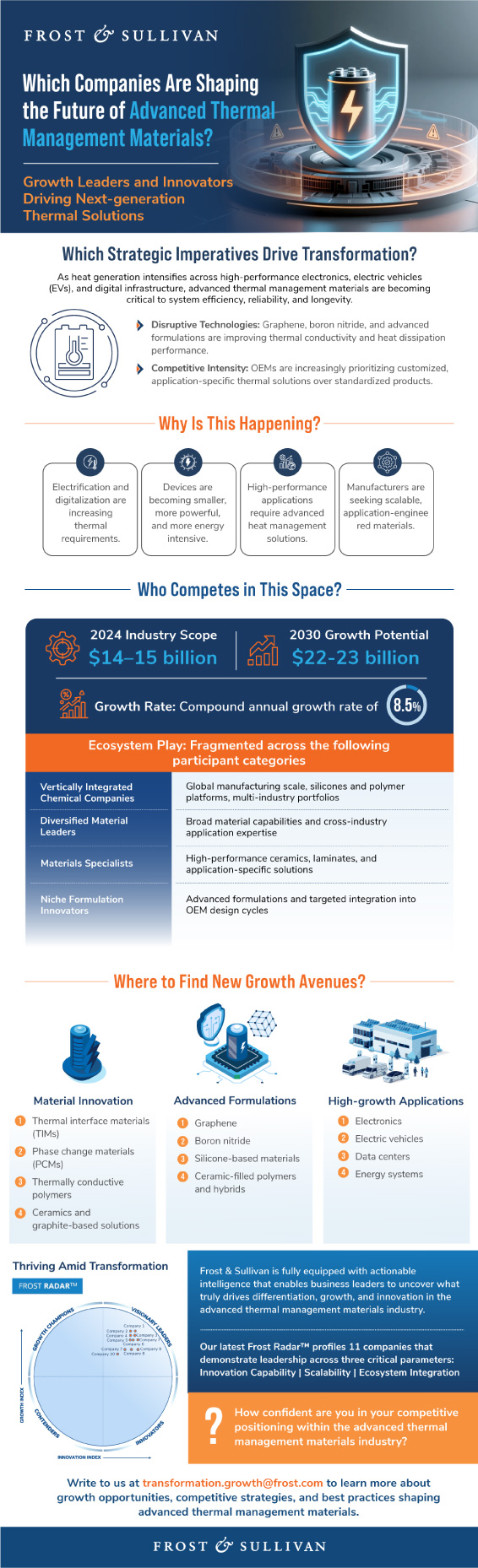
Best Practices Shaping the Advanced Thermal Management Materials Industry
Going forward, competitive differentiation will increasingly depend on how effectively companies combine material innovation, application expertise, and manufacturing scale to address the growing thermal demands of high-performance systems.
- Developing multifunctional material platforms: Leading companies are integrating thermal management with electrical insulation, electromagnetic interference (EMI) shielding, and structural performance, positioning materials as system-level solutions rather than standalone components.
- Expanding integration capabilities: Companies are moving beyond material supply into co-design, prototyping, and process integration, enabling closer collaboration with OEMs and system integrators.
- Building scalable and customizable portfolios: Modular material platforms with multiple grades and form factors are enabling rapid customization across industries while supporting manufacturing efficiencies and commercial scale.
Advanced Thermal Management Materials: Growth Focus
Much of the industry’s future growth potential lies beyond conventional heat dissipation materials. As power densities increase and applications become more complex, the following avenues are creating new opportunities across the value chain:
- Next-generation material innovation: Ultrahigh-conductivity materials, hybrid TIMs, and advanced composites are enabling higher performance in compact, high-temperature environments.
- Integrated thermal solutions: Thermal architecture design, liquid-cooling interfaces, and integrated modules are expanding the industry from material supply to system-level solutions.
- Emerging application opportunities: Industrial electrification, renewable energy systems, advanced mobility, and AI infrastructure are creating new demand for specialized thermal management solutions.
Do you have the tools to identify, analyze, and act on emerging opportunities in advanced thermal management materials?
Ready to Lead the Transformation?
- Book a Growth Strategy Session: Align your growth roadmap with Frost & Sullivan’s visionary Growth Pipeline™ Dialog.
- Engage with Growth Experts: Co-design AI-enabled, data-driven operating models that scale industry-specific and commercial impact.
- Share Your Transformation Story: Position your organization as a transformation leader through Frost & Sullivan’s Transformational Growth Leadership platform.
- Join the Growth Council: Collaborate with industry leaders shaping the future of your ecosystem.
- Nominate for the Best Practices Recognition: Be recognized for excellence in growth strategy, execution, and customer impact.
- Demonstrate Industry Positioning on the Frost Radar™: Benchmark your growth performance and innovation strength against industry competitors.
- Activate Brand & Demand Growth: Accelerate awareness, engagement, and revenue growth through integrated brand and demand generation strategies.
Frequently Asked Questions
What are advanced thermal management materials?
Advanced thermal management materials are specialized materials designed to transfer, dissipate, or regulate heat in electronic, automotive, and industrial systems. Common examples include thermal interface materials (TIMs), phase change materials (PCMs), thermally conductive polymers, advanced ceramics, and graphite-based solutions.
Why are advanced thermal management materials becoming increasingly important?
Rising power densities in electric vehicles, AI infrastructure, and high-performance electronics are generating greater amounts of heat in increasingly compact systems. Effective thermal management is essential to improving system efficiency, reliability, and operational lifespan.
Which industries are driving demand for advanced thermal management materials?
Demand is expanding across electric vehicles, consumer electronics, data centers, renewable energy systems, industrial equipment, and advanced computing applications where heat management directly influences system performance.
What technologies are shaping the future of advanced thermal management materials?
Innovation is increasingly centered on graphene and boron nitride fillers, ceramic-filled polymers, hybrid materials, and multifunctional solutions that combine thermal conductivity with electrical insulation and mechanical performance.
How are original equipment manufacturers (OEMs influencing material innovation?
Original equipment manufacturers (OEMs) are increasingly seeking application-specific and co-developed thermal solutions that align with evolving system architectures, driving demand for customized and integrated material platforms.
What factors are influencing competition in advanced thermal management materials?
Competitive differentiation is increasingly tied to material performance, manufacturing scalability, application expertise, strategic partnerships, and the ability to deliver application-engineered solutions across multiple industries.