This blog is based on the analysis – Top 10 Growth Opportunities in Energy Decarbonization, 2026 – authored by Frost & Sullivan’s Growth Expert, Jonathan Robinson, from the Energy team.
Today, oil and gas companies are navigating unprecedented pressures. Decarbonization mandates, price volatility, and rapid technological disruption are reshaping the energy value chain. As traditional, siloed operations struggle to keep pace, integrated low-carbon strategies and digital technologies are emerging as the foundation for operational efficiency, emissions reduction, and new business models.
Explore how innovative business models and disruptive technologies are reshaping the Oil & Gas sector.
As we move into 2026, companies feel increasing pressure to balance short-term energy reliability with long-term decarbonization commitments, or risk losing competitive ground. To guide decision-making, this blog highlights where targeted investments, partnerships, and innovations can deliver measurable impact and accelerate the path to a net-zero future.
With the energy landscape evolving rapidly, is your organization equipped with the right tools to capitalize on this transformation?
Listen to our latest podcast on decarbonization, digitalization, and future growth in oil and gas.
The Energy Transition: Challenges and Opportunities Ahead
Key Forces Transforming the Oil & Gas Ecosystem
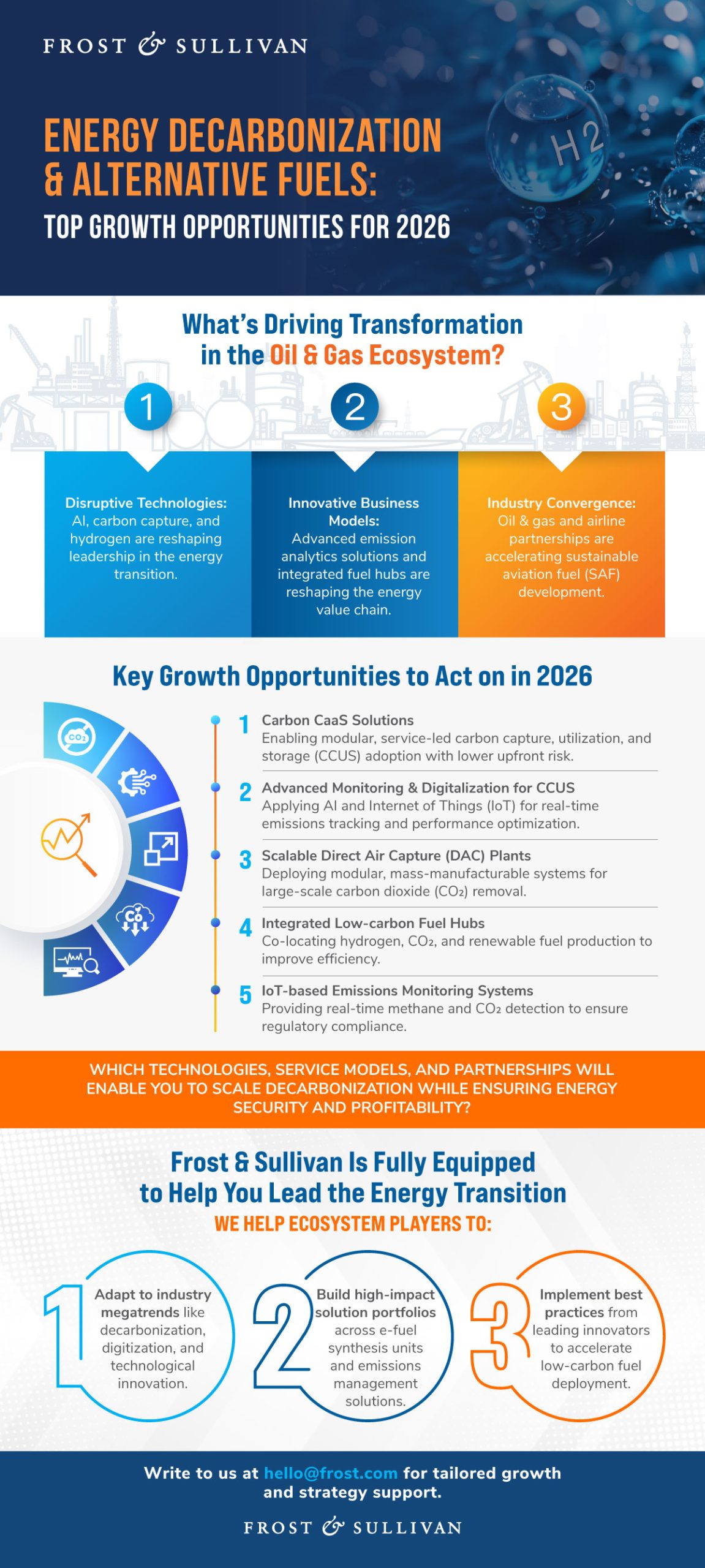
These forces are transforming how oil and gas companies operate, compete, and create value:
- Industry Convergence: Collaboration across sectors is accelerating, with oil and gas companies partnering with airlines and utilities to scale sustainable aviation fuel (SAF) and other low-carbon solutions.
- Disruptive Technologies: Carbon capture, hydrogen, and AI-driven asset optimization are redefining leadership and creating new opportunities for decarbonization.
- Innovative Business Models: Carbon Capture-as-a-Service (CCaaS), integrated low-carbon fuel hubs, and platform-based approaches are reshaping how value is delivered across the energy value chain.
Are you adopting the right growth strategies to thrive amid these transformative forces?
Companies to Action Leading the Path to a Net-zero Future
These leaders are setting a benchmark for effective decarbonization and low-carbon innovation:
- Carbon Clean: Developing modular, scalable CycloneCC technology to reduce capital and operating costs, while actively offering Carbon Capture-as-a-Service solutions.
- SLB: Delivering end-to-end subsurface MRV (monitoring, reporting, and verification) capabilities using advanced seismic, well integrity, and fiber-optic monitoring to enable safe and verifiable CO₂ storage.
- Climeworks: Operating the world’s first commercial Direct Air Capture (DAC) facility, targeting megaton-scale CO₂ capture by 2030.
Is your team leveraging partnerships and collaborations to accelerate low-carbon innovation?
Where to Invest: High-impact Decarbonization & Alternative Fuels Opportunities for 2026
As the energy ecosystem transforms, companies need to pinpoint the investments that will deliver maximum impact. The following areas highlight the emerging opportunities in oil and gas sector:
- Carbon Capture-as-a-Service (CaaS) Solutions
Carbon capture, utilization, and storage (CCUS) is essential for achieving decarbonization goals, but high capital costs and long-term storage risks are slowing adoption. CCUS-as-a-Service (CCUSaaS) shifts carbon capture from a capital-intensive asset to a managed service, letting customers pay per tonne of carbon dioxide (CO₂) removed while providers handle capture, transport, and storage. This model is expanding CCUS adoption and accelerating deployment across the energy value chain.
What’s Driving Growth?
- High upfront costs and storage liabilities drive demand for service-based models
- Pay-per-tonne pricing reduces financial and operational risk
- Integrated capture, transport, and storage simplify project execution
- Access for small and new emitters expands CCUS adoption
- Ecosystem partnerships accelerate scale and deployment
- Advanced Monitoring and Digitalization for CCUS
As CCUS deployment expands, traditional monitoring methods like manual inspections, struggle to keep up with cost, safety, and compliance demands. Advanced digital tools, including AI analytics, remote and fiber-optic sensing, digital twins, and real-time subsurface modeling, are enabling continuous monitoring across capture sites, pipelines, and storage facilities. This approach enhances operational efficiency, reduces risks, and builds confidence in long-term CO₂ storage.
What’s Driving Growth?
- Scaling CCUS projects require continuous, real-time oversight
- Compliance and verification demand push for auditable, high-quality data
- AI, digital twins, and remote sensing provide predictive insights and optimize operations
- Integrated digital systems connect capture, transport, and storage for seamless monitoring
- Collaborations with tech and research partners accelerate innovation and reliable carbon accounting
- Scalable Direct Air Capture (DAC) Plants
DAC plants are becoming essential for global carbon removal, but current plants are costly, bespoke, and hard to scale. Modular, standardized DAC units allow rapid, repeatable deployment across renewable energy sites, industrial hubs, or CO₂ storage locations. This supports both centralized and distributed carbon removal while accelerating commercial adoption.
What’s Driving Growth?
- High costs and bespoke designs drive demand for modular, replicable units
- Policy incentives like carbon removal credits, carbon contracts for differences (CCfDs), and tax breaks create reliable demand
- Public funding and pilots reduce risk and accelerate commercialization
- Shared CO₂ transport and storage networks simplify integration into downstream systems
- Digital twins, AI, and automated fabrication boost efficiency, quality, and scale
Are you implementing the right best practices to capitalize on these emerging growth opportunities?
Next Steps on Your Oil & Gas Growth Journey
The oil and gas sector in 2026 will increasingly rely on integrated CCUS models, digital-first project design, and data-driven emissions intelligence to meet decarbonization goals. As companies navigate capital constraints, regulatory complexity, and rising expectations for accountability, acting on these growth opportunities will be critical to scaling low-carbon fuels and carbon management solutions.
What bold actions will you take today to capture growth in the evolving oil and gas ecosystem?
Frequently Asked Questions (FAQs)
What is the meaning of decarbonization?
Decarbonization means reducing or eliminating carbon dioxide (CO₂) emissions from activities like energy production, transportation, and manufacturing. It focuses on shifting away from fossil fuels toward cleaner energy sources and more efficient systems.
Is decarbonization good or bad?
Decarbonization is widely seen as positive because it helps slow climate change, improve air quality, and reduce reliance on fossil fuels. While it can require upfront investment and system changes, the long-term benefits include lower emissions, cleaner energy, and more sustainable economic growth.
What is the decarbonisation of energy?
Energy decarbonisation refers to replacing carbon-intensive energy sources—such as coal, oil, and gas—with low-carbon or carbon-free alternatives like solar, wind, hydropower, nuclear, and green hydrogen. It also includes improving energy efficiency and electrifying end-use sectors.
What are the alternative fuels?
Alternative fuels are energy sources that can replace traditional fossil fuels. Common examples include biofuels, hydrogen, electricity, renewable natural gas (RNG), ammonia, and synthetic fuels. These options typically produce fewer emissions and support cleaner energy systems.
What is the best alternative fuel?
There is no single “best” alternative fuel—it depends on the application. Electricity works best for light vehicles, hydrogen suits heavy transport and industry, and biofuels are effective for aviation and shipping. Most decarbonization strategies use a mix of fuels based on cost, infrastructure, and emissions impact.
Ready to Lead the Transformation?
- Book a Growth Strategy Session: Align your growth roadmap with Frost & Sullivan’s visionary Growth Pipeline™ Dialog.
- Engage with Growth Experts: Co-design AI-enabled, data-driven operating models that scale industry-specific and commercial impact.
- Share Your Transformation Story: Position your organization as a transformation leader through Frost & Sullivan’s Transformational Growth Leadership platform.
- Join the Growth Council: Collaborate with industry leaders shaping the future of your ecosystem.
- Nominate for the Best Practices Recognition: Be recognized for excellence in growth strategy, execution, and customer impact.
- Demonstrate Industry Positioning on the Frost Radar™: Benchmark your growth performance and innovation strength against industry competitors.
- Activate Brand & Demand Growth: Accelerate awareness, engagement, and revenue growth through integrated brand and demand generation strategies.