This blog is based on Frost & Sullivan’s recent analysis, “Enterprise Risk Mitigation and Management (ERMM) Solutions, Global, 2025–2030,” authored by Danielle VanZandt and Dolores Aleman from the Security Practice Area.
Executive Summary
Enterprise security is shifting beyond traditional perimeter defense as cloud adoption, AI, connected ecosystems, and third-party dependencies expand external risk exposure. Organizations are embracing Enterprise Risk Mitigation and Management (ERMM) to gain continuous visibility, strengthen cyber resilience, and proactively address emerging threats. The future of cybersecurity lies in intelligence-driven strategies that protect digital trust while aligning security investments with business objectives.
Key Takeaways
- External attack surfaces are expanding faster than traditional security models can manage.
- Unified ERMM platforms are replacing fragmented approaches by integrating EASM, Cyber Threat Intelligence (CTI), and Digital Risk Protection (DRP) capabilities.
- AI, automation, and behavioral threat intelligence are redefining proactive cybersecurity.
- Organizations are evaluating cybersecurity investments based on measurable business outcomes rather than technical metrics alone.
Cloud adoption, AI, remote work, connected ecosystems, and third-party dependencies are expanding organizations’ external attack surfaces, exposing digital assets to phishing, brand impersonation, supply chain vulnerabilities, and other sophisticated cyber threats. In response, Enterprise Risk Mitigation and Management (ERMM) is emerging as a strategic approach that provides comprehensive visibility across an organization’s digital footprint, helping security teams identify, prioritize, and mitigate risks before they disrupt business operations.
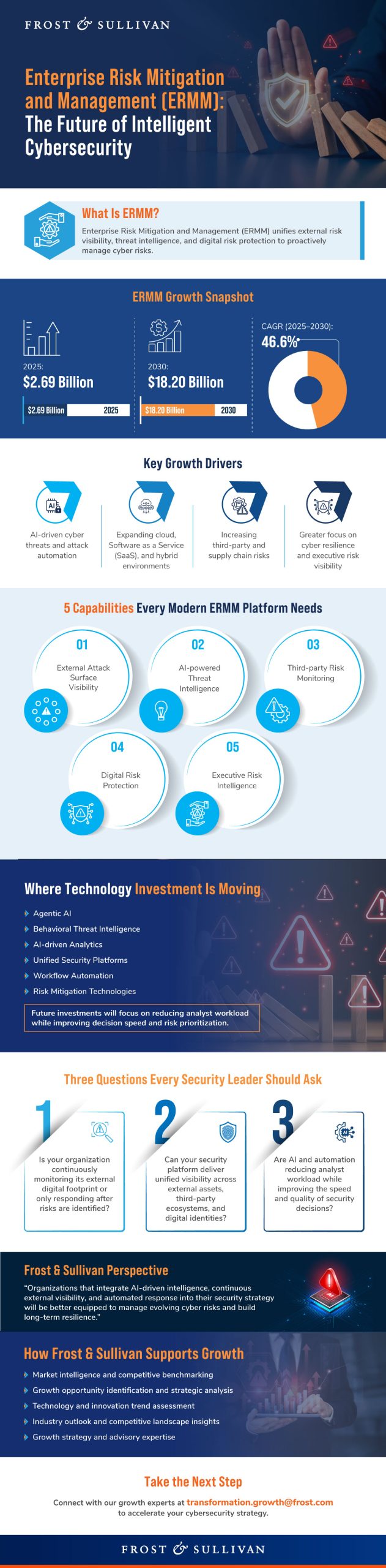
Reflecting this shift, Frost & Sullivan projects the global ERMM market to grow from $2.69 billion in 2025 to $18.20 billion by 2030, at a 46.6% CAGR. As adoption accelerates, the key question for security leaders is not whether to invest in enterprise risk management, but how to build a proactive strategy that strengthens resilience, protects digital trust, and supports business objectives.
How prepared is your organization to identify and mitigate risks beyond the traditional security perimeter?
Tune into our latest podcast episode on Growth Opportunities in ERMM
What Is Enterprise Risk Mitigation and Management (ERMM), and Why Does It Matter?
ERMM is a unified cybersecurity approach that combines External Attack Surface Management (EASM), Cyber Threat Intelligence (CTI), and Digital Risk Protection (DRP) into a single platform. It provides organizations with continuous visibility into their digital footprint, enabling them to identify, prioritize, and mitigate cyber risks before they escalate into business disruptions.
As organizations accelerate cloud adoption, AI deployment, remote work, and third-party collaborations, their digital ecosystems continue to expand, creating new opportunities for cyber threats such as phishing, brand impersonation, credential theft, and supply chain attacks. ERMM addresses these challenges by integrating intelligence, automation, and continuous monitoring, helping enterprises strengthen cyber resilience, protect digital trust, and improve overall risk management.
How Enterprise Risk Management Is Evolving
| Traditional Security | Next-generation ERMM |
| Focuses on protecting internal networks | Continuously monitors the external digital ecosystem |
| Perimeter-centric defense | Intelligence-driven, proactive risk management |
| Siloed security tools | Unified EASM, CTI, and DRP platform |
| Reactive incident response | Continuous monitoring and automated remediation |
| Technical security metrics | Business-aligned risk visibility and executive reporting |
| Manual Investigations | AI-enable intelligence and workflow automation |
This evolution reflects a broader shift in enterprise security priorities, from responding to attacks after they occur to preventing risks before they disrupt business operations.
Strategic Imperatives Reshaping the ERMM Industry
- Industry Convergence Is Accelerating Platform-based Security
Organizations are consolidating fragmented security tools into integrated platforms to simplify operations and improve visibility across their digital ecosystems. As capabilities such as EASM, CTI, and DRP converge, ERMM is emerging as a unified approach that strengthens cyber resilience, streamlines security operations, and reduces vendor complexity.
- Competitive Intensity Is Accelerating Innovation
Growing awareness of external cyber risks is driving investment and attracting both established cybersecurity providers and new entrants to the ERMM market. This competitive environment is accelerating innovation in AI-powered analytics, threat intelligence, automation, remediation capabilities, and other risk mitigation technologies that help organizations proactively identify and address emerging cyber threats.
- Digital Transformation Is Redefining Enterprise Risk
Cloud adoption, AI, connected devices, and third-party ecosystems are expanding organizations’ digital footprints and exposing them to sophisticated threats such as phishing, brand impersonation, social engineering, and supply chain attacks. In response, organizations are adopting intelligence-driven ERMM platforms that provide continuous monitoring, contextual threat intelligence, and proactive risk mitigation to strengthen enterprise resilience.
According to Frost & Sullivan, security leaders that proactively embrace these shifts will be better equipped to anticipate emerging risks, optimize security investments, and align cybersecurity with broader business objectives.
Key Challenges Slowing ERMM Adoption
- Bridging the Skills and Resource Gap: Many organizations lack the expertise and resources needed to fully leverage AI-powered analytics, automation, and threat intelligence, leading to underutilization of ERMM capabilities and slower deployment.
- Breaking Down Organizational Silos: Effective enterprise risk management requires collaboration across security, IT, legal, fraud, and business teams. Siloed operations limit visibility, delay response efforts, and reduce the effectiveness of integrated risk management.
- Translating Intelligence into Business Value: Security insights must be presented in business terms that demonstrate their impact on revenue, resilience, compliance, and brand reputation. Without this context, securing executive buy-in and strategic investment becomes more challenging.
- Demonstrating Measurable ROI: Complex pricing models, uncertain cost forecasting, and the difficulty of quantifying risk reduction can extend procurement cycles and delay ERMM investments.
Regional Growth Dynamics Shaping the ERMM Market
While ERMM is experiencing rapid global growth, the pace of adoption and strategic priorities vary across regions. Understanding these regional dynamics helps technology providers, investors, and enterprise leaders identify where demand is accelerating, where innovation is taking shape, and where the greatest opportunities for expansion lie.
| Region | Growth Outlook (2025-2030) | Strategic Opportunity |
| North America | Largest and most mature ERMM market with a 42.9% CAGR. | Differentiate through AI-enabled automation, integrated platforms, and executive-level risk intelligence. |
| Europe, Middle East & Africa (EMEA) | Strong growth with a 41.4% CAGR. | Support organizations with unified enterprise risk management solutions that strengthen governance, compliance, and cyber resilience. |
| Asia-Pacific | Fastest-growing regional market with a 59.7% CAGR. | Expand localized, intelligence-driven ERMM platforms to meet accelerating enterprise demand. |
| Latin America | Emerging high-growth market with a 57.0% CAGR. | Capture early growth by delivering scalable ERMM solutions for organizations advancing their cybersecurity capabilities. |
According to Frost & Sullivan, regional differences in digital maturity, regulatory priorities, and cybersecurity investment strategies will continue to influence ERMM adoption. Addressing these regional priorities through localized innovation and scalable platforms will be critical to sustaining long-term growth.
Top 5 Five Growth Opportunities Defining the Future of ERMM
Leading vendors such as Recorded Future, ReliaQuest, CrowdStrike, Rapid7, and Palo Alto Networks are expanding beyond traditional threat detection by integrating AI, automation, digital risk protection, and threat intelligence into unified ERMM platforms. This evolution is creating new opportunities for differentiation through platform consolidation, executive risk visibility, and enterprise-wide resilience.
- Expanding ERMM Beyond Security Operations
ERMM is evolving into an enterprise-wide platform supporting third-party risk management, governance, risk, and compliance (GRC), and operational resilience. Vendors that combine automation, intelligence, and integrated workflows will be well positioned for future growth.
- Converging Enterprise Risk and Fraud Management
Integrating fraud detection with ERMM helps organizations identify complex attack patterns, improve risk visibility, and strengthen enterprise-wide resilience through a unified approach to risk management.
- Leveraging Threat Actor Behavioral Intelligence
ERMM platforms are shifting from reactive threat detection to behavioral intelligence, enabling organizations to anticipate attacker tactics, prioritize risks, and strengthen proactive cyber defense.
- Integrating Agentic AI into Security Workflows
Agentic AI is enhancing security operations by automating routine tasks, accelerating investigations, and enabling analysts to focus on higher-value decisions, improving both efficiency and response times.
- Elevating Executive-level Risk Reporting
The next generation of ERMM platforms is enabling executive dashboards that connect cybersecurity outcomes to business objectives, helping leaders quantify risk reduction and make informed investment decisions.
Download the full analysis to explore in-depth details about ERMM growth opportunities.
The Future of Enterprise Risk Mitigation and Management
ERMM is evolving into a strategic business capability that extends beyond cyber defense to safeguard operational resilience, digital trust, and enterprise performance. The future of ERMM is also being shaped by emerging innovators such as SecurityScorecard, BitSight, Flashpoint, Group-IB, Mandiant, and ZeroFox. Their investments in AI, threat intelligence, digital risk protection, and platform integration are accelerating the evolution of enterprise risk management solutions, enabling organizations to proactively identify, prioritize, and mitigate emerging cyber risks.
Organizations investing in unified ERMM capabilities can:
- Detect and address cyber threats before they disrupt business operations.
- Safeguard digital identities, brand reputation, and customer trust.
- Improve security operations through AI-enabled automation and streamlined workflows.
- Consolidate security functions to enhance visibility and operational efficiency.
- Deliver measurable risk insights that support executive decision-making and regulatory compliance.
As cyber threats grow in scale and sophistication, ERMM is emerging as a core pillar of enterprise risk strategy, empowering organizations to transform external risk intelligence into stronger resilience, informed decision-making, and sustainable competitive advantage.
Frequently Asked Questions (FAQs): ERMM
1. What is enterprise risk in risk management?
Enterprise risk refers to threats that originate outside an organization’s direct control and can impact its operations, reputation, financial performance, or digital assets. In cybersecurity, these risks include phishing campaigns, brand impersonation, exposed assets, third-party vulnerabilities, credential leaks, ransomware, and supply chain attacks that exploit an organization’s external digital footprint.
2. How do you mitigate external risks?
Organizations mitigate external risks by continuously monitoring their external attack surface, identifying emerging threats, prioritizing risks based on business impact, and implementing timely remediation measures. Leveraging enterprise risk management solutions enables organizations to combine external attack surface management, threat intelligence, digital risk protection, automation, and continuous monitoring to proactively reduce cyber risk and strengthen resilience.
3. What is third party risk management?
Third-party risk management (TPRM) is the process of identifying, assessing, monitoring, and mitigating risks associated with external vendors, suppliers, partners, and service providers. It helps organizations ensure that third parties maintain appropriate security, privacy, regulatory compliance, and operational standards, reducing the likelihood of supply chain attacks and other external risks.
4. Which industries are expected to invest most heavily in ERMM?
Financial services, technology, government, manufacturing, healthcare, retail, and utilities are expected to remain among the largest investors in ERMM. These industries manage extensive digital ecosystems, sensitive data, and complex third-party relationships, making them more vulnerable to external cyber threats and increasing the need for proactive external risk management.
5. What technologies are shaping the future of ERMM?
The future of ERMM is being shaped by AI-driven analytics, behavioral threat intelligence, workflow automation, unified security platforms, and agentic AI. These risk mitigation technologies enhance threat detection, automate risk prioritization and remediation, improve analyst productivity, and provide organizations with deeper visibility into their enterprise risk landscape, enabling faster and more informed security decisions.
Ready to Lead the Transformation?
- Schedule a Growth Strategy Dialog: Align your growth roadmap with Frost & Sullivan’s Visionary Growth Pipeline™ Dialog.
- Engage with Growth Experts: Co-design AI-enabled, data-driven operating models that scale industry-specific and commercial impact.
- Showcase Your Transformational Leadership: Position your organization as a transformation leader through Frost & Sullivan’s Transformational Growth Leadership platform.
- Join the Growth Council: Collaborate with industry leaders shaping the future of your ecosystem.
- Explore Best Practices Recognition: Be recognized for excellence in growth strategy, execution, and customer impact.
- Benchmark Your Industry Positioning on the Frost Radar™: Benchmark your growth performance and innovation strength against industry competitors.
- Tell Your Story: Accelerate awareness, engagement, and revenue growth through integrated brand and demand generation strategies.