This blog is based on the recent Frost & Sullivan analysis, “Sleep Management Technologies Market, Global, 2026–2031,” authored by Utkarsha Kaustubh Soundankar, Industry Analysts, Healthcare & Life Sciences Practice.
Sleep management technologies include therapeutic and diagnostic solutions used to diagnose, monitor, and treat sleep disorders. These technologies include CPAP (Continuous Positive Airway Pressure), BiPAP (Bilevel Positive Airway Pressure), APAP (Auto-adjusting Positive Airway Pressure), oral appliances, polysomnographs, home sleep testing systems, and actigraphs. The development of home sleep tests, wearables, telehealth, cloud-linked devices, and advanced sensors is moving sleep diagnostics and treatments into home care settings.
Build a Future-ready Sleep Care Strategy
Explore how connected care, home sleep testing, and digital technologies are reshaping the sleep diagnostics and therapy.
Today, hospitals and sleep clinics are changing their business models to focus on more complex and holistic sleep care. At the same time, companies are improving therapy adherence, personalization, patient comfort, and ease of use to support wider adoption of sleep management technologies.
As sleep care continues to move beyond traditional clinical settings, companies investing in connected and home-based sleep solutions will be better placed to support changing patient and provider needs.
How will your organization adapt to the growing demand for connected and home-based sleep solutions?
Listen to our latest podcast episode on sleep management technologies.
Strategic Imperatives Shaping the Sleep Management Technology Industry
Disruptive Technologies
Sleep management technology continues to evolve around connected CPAP devices, wearables, and oral appliances that support both detection and treatment of sleep disorders. This focus is shifting toward what makes therapy easier to stay with, including better comfort, smoother digital health integration, and credible alternatives to traditional approaches.
Transformative Megatrends
Remote patient monitoring and the steady move toward home-based care are changing how sleep care is delivered day to day. As a result, demand is rising for remote sleep management tools, supported by cloud platforms, wearables, and AI-enabled capabilities that fit naturally into home and virtual care settings.
Innovative Business Models
Remote monitoring, telehealth, and virtual care are opening up new revenue paths across the industry. So, leading players like ResMed and Inspire Medical are also moving toward subscription-style models that emphasize personalized care and ongoing remote patient support.
So, which growth processes and strategies will help your teams adapt to these industry headwinds?
The Sleep Management Technologies – At a Glance
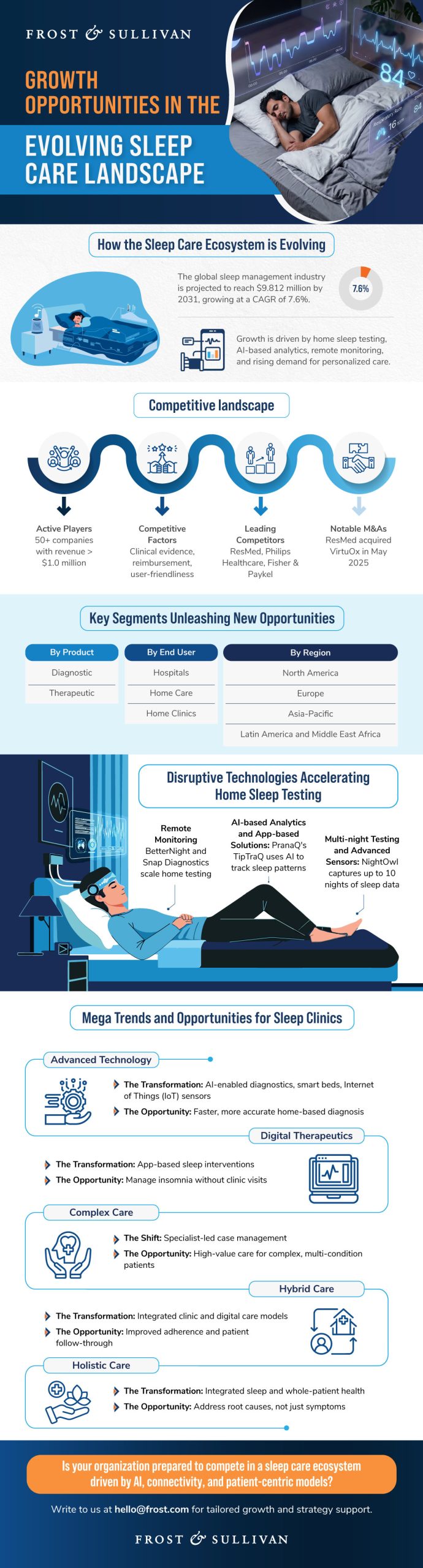
Key Growth Drivers Accelerating Sleep Care Adoption
- Growing Adoption of Sleep Tracking Devices: Smartwatches, fitness trackers, and sensor-based sleep tools are becoming easier to access and more widely used, which is raising everyday sleep monitoring and awareness of sleep disorders. As more people track symptoms early, diagnosis rates are improving and demand is rising for CPAP, BiPAP, and APAP devices.
- Shift Toward Home-based Sleep Management: Home-based sleep assessment is expanding, supported by remote monitoring, telehealth, AI-powered analytics, and cloud-enabled platforms. This makes personalized insights easier to deliver and strengthens sleep management in home care settings.
- Rising Awareness of Sleep Health: Preventive care and wellness megatrends are pushing sleep health higher on the consumer priority list. This is also improving awareness of the link between sleep disorders and chronic conditions, which is supporting industry growth.
- Focus on Patient Comfort and Adherence: Innovation is increasingly centered on making therapy more comfortable and easier to stay consistent with over time. Better adherence and stronger outcomes are, in turn, encouraging wider adoption of sleep management technologies.
How will your organization respond to rising demand for remote and personalized sleep care?
Challenges Limiting Adoption Across Sleep Care Solutions
- High Cost of Advanced Technologies: Advanced sleep management solutions are expensive, which slows adoption in many markets. This is especially limiting across low- and middle-income regions where affordability is a primary barrier.
- Inconsistent Reimbursement Policies: Reimbursement for sleep management technologies varies widely across global healthcare systems. This inconsistency directly affects adoption rates and slows scale-up.
- Impact of Device Recalls: CPAP device recalls by major companies like Philips Healthcare and ResMed have weakened customer confidence. These setbacks are also weighing on industry growth in the near term.
Is your organization prepared to address the barriers impacting sleep care adoption?
Regional Developments Influencing Sleep Care Growth
North America
North America remains the largest market. Home sleep testing, cloud-connected devices, remote monitoring, AI-based risk stratification, subscription models, and wearables are accelerating the shift toward home-first sleep diagnostics.
Europe
The United Kingdom, Germany, France, and the Nordic region are key contributors. The region favors clinically validated sleep technologies integrated into public healthcare networks and care pathways.
Asia-Pacific
Japan and South Korea continue to adopt advanced sleep technologies, while China and India are expanding through innovative and affordable solutions from local companies.
Latin America
Brazil and Mexico are driving regional growth, supported by rising adoption of remote monitoring, virtual care, and home sleep testing solutions.
Middle East and Africa
Investment in healthcare infrastructure and advanced sleep labs is supporting growth in the Gulf region, while NGO-led pilots and a large undiagnosed population are driving gradual adoption across Africa.
Are you implementing best practices to maximize ROI across high-growth regions?
Emerging Opportunities Transforming Sleep Management
- AI-driven Connected Sleep Solutions
AI, wearables, and digital health platforms are accelerating connected solutions for sleep monitoring, diagnosis, and treatment. Wearables, mobile apps, and software platforms are improving diagnosis and making home-based sleep management more practical, especially where access to sleep clinics is limited and remote care becomes the easier path.
To capitalize on this opportunity, companies are:
- Building integrated offerings that bring together devices, AI capabilities, and digital services into one experience.
- Strengthening algorithms that support predictive alerts, behavioral therapy, and more personalized sleep management.
- Expanding B2B2C sleep management platforms aimed at employers, enterprises, and insurers.
- Home Sleep Testing
Sleep diagnostics is moving beyond traditional sleep labs and into scalable, home-based settings. High polysomnography costs, limited clinic capacity, and demand for lower-cost testing are accelerating adoption of home sleep testing, while newer AI algorithms and next-generation devices, such as contactless radar, sonar, and fingertip sensors, are improving at-home diagnostic accuracy.
To unlock this opportunity, companies are:
- Developing Food and Drug Administration (FDA)- and CE-approved hardware–software bundles that simplify home sleep testing and build clinical confidence.
- Using existing clinical expertise and installed bases to expand into home diagnostics faster and with lower go-to-market risk.
- Integrating home sleep testing into cardiology, pulmonology, and primary care workflows so patients can be identified and directed to therapy earlier.
Which of these opportunities will have the maximum impact on your organization, and how will you measure it?
The Shift Toward Connected Sleep Care
Sleep management is shifting from sleep labs to connected, home-based care powered by wearables, remote monitoring, and digital platforms. Success will depend on delivering accessible, accurate, and patient-centric solutions that improve diagnosis and long-term adherence. The question remains: is your organization ready for this connected sleep care shift?
Frequently Asked Questions (FAQs)
- What are sleep management technologies?
Sleep management technologies include diagnostic and therapeutic solutions such as CPAP, BiPAP, APAP, oral appliances, polysomnographs, home sleep testing systems, and actigraphs used to detect and treat sleep disorders.
- What is home sleep testing?
Home sleep testing refers to diagnosing sleep disorders outside sleep labs using portable devices and connected technologies that monitor sleep patterns in a home setting.
- How is AI used in sleep management?
AI is used in sleep management for sleep scoring, pattern detection, circadian rhythm analysis, and improving diagnostic accuracy and treatment personalization.
- What are the key trends in sleep management technologies?
Key trends include the shift toward home-based sleep care, growing use of connected devices and wearables, expansion of remote monitoring, and integration of digital platforms across diagnosis and therapy.
Ready to Lead the Transformation?
- Book a Growth Strategy Session: Align your growth roadmap with Frost & Sullivan’s visionary Growth Pipeline™ Dialog.
- Engage with Growth Experts: Co-design AI-enabled, data-driven operating models that scale industry-specific and commercial impact.
- Share Your Transformation Story: Position your organization as a transformation leader through Frost & Sullivan’s Transformational Growth Leadership platform.
- Join the Growth Council: Collaborate with industry leaders shaping the future of your ecosystem.
- Nominate for the Best Practices Recognition: Be recognized for excellence in growth strategy, execution, and customer impact.
- Demonstrate Industry Positioning on the Frost Radar™: Benchmark your growth performance and innovation strength against industry competitors.
- Accelerate Brand & Demand Growth: Accelerate awareness, engagement, and revenue growth through integrated brand and demand generation strategies.