Digital Transformation of Blockchain: Enabling Trusted, Automated, and Decentralized Digital Economies
Blockchain is evolving into a foundational infrastructure layer supporting secure, transparent, and automated digital ecosystems. Organizations are using blockchain to enable trusted data exchange, autonomous transactions, and immutable recordkeeping across increasingly complex digital environments.
Key developments shaping blockchain’s digital transformation include:
- Infrastructure transformation is accelerating: Blockchain is enabling decentralized data exchange, tokenized assets, and autonomous value chains across industries.
- Enterprise adoption is expanding: Organizations are addressing fragmented data environments, cybersecurity risks, and regulatory complexity by deploying trusted, decentralized architectures.
- Market growth is accelerating rapidly: Blockchain technology is growing at a 72.7% CAGR between 2024 and 2030, reflecting strong global enterprise adoption.
- Technology convergence is expanding capabilities: Integration with artificial intelligence (AI), Internet of Things (IoT), and decentralized physical infrastructure networks is enabling intelligent, automated ecosystem coordination.
- Business model transformation is advancing: Enterprises are leveraging blockchain to improve operational transparency, strengthen security, and enable new decentralized business models.
Blockchain adoption is accelerating across financial services, supply chains, and digital infrastructure, unlocking new models for secure automation, asset tokenization, and decentralized coordination.
What’s In It for You?
- Analysis of the key megatrends accelerating enterprise blockchain adoption globally
- Identification of high-growth segments, emerging use cases, and technology convergence pathways
- Strategic advantage into competitive positioning and future blockchain growth opportunities
How is your organization leveraging blockchain to unlock new growth opportunities through decentralized platforms, tokenization, and autonomous value exchange?
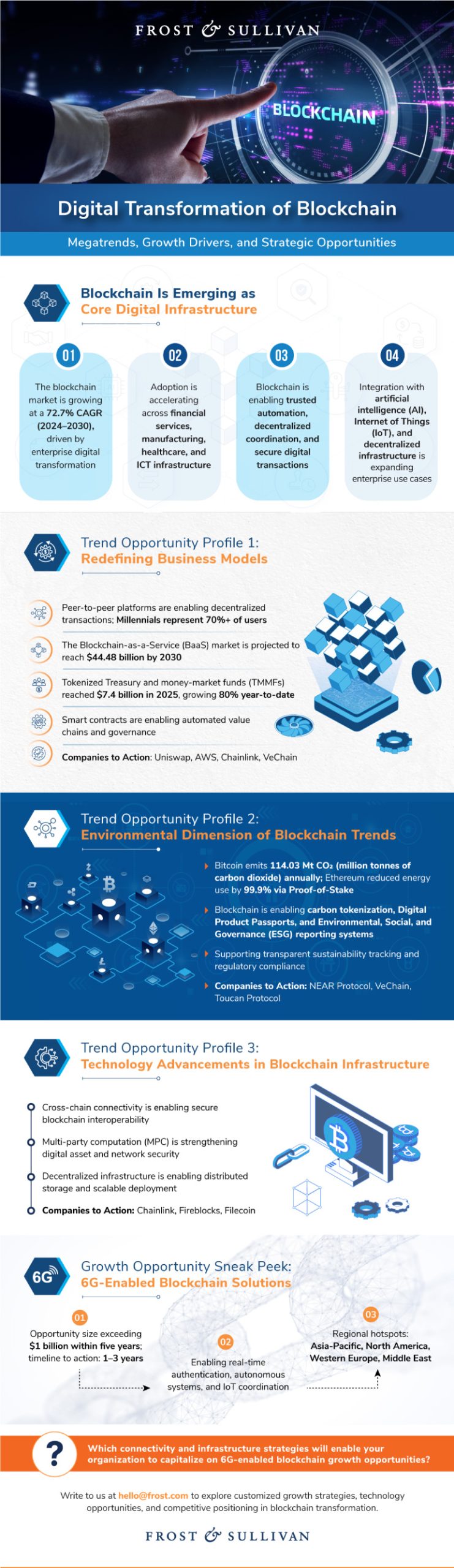
Transformative Megatrends Are Accelerating Blockchain’s Digital Transformation
Blockchain is enabling structural shifts across business models, sustainability frameworks, and digital infrastructure. The following megatrends are accelerating its adoption as a core layer of the digital economy:
- Business Model Transformation Is Enabling Decentralized Value Creation: Blockchain is supporting new operating and revenue models by enabling:
- Decentralized marketplaces and peer-to-peer platforms removing intermediaries
- Smart contracts automating transactions, governance, and operational workflows
- Tokenization enabling fractional ownership, liquidity, and digital asset creation
- Blockchain-as-a-Service (BaaS) platforms enabling scalable enterprise deployment
How is your organization integrating blockchain to enable decentralized business models, automate value chains, and unlock new revenue opportunities?
- Environmental Priorities Are Driving Sustainable Blockchain Adoption: Organizations are deploying blockchain to strengthen sustainability reporting and reduce environmental impact through:
- Energy-efficient consensus models such as Proof-of-stake
- Carbon credit tokenization and transparent carbon tracking
- Digital Product Passports enabling lifecycle traceability
- Tamper-proof Environmental, Social, and Governance (ESG) reporting and compliance verification
How is your organization leveraging blockchain to strengthen sustainability transparency, ESG compliance, and lifecycle traceability across value chains?
- Technology Advancements Are Expanding Blockchain Infrastructure Capabilities: Emerging innovations are strengthening blockchain’s role in digital infrastructure:
- Cross-chain connectivity enabling seamless data and asset exchange
- Zero-knowledge proofs strengthening privacy and secure verification
- AI and blockchain convergence enabling intelligent automation
- Decentralized Physical Infrastructure Networks (DePINs) supporting distributed infrastructure
- Quantum-resistant cryptography strengthening long-term security
How are emerging blockchain technologies enabling your organization to strengthen digital infrastructure resilience, security, and automation capabilities?
Technology Advancements Are Strengthening Blockchain’s Scalability, Security, and Infrastructure Resilience
Emerging innovations in interoperability, cryptography, and decentralized infrastructure are expanding blockchain’s ability to support enterprise-scale deployment, trusted automation, and secure digital ecosystem coordination.
- Cross-chain Connectivity Is Enabling Seamless Blockchain Interoperability: Cross-chain connectivity is addressing fragmentation across blockchain networks by enabling secure communication, data exchange, and asset transfers between previously isolated ecosystems.
- Enabling seamless transfer of digital assets, data, and smart contract execution across blockchain platforms
- Supporting enterprise integration across decentralized finance, insurance, supply chains, and digital identity systems
- Strengthening blockchain scalability, interoperability, and ecosystem coordination
- Companies to Action: Chainlink CCIP is enabling secure cross-chain messaging and token transfers, allowing financial institutions and enterprises to connect public and private blockchain networks while reducing interoperability risks.
How is your organization leveraging cross-chain connectivity to enable secure interoperability and unlock new decentralized ecosystem opportunities?
- Multi-party Computation and Quantum-resistant Cryptography Are Strengthening Blockchain Security: Next-generation cryptographic models are strengthening blockchain infrastructure by protecting digital assets, identities, and transactions from evolving cyber threats.
- Multi-party computation is securing digital asset storage and transactions by distributing cryptographic key control
- Quantum-resistant cryptography is strengthening long-term blockchain infrastructure resilience
- Improving wallet security, validator protection, and enterprise blockchain risk management
- Companies to Action: Fireblocks is enabling secure digital asset infrastructure using multi-party computation to protect transactions, prevent unauthorized access, and strengthen institutional blockchain security.
How is your organization strengthening blockchain security readiness to protect digital assets and ensure infrastructure resilience?
- Decentralized Physical Infrastructure Networks (DePINs) Are Enabling Distributed and Resilient Digital Infrastructure: DePINs are enabling blockchain-powered infrastructure models where distributed participants provide storage, compute, and connectivity resources.
- Enabling decentralized storage, telecom infrastructure, and distributed compute networks
- Improving infrastructure scalability, cost efficiency, and operational resilience
- Supporting decentralized cloud storage, digital infrastructure, and enterprise ecosystem coordination
- Companies to Action: Filecoin is enabling decentralized storage infrastructure by allowing organizations to securely store and retrieve data across distributed networks while ensuring data integrity through blockchain verification.
How is your organization leveraging decentralized infrastructure models to improve scalability, resilience, and cost efficiency?
Growth Opportunity Sneak Peak: Trust-as-a-Service Is Enabling Verified and Automated Digital Ecosystems
As digital ecosystems are expanding, organizations are requiring trusted infrastructure to verify transactions, identities, and operational processes. Blockchain is enabling Trust-as-a-Service (TaaS) by providing shared, tamper-proof systems that strengthen transparency, automate compliance, and enable real-time verification.
Key opportunity drivers include:
- Immutable digital records enabling trusted data and transaction verification
- Automated compliance, audit readiness, and certification validation
- Verified supply chain traceability and lifecycle transparency
- Secure digital identity and ecosystem coordination
Opportunity snapshot:
- Opportunity size exceeding $1 billion within five years
- Timeline to action: Under 12 months
- High-impact sectors: Banking, manufacturing, public sector, healthcare, ICT
How is your organization leveraging blockchain to enable trusted data verification, automate compliance, and strengthen ecosystem transparency?
Frequently Asked Questions: Digital Transformation of Blockchain
- What is the digital transformation of blockchain?
The digital transformation of blockchain is the evolution of blockchain into a core digital infrastructure enabling secure data exchange, automated transactions, and decentralized ecosystem coordination. Organizations are using blockchain to support tokenization, smart contract automation, and trusted digital interactions across industries.
- Why is blockchain becoming critical for enterprise digital infrastructure?
Blockchain is enabling organizations to strengthen transparency, automate compliance, and secure digital operations. Its ability to provide immutable records, trusted verification, and decentralized coordination is improving operational efficiency and reducing reliance on intermediaries.
- What are the key growth drivers accelerating blockchain adoption?
Blockchain adoption is accelerating due to:
- Rising demand for trusted and transparent digital systems
- Expansion of tokenization and decentralized business models
- Increasing need for automated compliance and verification
- Integration with Artificial Intelligence (AI) and Internet of Things (IoT)
- Growing regulatory focus on data traceability and security
These drivers are positioning blockchain as a foundational digital infrastructure layer.
- What is Trust-as-a-Service in blockchain?
TaaS is a blockchain-enabled capability that provides secure, tamper-proof verification of data, transactions, and identities. It is enabling organizations to automate compliance, strengthen supply chain transparency, and enable trusted ecosystem coordination.
- Which industries are seeing the fastest blockchain adoption?
Blockchain adoption is accelerating across:
- Banking and financial services
- Manufacturing and supply chain
- Healthcare and life sciences
- Government and public sector
- Information and communications technology
These sectors are prioritizing trusted automation and digital transparency.
- What are the biggest growth opportunities in blockchain?
Key blockchain growth opportunities include TaaS, smart contract-driven automation, tokenized digital assets, and decentralized infrastructure networks. These opportunities are enabling new business models, improving operational efficiency, and strengthening digital ecosystem coordination.
Ready to Lead the Transformation?
- Book a Growth Strategy Session: Align your growth roadmap with Frost & Sullivan’s visionary Growth Pipeline™ Dialog.
- Engage with Growth Experts: Co-design AI-enabled, data-driven operating models that scale industry-specific and commercial impact.
- Share Your Transformation Story: Position your organization as a transformation leader through Frost & Sullivan’s Transformational Growth Leadership platform.
- Join the Growth Council: Collaborate with industry leaders shaping the future of your ecosystem.
- Nominate for the Best Practices Recognition: Be recognized for excellence in growth strategy, execution, and customer impact.
- Demonstrate Industry Positioning on the Frost Radar™: Benchmark your growth performance and innovation strength against industry competitors.
- Activate Brand & Demand Growth: Accelerate awareness, engagement, and revenue growth through integrated brand and demand generation strategies.