This blog is based on Frost & Sullivan’s recent analysis, The Global Care Economy, Transformations and Opportunities to 2035, authored by growth expert Neha Anna Thomas from the Economic analytics Practice.
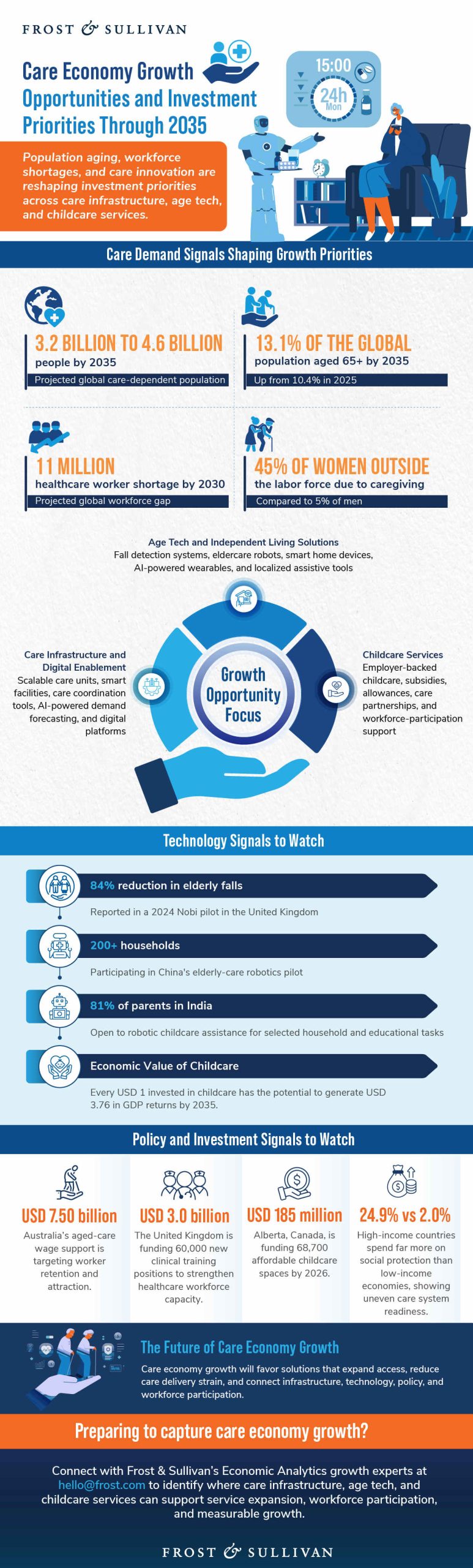
Care economy growth is gaining strategic relevance across workforce planning, infrastructure investment, technology adoption, and capital allocation. By 2035, the global care-dependent population is projected to reach 3.2 billion to 4.6 billion, increasing pressure on healthcare systems, employers, households, and public services.
Commercial relevance is expanding beyond direct care provision:
- Elderly care technology, silver tech or age tech, fall detection technology, and AI-powered wearables are supporting care access and independent living
- Integrated care infrastructure and digital platforms are strengthening service capacity and coordination
- Childcare services and employer-backed support are influencing workforce participation and productivity
Care Economy Growth Signals for Strategic Action
Frost & Sullivan’s sample analysis helps leaders identify:
• Where elderly care technology and age tech can reduce care delivery strain
• How the healthcare worker shortage is reshaping care capacity and investment needs
• Which childcare services can support workforce participation and productivity
• Where care infrastructure, digital platforms, and policy support can create new growth routes
Healthcare worker shortages and the unpaid care burden on women further connect care capacity with economic participation. The care economy is therefore taking shape as an investable growth and productivity agenda, rather than a fragmented support function.
Listen to Our Growth Podcast Episode on Elderly Care Technology and the Global Care Economy
Strategic Imperatives Reshaping Care Economy Growth Priorities
Growth priorities are forming around routine care support, product adaptation for users with physical limitations, and adjacent-industry participation in care delivery.
- Innovative Business Models: Next-generation care technologies are expanding how support is organized inside and outside the home. This creates relevance for models that reduce avoidable manual checks, improve response timing, and allow professional care teams to focus on complex needs.
- Disruptive Technologies: Product portfolio modifications, retrofitting, and technology upgrades are widening the addressable user base. Solutions designed around regional dialects, mobility limitations, privacy safeguards, and safety requirements are gaining relevance across elderly and disabled user groups.
- Industry Convergence: Care activity is extending into sectors beyond healthcare. Retail, mobility, real estate, finance, insurance, education, and technology firms are finding roles in care navigation, accessible shopping, smart housing, caregiver skilling, and care-linked financial products.
How will these Strategic Imperatives shape care technology portfolios, partnership models, and service expansion priorities?
Growth Drivers and Readiness Challenges Shaping Care Economy Investment
Care demand is increasingly intersecting with worker shortages, wage pressure, household caregiving responsibilities, and public-spending constraints. Investment relevance is increasing where capacity, affordability, and access can be improved simultaneously.
- Population Aging Is Reshaping Care Economy Investment: Older adults represent the fastest-growing segment of the global care-dependent population. The 65 years and above cohort is growing at 23% CAGR, while the 80 years and above cohort is growing at 3.67% CAGR through 2035. This is increasing demand for long-term care models, assisted living support, home-based services, and technology that helps older adults remain independent for longer.
- Workforce Shortages Are Constraining Care Capacity: The healthcare worker shortage remains a major constraint, with the World Health Organization projecting a shortage of 11 million healthcare workers globally by 2030. Low wages across care roles add to retention challenges and limit how quickly formal care capacity can expand.
- Caregiving Responsibilities Are Reshaping Workforce Participation: Caregiving responsibilities keep 45% of women outside the labor force, compared with 5% of men. Expanded childcare services, caregiver support, and family-focused policy can strengthen workforce participation while improving broader economic outcomes.
Growth Opportunities Emerging Across the Care Economy
Growing care demand is highlighting three critical areas for investment and innovation:
- Families need greater access to care services.
- Older adults require solutions that support independent living.
- Employers and governments need care systems that strengthen workforce participation and productivity.
Each opportunity area carries value potential of more than USD 1 billion within the next five years.
Care Infrastructure and Digital Enablement
- Where value is forming
Integrated care ecosystems can bring eldercare, childcare, healthcare access, and caregiver support into more coordinated settings. - What will matter commercially
Scalable care units, smart facilities, care coordination tools, AI-powered demand forecasting, and digital platforms can improve scheduling, resource allocation, and service access. - Who can participate
Real estate developers, construction firms, healthtech providers, healthcare systems, and platform companies can build value as care infrastructure becomes more localized and technology-enabled.
Age Tech and Independent Living Solutions
- Where value is forming
Fast-growing elderly and super-senior cohorts are raising demand for aging-in-place and safer independent living. - What will matter commercially
Fall detection systems, eldercare robots, smart home devices, AI-powered wearables, and localized assistive tools can reduce routine monitoring and improve response timing. - What will affect adoption
Affordability, regulatory oversight, data protection, regional dialect support, and design quality will influence wider rollout.
Childcare Services
- Where value is forming
Children remain the largest care-dependent group, making childcare services central to workforce participation and family support. - Why it matters economically
Every USD 1 invested in childcare can generate USD 3.76 in GDP returns by 2035, strengthening its relevance for governments, employers, and care providers.
Policy and Corporate Action Shaping Care Economy Execution
Care economy growth is increasingly linked to how governments, employers, and service providers convert care needs into structured support systems. Policy programs and corporate initiatives point to three readiness signals.
- Care access needs physical and mobile support
Bogotá Care Blocks show how centralized care hubs, care buses, and home-delivery support can improve access for caregivers and care-dependent groups. - Technology needs policy support and standards
China’s pilot plan for robot deployment in elderly care highlights how public-sector support can accelerate robotics use while helping shape industry standards. - Employer support is becoming part of workforce strategy
Hilton’s expanded Care for All Hub, Microsoft’s caregiver leave program, and Adobe’s care subsidies show how corporate care policies can support parents, family caregivers, and employee retention.
These models highlight how policy design, employer support, and technology adoption can improve access, reduce workforce penalties, and create more structured routes for care infrastructure and service expansion.
Charting the Next Phase of Care Economy Growth
Care demand now influences workforce planning, technology investment, infrastructure development, and policy execution. Long-term care industry growth is increasingly linked to solutions that expand access, reduce pressure on care workers, and help households and employers manage care responsibilities with greater reliability.
Connected care infrastructure, elderly care technology, age tech, childcare services, and care-linked corporate benefits are defining the clearest areas of commercial relevance. Across the global care economy market, value creation is tied to capacity expansion, affordability, workforce participation, and service accessibility.
Ready to Lead the Transformation?
- Book a Growth Strategy Session: Align your growth roadmap with Frost & Sullivan’s visionary Growth Pipeline™ Dialog.
- Engage with Growth Experts: Co-design AI-enabled, data-driven operating models that scale industry-specific and commercial impact.
- Share Your Transformation Story: Position your organization as a transformation leader through Frost & Sullivan’s Transformational Growth Leadership platform.
- Join the Growth Council: Collaborate with industry leaders shaping the future of your ecosystem.
- Nominate for the Best Practices Recognition: Be recognized for excellence in growth strategy, execution, and customer impact.
- Demonstrate Industry Positioning on the Frost Radar™: Benchmark your growth performance and innovation strength against industry competitors.
- Activate Brand & Demand Growth: Accelerate awareness, engagement, and revenue growth through integrated brand and demand generation strategies.
FAQs
1. What is shaping the care economy through 2035?
The care economy is being shaped by aging populations, childcare needs, disability support, chronic health conditions, workforce shortages, and policy support. Growth will depend on how care systems expand access, improve capacity, and reduce pressure on families, employers, and public services.
2. How is elderly care technology changing care delivery?
- Elderly care technology is helping older adults live more independently through fall detection systems, eldercare robots, smart home devices, AI-powered wearables, and assisted living tools. Wider adoption will depend on affordability, privacy safeguards, regulatory oversight, and local language support.
3. Why does the healthcare worker shortage matter for long-term care industry growth?
The healthcare worker shortage limits how quickly formal care capacity can expand. Long-term care industry growth will depend on workforce development, better care worker retention, technology-supported delivery, and care models that reduce routine workload.
4. How should businesses assess the global care economy market?
The global care economy market should be assessed through demand growth, care infrastructure gaps, age tech adoption, childcare services, policy support, and workforce participation. Stronger opportunities will emerge where care access, service capacity, and economic productivity improve together.
5. What does the healthcare economy forecast mean for future investment?
The healthcare economy forecast points to rising demand for integrated care infrastructure, digital care platforms, silver tech or age tech, and childcare services. Investors and businesses should track where demographic pressure, public spending, and technology adoption create scalable opportunities.