This blog is based on Frost & Sullivan’s recent analysis, “Humanoids Market, Global, 2025–2032,” authored by Karthik Sundaram from the Industrial Practice Area.
Industries worldwide are confronting structural workforce constraints. Aging populations, persistent labor shortages, and rising productivity pressures are exposing the limits of traditional labor models and incremental automation approaches.
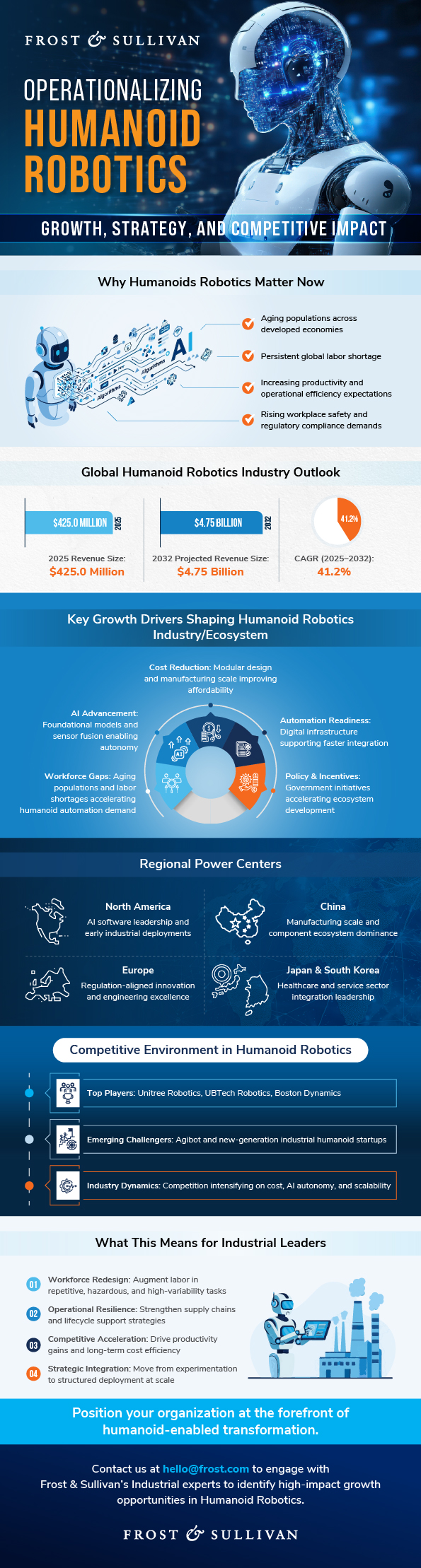
Humanoid robotics is shifting from experimental promise to practical deployment. Advances in AI, multimodal sensing, and modular engineering are enabling humanoids to operate in human-designed environments across manufacturing, logistics, healthcare, and other labor-intensive sectors. The global humanoid robotics industry is expected to grow to approximately $4.75 billion by 2032, reflecting a 41.2 % CAGR, signaling accelerating commercialization momentum.
- Evaluate optimal investment timing
- Benchmark competitive positioning
- Identify high-impact growth opportunities
- Assess workforce impact
Why Humanoids Are Entering the Deployment Phase
- Workforce Gaps Are Intensifying: Aging populations and labor shortages are driving demand for flexible automation Humanoids can operate in human-designed environments and handle variable, labor-intensive tasks more effectively than fixed automation systems.
- AI Is Enabling Real-world Adaptability: Advances in foundational AI and multimodal sensing are allowing humanoids to interpret context, adapt to dynamic environments, and perform tasks with greater autonomy.
- Engineering Improvements Are Strengthening Viability: Progress in actuators, motors, and next-generation batteries is improving precision, energy efficiency, and operational endurance making sustained deployment increasingly feasible.
Strategic Imperatives Reshaping the Humanoid Robotics Industry
Innovative Business Models
Companies are transitioning from capital-intensive sales toward Robots-as-a-Service (RaaS), leasing, and subscription models to reduce adoption barriers and accelerate deployment. As humanoids expand into service environments, value-added services and lifecycle support are strengthening competitive differentiation and recurring revenue.
Disruptive Technology Integration
Firms are continuously advancing AI, sensors, materials, and energy systems to improve autonomy and operational efficiency. Modular architectures are enabling upgrades without full replacement, extending lifecycle value and protecting capital investment.
Geopolitical and Supply Chain Resilience
With supply chains spanning multiple regions, trade tensions and export controls are creating geopolitical volatility. Organizations are diversifying sourcing and strengthening regional manufacturing capabilities to enhance improve supply chain resilience and reduce risk.
Regional Power Dynamics Shaping the Humanoid Ecosystem
Regional dynamics are increasingly influencing competitive positioning and commercialization pathways in the humanoid robotics industry.
- North America is maintaining leadership in AI software, high-performance computing, and early industrial deployments.
- China is scaling manufacturing capacity and strengthening control over critical components, supported by coordinated national policy initiatives.
- Europe is reinforcing its ecosystem through regulation-aligned innovation, advanced engineering capabilities, and targeted R&D incentives.
- Japan and South Korea are leveraging long-standing robotics expertise to drive adoption in healthcare, education, and service applications.
Emerging regions are presenting long-term growth potential as capabilities mature and costs decline., geopolitical volatility is creating supply risk, with humanoid production reliant on globally sourced semiconductors, rare earth materials, and precision components. In response, humanoid robot companies are diversifying sourcing and strengthening regional manufacturing to enhance resilience.
Growth Opportunities Driving Transformation Across the Humanoid Industry
- Telepresence-enabled Workforce Avatars: Organizations are deploying virtual reality (VR)-controlled humanoids to extend skilled expertise remotely, enabling scalable service delivery while reducing travel costs and improving operational responsiveness.
- AI-enhanced Public Safety Automation: Autonomous humanoids are supporting patrol, surveillance, and hazard detection through AI-driven analytics and sensor fusion, enhancing safety while minimizing human risk exposure.
- Commercial Space Operations Support: Humanoid platforms are being adapted for zero-gravity environments to assist in satellite servicing and space infrastructure tasks, positioning companies for participation in the expanding commercial space economy.
Download the full analysis for detailed humanoids growth opportunity analytics.
Companies to Action: Key Players Shaping the Humanoid Robotics Landscape
- Unitree Robotics: Positioning itself as a cost-competitive player, Unitree is leveraging manufacturing scale and rapid iteration to introduce lower-priced humanoid platforms, accelerating industrial adoption.
- UBTech Robotics: Focusing on real-world deployment, UBTech is strengthening its portfolio through AI integration, modular design, and scalable production capabilities.
- Boston Dynamics: A benchmark in advanced mobility, Boston Dynamics is evolving from R&D-led innovation toward structured commercial deployment supported by strong industrial partnerships.
- Agibot: An emerging specialized OEM, Agibot is targeting industrial and logistics use cases with scalable, application-focused humanoid platforms.
Ready to Lead the Transformation?
- Book a Growth Strategy Session: Align your growth roadmap with Frost & Sullivan’s visionary Growth Pipeline™ Dialog.
- Engage with Growth Experts: Co-design AI-enabled, data-driven operating models that scale industry-specific and commercial impact.
- Share Your Transformation Story: Position your organization as a transformation leader through Frost & Sullivan’s Transformational Growth Leadership platform.
- Join the Growth Council: Collaborate with industry leaders shaping the future of your ecosystem.
- Nominate for the Best Practices Recognition: Be recognized for excellence in growth strategy, execution, and customer impact.
- Demonstrate Industry Positioning on the Frost Radar™: Benchmark your growth performance and innovation strength against industry competitors.
- Activate Brand & Demand Growth: Accelerate awareness, engagement, and revenue growth through integrated brand and demand generation strategies.
Frequently Asked Questions (FAQs): Humanoid Robots
- Why is humanoid robotics gaining strategic importance now?
Converging workforce shortages, rising productivity pressures, and rapid advancements in AI and modular engineering are making humanoid deployment commercially viable and strategically relevant. - Which industries are leading early adoption in AI humanoid robots?
Manufacturing, logistics, healthcare, public safety, and emerging space operations are currently driving initial deployment due to labor intensity and operational complexity. - How do humanoids differ from traditional industrial robots?
Unlike fixed automation systems, humanoids are designed to operate in human-centric environments, enabling greater task flexibility without extensive infrastructure redesign. - What are the primary barriers to large-scale humanoids deployment?
High upfront costs, regulatory complexity, supply chain dependencies, and performance limitations in unstructured environments remain key considerations. - What should organizations evaluate before investing in humanoids?
Enterprises should assess return on investment (ROI) potential, AI maturity, supply chain resilience, workforce integration impact, and long-term scalability within their automation roadmap.