This blog is based on our analyses, Top 10 Strategic Imperatives in Unified Communications and Collaboration, 2025 and Growth Opportunities in Global Cloud Meetings and Team Collaboration Services authored by Frost & Sullivan’s growth expert, Chris Pennell from the Unified Communications team.
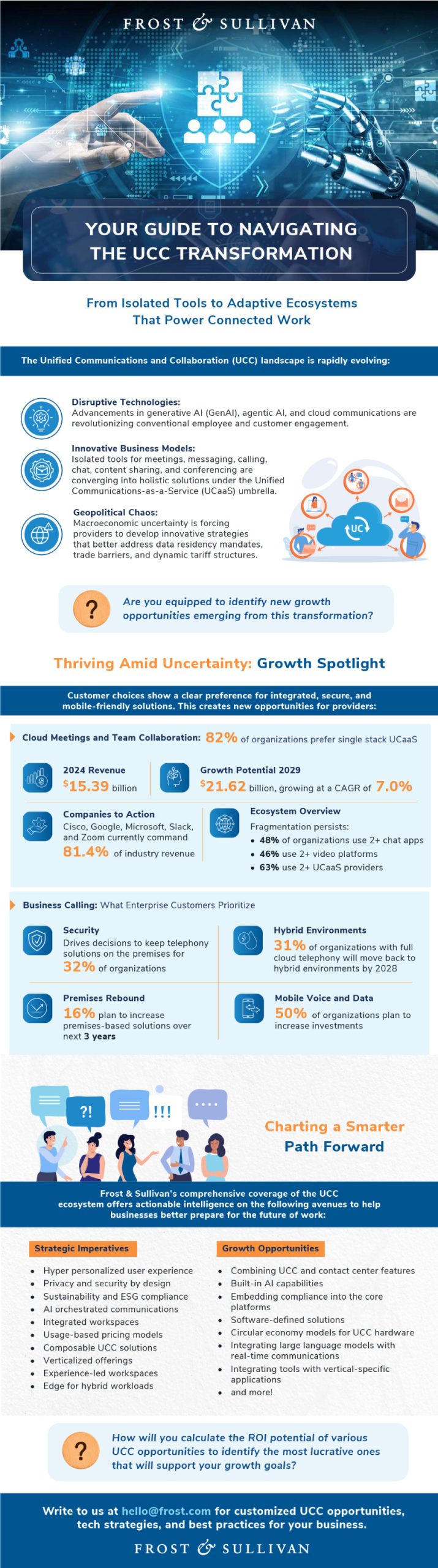
Today, Unified Communications and Collaboration (UCC) providers face mounting pressure from geopolitical chaos, intense competition, and dwindling margins, while fragmented tools continue to give rise to data silos that frustrate users and undermine productivity. To add to these burdens, enterprises are becoming more wary about compliance, governance, and data security. Meanwhile, tightening IT budgets signal that organizations are becoming more cautious about investing in piecemeal UCC applications going forward.
As a result, the next phase of innovation goes beyond feature checklists. Providers that embrace interoperability, strategic partnerships, and AI can deliver adaptive solutions that simplify work and deepen customer trust with:
- Agentic AI: AI agents that proactively manage, automate, and customize communications workflows by analyzing contextual factors, user behavior, and communication patterns.
- Service-as-Software: comprehensive, result-driven AI services bucketed under a holistic, Unified Communications-as-a-Service (UCaaS) stack.
- Adaptive Security: automating compliance mapping and security while integrating zero-trust architecture, end-to-end encryption, and more stringent access controls.
- Modularity: software development kits (SDKs), microservices, and application programming interfaces (APIs) that help customize solutions for vertical-specific requirements in government services, healthcare, and finance.
- Cross-Platform Interoperability: ensuring seamless integration between team collaboration tools, CRM, and productivity management applications.
- Audio and Video Conferencing: AI-driven improvements like noise suppression, real-time translation, speaker tracking, and automated captions for more inclusive, high-quality employee experiences.
- Mobile UCC: factoring in mobile applications, composable user interfaces, and integration with desktop/web/mobile soft clients, to facilitate workflow digitization.
Turning UCC Disruption into Opportunity
Frost & Sullivan’s exclusive whitepaper offers actionable intelligence on the following avenues to help businesses prepare for the future of work:
- Strategic imperatives revolutionizing UCC: Privacy and security by design, Sustainability and ESG compliance, and Integrated workspaces.
- Emerging Growth Opportunities: role-based features, predictive analytics, and premium compliance services.
- Best practices from companies to action like Microsoft, Atlassian, Slack, Tata Communications, Cisco, Alcatel-Lucent Enterprise, and more!
The question is – What technology bets will separate resilient UCC leaders from those that struggle to differentiate their solutions?
Stop Chasing Isolated Tools. Start Capitalizing on UCC Platforms.
The Rise of AI-orchestrated Communications
AI is fast changing the “when” and “why” of enterprise communications, enabling more proactive, real-time workflows. Instead of waiting for human agents to initiate a call, send an email, or trigger a meeting, event-driven, agentic systems are starting to handle these interactions automatically — surfacing the right message, at the right time, on the right channel.
The outcome is not just higher efficiency, but enhanced CX, business resilience, and data-driven decision making through:
- Intelligent communication systems that take advantage of modular components like APIs, SDKs, microservices, and low-code tools.
- AI assistants and copilots that enable more efficient and responsive communications workflows and adaptive interactions.
- Experience-led workspaces with smart peripherals and digital tools that facilitate employee engagement, maximize focus time, and simplify cross-team collaboration.
- Software-defined solutions that combine data-powered insights with usage-based pricing.
- Integrated workspaces with the ability to monitor and track specific resources and services that teams consume.
Which partnership strategies and collaborations will help you make the most of these avenues?
Embedded Security in UCC: Best Practices and Enabling Technologies
In a digital workplace, holistic UCC platforms are central to enterprise productivity. However, the integration of multiple communication channels, devices, applications, and tools also expands the attack surface, making embedded security a top priority. Now, the following best practices can help companies combat threats from phishing, session hijacking, malware, data leakage, and Voice over Internet Protocol (VoIP) toll fraud:
- End-to-end Encryption: Ensuring all voice, video, and messaging traffic is encrypted, thereby preventing data interception and loss as it passes through various servers, routers, or cloud infrastructure.
- Robust Authentication: Multi-factor authentication and single sign-on features reduce risks of unauthorized access and impersonation on UCC systems.
- Zero Trust Principles: Verifying every user, device, and session minimizes the potential for lateral movement by attackers within networks.
- Secure Configuration Management: Regular patching, hardened default settings, and continuous monitoring help eliminate common vulnerabilities.
- User Awareness Training: Human error is often the weakest link. This implies that educating employees on phishing and safe communication practices will strengthen overall defenses.
By combining robust technologies with strategic best practices, organizations can create a resilient UCC ecosystem capable of withstanding modern cyber threats.
Charting a Smarter Path Forward Amid the UCC Transformation
In conclusion, future of UCC is being revolutionized by AI and automation, giving rise to more intuitive communication systems with features like real-time language translation, sentiment analysis, and intelligent virtual assistants. Moreover, the need for vertical-specific solutions and APIs is creating new growth avenues for providers.
Ultimately, those who can fulfill this need with unified platforms that facilitate embedded security, agentic systems, mobile functionalities, user-friendly interfaces, and smoother third-party integrations can position themselves for long-term success and competitive differentiation — Do you have the tools to evaluate different UCC offerings and identify the best ones for your organization’s specific needs?
Get in touch with our Unified Communications experts to explore customized growth opportunities, technology strategies, and best practices today.
Alternatively, you can also write to us at [email protected].