How embedded AI could help trucking fleets improve cost control, compliance and operational efficiency.
The trucking industry faces growing pressure to control costs, meet regulatory requirements and improve operational efficiency. Fleet managers must oversee multiple activities, including vehicle compliance, driver safety, inspections, documentation, toll payments etc. While technology has improved visibility across these areas, managing the growing volume of information remains a challenge. Fleets operating across multiple states often deal with different toll accounts, transponders, invoices and payment arrangements. Duplicate charges, malfunctioning transponders and incorrect billing can go unnoticed, gradually increasing operating costs. Similar challenges exist across safety and compliance, where managers must monitor large volumes of driver records, vehicle documentation and operational data.
The gap in the market is not a lack of information, rather the lack of ability to turn that information into timely, actionable decisions. Managers still spend considerable time reviewing reports, identifying unusual patterns, investigating problems and deciding what to do next. This creates an opportunity for AI, but simply adding an AI assistant or another dashboard will not solve the problem. The real value lies in helping fleets understand what is happening and act on it.
Fleetworthy: Bringing fleet readiness together
Fleetworthy has been building its position as an integrated fleet readiness platform, bringing together safety and compliance, toll management and weigh station bypass. Its solutions help fleets manage toll expenditure, simplify compliance processes, monitor safety and reduce unnecessary stops at inspection stations. The company already serves 90% of the largest fleets in North America and supports millions of vehicles and drivers. Its presence across these operational areas provides an established customer base and a valuable foundation for its next stage of product development.
Its latest development is its AI layer, RADAR™ (Real-time AI, Decisioning and Automated Resolution), which is designed to operate across the Fleetworthy platform. Rather than introducing a separate application, Fleetworthy is embedding intelligence into the tools its customers already use.
RADAR™: From data visibility to actionable intelligence
Fleetworthy RADAR™ was announced at the Fleetworthy Roadshow in Nashville on November 4, 2026 and is launching first within Fleetworthy’s Toll Management solution. It allows fleet managers to ask questions in plain English about their own toll data, without having to export reports or manually search through multiple records. Managers can ask what is driving their toll spend, by vehicle or agency; which vehicles’ tolls are being read by plate instead of transponder; or which vehicles are generating the highest toll expenditure. RADAR™ provides answers and presents insight cards highlighting unusual charges, spending trends and potential cost-saving opportunities.
The product is currently in early access (beta), with general availability for toll management expected in Q1 2027. Fleetworthy plans to extend RADAR™ into weigh station bypass, safety and compliance during 2027. Guided workflows to help resolve issues are also planned.
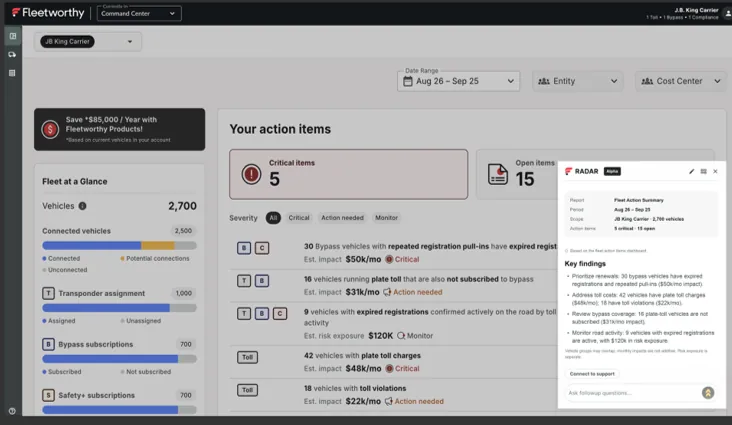
Figure 1: Fleetworthy RADAR™ Tool
Closing the gap between identifying and resolving issues
RADAR™’s immediate opportunity is to help fleets identify inefficiencies that might otherwise remain hidden in operational data. For example, a manager investigating rising toll expenditure could use RADAR™ to identify vehicles with unusually high costs and examine the reasons behind them. This could help uncover duplicate charges, incorrect billing or transponder related problems much faster than manually reviewing transaction reports.
The financial opportunity is tangible. Fleetworthy’s existing customer examples illustrate the potential impact of better toll management. CK Companies reduced monthly toll costs from $25,000 to $11,000 after identifying double-billed transponders and cash-rate tolling. Leonard’s Express reported more than $120,000 in annual toll savings. While these results are attributed to Fleetworthy’s toll management service, the RADAR is designed specifically to surface the same kinds of issues faster and contribute to increased cost savings. Its longer term opportunity could be greater as RADAR™ expands across the platform. In safety and compliance, it will help managers identify expiring documents, recurring compliance issues and areas requiring attention. Within weigh station bypass, it could help fleets better understand inspection activity and operational patterns. Bringing these capabilities together could give managers a more connected view of fleet readiness instead of requiring them to investigate each function separately. Fleetworthy also plans to move beyond providing information and recommendations towards guided workflows and selected automated actions as part of its future strategies.
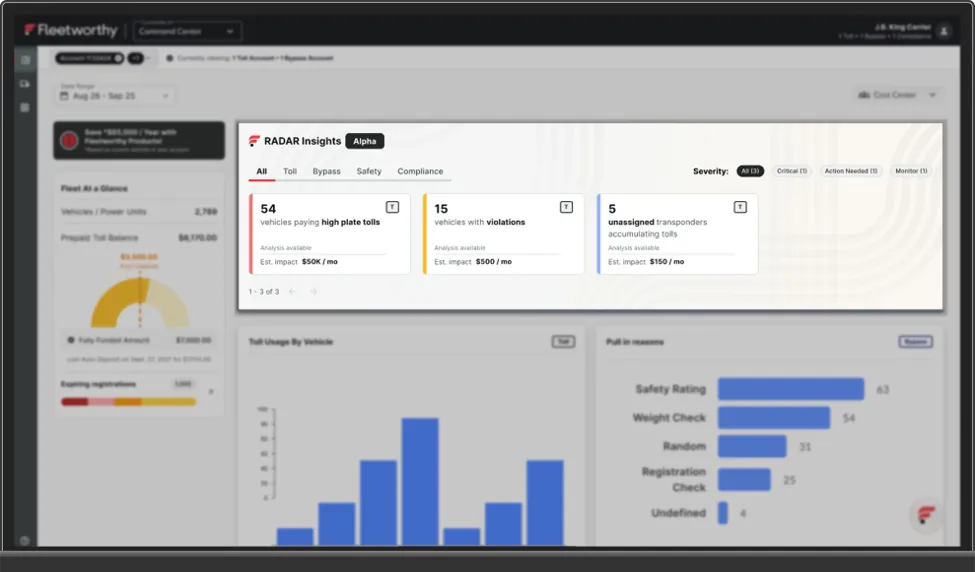
Figure 2: Fleetworthy RADAR™ Insights
The bigger strategic opportunity
RADAR™’s significance is not simply an AI addition to the Fleetworthy platform. Its significance lies in making its existing solutions more valuable by helping customers use their operational data more effectively. Its established presence in toll management, safety, compliance and weigh station bypass gives it a relevant foundation to develop this intelligence layer. The RADAR does not train AI models on customer data, and customers see only the accounts they can already access. Its widespread adoption will depend on accuracy and execution. The accuracy of its insights, the relevance of its recommendations and its ability to demonstrate measurable customer savings will determine whether fleets adopt it as an essential operational tool. The next stage of fleet management technology will be less about collecting data and more about helping fleets make better decisions and act faster.
Fleetworthy’s RADAR™ has the potential to become the intelligence layer connecting fleet costs, safety, compliance and operational performance. This would strengthen its position to a more integrated fleet readiness partner, helping customers move from reacting to problems towards proactively preventing inefficiencies.