Japan’s commercial vehicle industry is gradually transitioning toward a more connected, electrified, and sustainable future.
Japan’s commercial vehicle (CV) industry is set to transform due to the impact of electrification, alternative fuels, and digital connectivity.
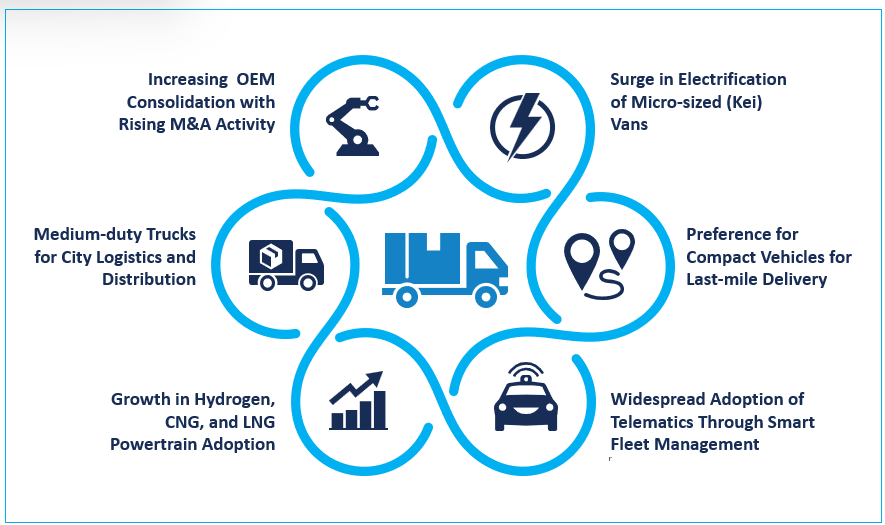
The growing importance of e-commerce has boosted demand for compact, light commercial vehicles (LCVs) capable of navigating dense urban environments. Medium- and heavy-duty (M&HD) trucks support long-distance freight movement and industrial logistics, with MD trucks finding increasing use in city logistics and distribution, even as micro-sized vans are becoming popular for last-mile delivery services. Alongside such trends, telematics adoption is expanding rapidly as fleet operators embrace smart fleet management solutions to enhance productivity and minimize operating costs.
Gasoline engines currently dominate the LCV segment, whereas diesel remains the primary powertrain for M&HD trucks. However, technologies such as battery electric powertrains, natural gas systems like CNG and LNG, and hydrogen fuel cells are gaining prominence in the push toward cleaner mobility and improved energy efficiency. Japan is positioning itself as a global leader in hydrogen technology. Government policy, combined with significant investments by major OEMs, is reinforcing the country’s quest to decarbonize and realize a more technologically advanced CV ecosystem.
As a result, the Japanese CV industry is gradually transitioning toward a more connected, electrified, and sustainable future.
To learn more, please see: Light Commercial Vehicle and Medium- and Heavy-Duty Truck Market Outlook, Japan, 2025, or contact [email protected] for information on a private briefing.
Electrification Set for Steady Growth
Electrification in Japan’s CV industry is still at a nascent stage but is expected to grow steadily over the coming decade.
Electric models represented only 0.9% of total LCV sales in 2024, with gasoline accounting for an estimated 83.1%. By 2035, however, the share of internal combustion engine (ICE) vehicles is expected to decline, with electric vehicles (EVs) poised to expand their share to nearly 30% of the LCV market.
Similarly, electric and natural gas alternatives remain at a very early stage of development in the M&HD truck segment, which is currently dominated by diesel engines. Here too, electrification is expected to gain momentum over time, with electric powertrains projected to expand their market share from 0.4% in 2024 to around 24% by 2035.
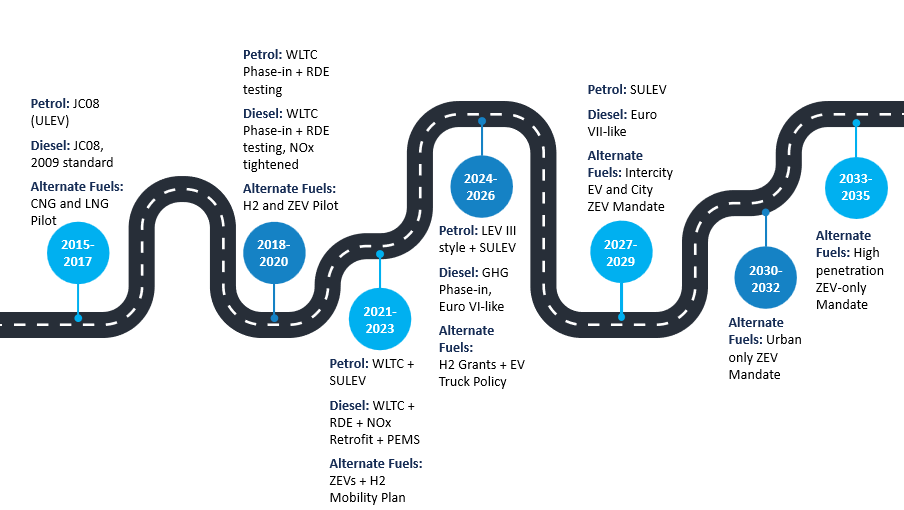
Government policy will play a central role in accelerating this shift. For instance, the Clean Energy Vehicle (CEV) program for electric and hydrogen-powered trucks and buses offers grants and purchase incentives. M&HD electric trucks can receive subsidies of up to approximately $5,500, while hydrogen fuel cell CVs may receive grants of up to $16,500. Additional incentives are available for fleets that replace older diesel vehicles with cleaner alternatives.
Tax incentives, green investment tax credits, regional subsidies for electric CVs, and preferential financing programs for logistics companies adopting low-emission fleets are further supporting the transition.
Japan has set ambitious targets for vehicle electrification, with the government aiming to achieve 100% electrification of new passenger vehicle sales, including LCVs, by 2035. Interim targets aim to expand the share of zero-emission vehicles to 20–30% of new LCV sales by 2030.
Moreover, the Ministry of Economy, Trade and Industry (METI) provides subsidies covering up to two-thirds of installation costs for fast charging stations. Japan aims to deploy approximately 150,000 chargers nationwide by 2030, including around 30,000 fast chargers. Such initiatives are set to encourage the growth of electric CVs.
Hydrogen Mobility Emerging as a Strategic Pillar
Alongside electrification, Japan is strongly promoting hydrogen as a critical anchor of its long-term energy and mobility strategy. Beyond being a clean transport fuel, hydrogen is also perceived as a means to strengthen national energy security and reduce dependence on imported fossil fuels.
This is an important consideration since Japan currently imports about 94% of its energy, making diversification of energy sources a critical national priority. This issue became particularly significant after the Fukushima Daiichi nuclear disaster in 2011, which led to a sharp reduction in nuclear power generation and increased reliance on fossil fuel imports, including coal and LNG.
To address these challenges while meeting its carbon neutrality target for 2050, Japan has positioned hydrogen as a central pillar of its long-term energy strategy. In 2017, it became the first country to adopt a national hydrogen strategy through the Basic Hydrogen Strategy introduced by METI.
The government has since launched multiple initiatives to support hydrogen development. The Next-Generation Vehicle Promotion Center (NEVPC) provides sizeable direct purchase subsidies for fuel cell vehicles. For example, for CVs, these subsidies typically range between $20,000 and $25,000, depending on vehicle size and efficiency.
Japan is also investing heavily in hydrogen infrastructure development. The Japan H₂ Mobility (JHyM) consortium targets the availability of 1,000 hydrogen refueling stations by 2030. Moreover, government programs have historically subsidized up to 50% of installation costs during early deployment phases to accelerate infrastructure rollout.
Japanese automotive manufacturers like Toyota are actively participating in this transition. The country’s leading automaker is now deploying fuel cell modules for trucks and vans and is testing hydrogen-electric hybrid models for logistics applications.
In tandem, collaborative pilot projects are expanding. Toyota and Hino Motors are working with logistics companies such as Seven-Eleven Japan and FamilyMart to test hydrogen-powered trucks for last-mile delivery operations. Meanwhile, Isuzu Motors and Honda have announced joint development plans for heavy-duty hydrogen trucks expected later in the decade. Mitsubishi Fuso, part of Daimler Truck Asia, is also exploring hydrogen mobility through prototypes such as the eCanter F-Cell.
Digital Connectivity Technologies Are Enhancing Fleet Management
Truck telematics adoption is expanding rapidly as fleet operators increasingly rely on connected technologies to improve operational efficiencies and reduce fuel consumption.
Japan has more than one million connected trucks. Embedded telematics systems dominate, accounting for approximately 85% of installed devices. These systems are facilitating vehicle diagnostics, route optimization, driver monitoring, and predictive maintenance.
Currently, most telematics solutions offered in Japan are entry-level services. However, the industry is gradually moving toward more advanced offerings. Fleet management providers are increasingly introducing mid-tier and premium solutions. This shift toward higher-value services is helping vendors increase average revenue per customer while enabling fleet operators to leverage data-driven insights. As logistics networks become more complex, fleets will increasingly rely on telematics to optimize operational efficiencies.
Strategic Opportunities for OEMs
Major domestic manufacturers such as Toyota, Suzuki, Isuzu, and Hino continue to lead Japan’s CV industry due to their extensive technological expertise and manufacturing capabilities.
The rapid expansion of e-commerce and last-mile deliveries will fuel demand for compact delivery vehicles that enable efficient operations in urban environments. Electric LCVs will be particularly suitable for such applications since predictable routes with frequent stops will allow them to use regenerative braking capabilities, even as city environments will facilitate easy access to charging infrastructure. Accordingly, OEMs will need to focus on developing modular electric platforms that reduce production complexity, while improving vehicle efficiency and lowering long-term costs.
Japan’s strong commitment to hydrogen technology is set to generate long-term growth opportunities, both domestically and in foreign markets. While hydrogen initiatives in some regions have slowed, Japan continues to invest heavily in building a comprehensive hydrogen ecosystem. By leveraging their expertise in fuel cell systems and hydrogen infrastructure, Japanese manufacturers will be well positioned to play a leading role in expanding hydrogen mobility markets both at home and abroad.
Emerging markets in Southeast Asia, Latin America, the Middle East, and Africa will offer both short-term and long-term gains for Japanese automakers, with room for growth in vehicle volumes and technologically advanced offerings. Japanese companies will need to ramp up exports and leverage their technological capabilities to gain a competitive advantage in these markets.