This blog is based on a recent analysis, “Growth Opportunities in India’s Two-Wheeler Rental Industry,” authored by Pravheen Terrance, Frost & Sullivan’s Mobility Growth Expert, specializing in the leasing and rental domain.
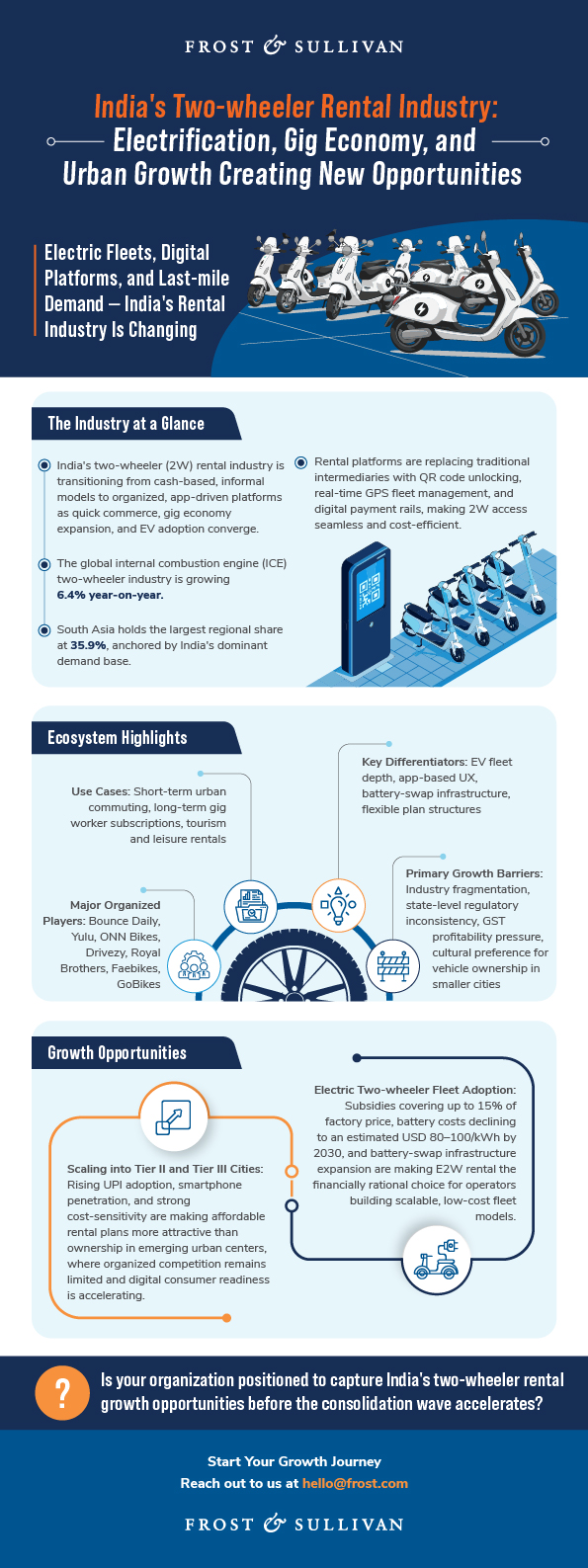
The two-wheeler (2W) industry is not slowing down, but shifting gears. Global internal combustion engine (ICE) motorcycle sales are climbing at 6.4% year-on-year, with South Asia accounting for more than a third of the world’s demand at 35.9%. Honda holds the top spot globally, while Hero MotoCorp, Yamaha, Bajaj, and TVS follow closely, each reinforcing their grip across some of the world’s most volume-driven emerging regions.
Access the full analysis
But the real story is not who is leading today; it is how fast the rulebook is changing. Established ICE manufacturers are no longer competing only with each other. They are actively forging alliances with battery technology firms and electric vehicle (EV) start-ups, signaling a fundamental shift in how the industry defines competitive advantage. Yamaha and Honda have both stepped into battery-swapping consortiums, working to create common standards for EV components and charging infrastructure. It is a clear sign that even the most dominant players recognize that the road ahead runs electric.
For India, this global context is providing a strong foundation. But the more compelling narrative is playing out specifically in the rental segment, where a convergence of urban mobility pressures, gig economy expansion, and electrification is converting a historically informal industry into an organized, technology-driven ecosystem.
Listen to the growth podcast on India’s two-wheeler rental industry.
Strategic Imperatives Reshaping India’s Motorcycle Rental Industry
- Customer Value Chain Compression: Rental platforms are removing the intermediary layer from the 2W rental experience. App access, quick response (QR) unlocking, live global positioning system (GPS) tracking, and instant digital payments are putting vehicle access directly in consumers’ hands, while enabling operators to run smarter, more efficient fleets without the overhead of traditional agent networks.
- Transformative Megatrends: Rising urban living costs, the financial burden of vehicle ownership, and a cultural shift toward asset-light lifestyles among younger Indian consumers are expanding addressable demand for rental solutions. The explosive growth of quick commerce and hyperlocal delivery is adding a parallel commercial demand layer that is growing faster than individual consumer adoption.
- Competitive Intensity: India’s 2W rental industry is competing across organized and unorganized layers simultaneously. Platforms including Bounce Daily, Yulu, ONN Bikes, Drivezy, and Royal Brothers are investing in technology, EV integration, and geographic expansion, while local operators are maintaining strong positions on price and accessibility. The gap between these two cohorts is widening, and the organized segment is actively working to consolidate the informal layer.
How are you leveraging these strategic imperatives to identify untapped revenue streams and accelerate your competitive advantage?
Top Growth Opportunities
- Tier II and III City Expansion: Rising Unified Payment Interface (UPI) adoption, smartphone penetration, and last-mile delivery networks are making app-first rental models viable beyond metros. Vehicle ownership costs consume a larger share of household income here, making affordable rental plans attractive to a wider user base. Early-moving platforms are finding lower competition, digitally ready consumers, and lighter infrastructure needs.
- Electric 2W Fleet Adoption: Charging costs, government subsidies, and declining battery costs are making electric two-wheeler (E2W) fleet electrification financially compelling. Battery-swap infrastructure is eliminating range anxiety for delivery riders, while partnerships with eCommerce platforms and OEMs are enabling low capital expenditure fleet models that align growth with demand without large upfront capital commitments.
Is your organization aligning its rental fleet strategy with these growth opportunities?
Growth Barriers to Address
The industry is running across a patchwork of local operators and organized platforms with no consistent pricing, service quality, or safety standards. This dynamic is slowing broad consumer trust in rental as a dependable mobility category and making it harder for the industry to present itself as organized and reliable at scale.
Regulatory complexity is adding operational friction and limiting expansion pace:
- Varying state-level permit requirements and inter-state usage restrictions are creating compliance complexity that is slowing fleet deployment across city boundaries.
- The Goods and Service Tax (GST)-related challenges are continuing to affect profitability for organized operators, particularly those running large fleets with tight margins.
- Vehicle ownership continues to carry cultural and social weight in India, particularly in smaller cities, where the perception of rental as a temporary alternative to ownership persists among certain consumer segments.
Is your organization building the regulatory and operational resilience to scale efficiently across India’s fragmented motorbike rental landscape?
Your Next Move
The platforms getting ahead in India’s rental market share one common thread: they are moving early. Early into EVs, early into smaller cities, and early into partnerships with the gig economy workers who keep last-mile delivery running. That combination of fleet, reach, and relationships is proving harder to replicate than any single technology advantage. The growth economics are moving clearly toward organized, technology-enabled, and EV-integrated models. Companies aligning their investments with this direction today are building a compounding advantage through the decade.
Listen to the growth podcast on India’s two-wheeler rental industry
Frequently Asked Questions
What is driving growth in India's two-wheeler rental industry?
How are E2W changing rental economics in India?
Which cities offer the highest growth potential for two-wheel vehicle rental in India?
Who are the leading players in India's motorbike rental industry?
What are the biggest challenges slowing growth in India's 2W rental industry?
Ready to Lead the Transformation?
- Schedule a Growth Strategy Dialog: Align your growth roadmap with Frost & Sullivan’s Visionary Growth Pipeline™ Dialog.
- Engage with Growth Experts: Co-design AI-enabled, data-driven operating models that scale industry-specific and commercial impact.
- Showcase Your Transformational Leadership: Position your organization as a transformation leader through Frost & Sullivan’s Transformational Growth Leadership platform.
- Join the Growth Council: Collaborate with industry leaders shaping the future of your ecosystem.
- Explore Best Practices Recognition: Be recognized for excellence in growth strategy, execution, and customer impact.
- Benchmark Your Industry Positioning on the Frost Radar™: Benchmark your growth performance and innovation strength against industry competitors.
- Tell Your Story: Accelerate awareness, engagement, and revenue growth through integrated brand and demand generation strategies.