This blog is based on a recent analysis, “OEM Strategies on Next Generation Electric Vehicles, Global,” authored by Srinag Rajendra, Frost & Sullivan’s Mobility Growth Expert, specializing in the electric vehicles and electrified powertrain domain.
The electric vehicle industry is maturing faster than most OEMs planned for, and the pressure is coming from every direction. Stiff Competition from Chinese electric vehicle (EV) manufacturers, persistent supply chain volatility, and the pullback of government purchase incentives in key regions are collectively demanding that OEMs rethink how they design, price, and deliver electric vehicles at a profit. Leading manufacturers are already investing in modular platform architectures capable of spanning budget to premium segments, partnering with battery chemistry innovators, and making deliberate moves into local manufacturing to navigate geopolitical exposure.
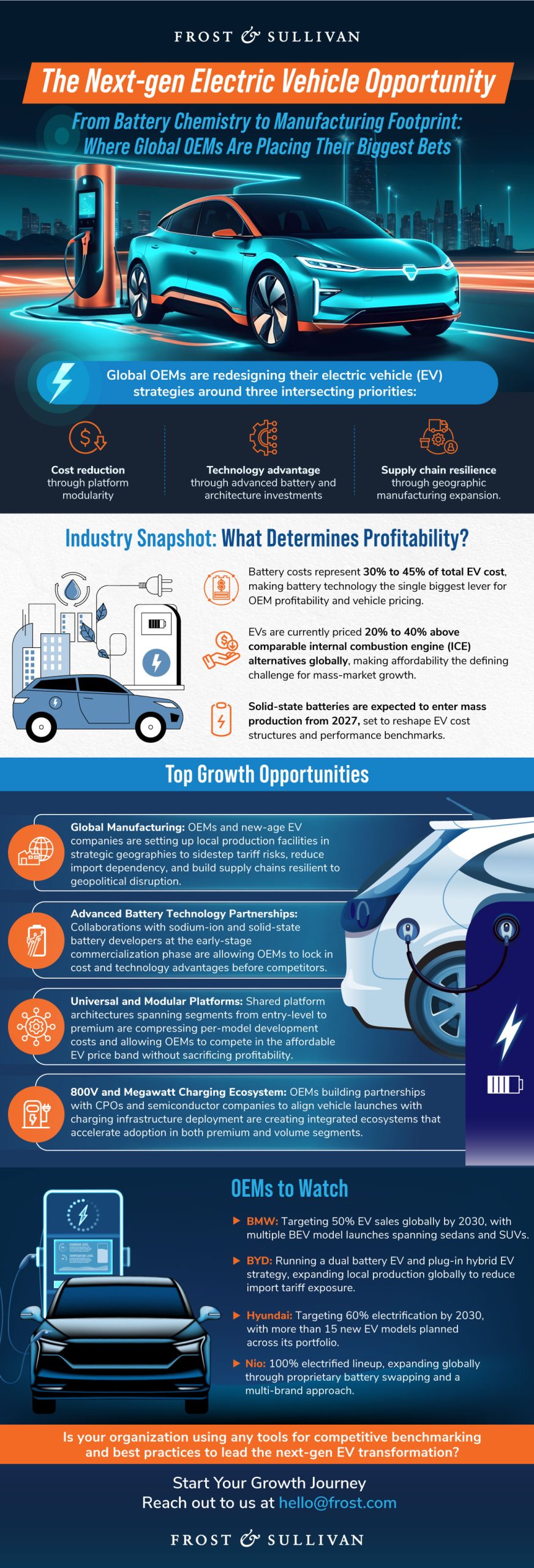
Battery costs represent 30% to 45% of total EV cost, making battery technology the single biggest lever for OEM profitability and vehicle pricing.
Strategic Imperatives Reshaping the OEM EV Strategy
Competitive Intensity
Chinese EV companies are currently the most disruptive force in the global electric vehicle industry. They are combining low-cost manufacturing, integrated battery supply chains, and aggressive pricing to challenge traditional OEMs in both home and export regions. In response, legacy manufacturers are accelerating their adoption of shared and universal platforms that allow the same underpinning to support multiple body styles and powertrain configurations.
Transformative Megatrends
The transition to 800V electrical architecture is moving from niche to mainstream. OEMs are prioritizing high-performance and premium segments for initial rollouts, and the broader shift from the current 400V standard is expected to gather greater momentum over the next three to five years. As 800V-based vehicles scale, the parallel buildout of ultra-fast and megawatt charging infrastructure is becoming a joint responsibility for OEMs, charge point operators, and grid utilities.
Disruptive Technologies
With batteries accounting for 30% to 45% of total vehicle cost, progress in battery chemistry is directly tied to OEM profitability. Lithium-ion improvements are delivering near-term gains, sodium-ion batteries are finding relevance in the micro-EV and entry-level segment, and solid-state batteries are expected to fundamentally alter EV cost structures and performance benchmarks.
Is your organization’s battery technology strategy aligned to capitalize on growth opportunities emerging from this transformation?
OEM Electrification: Growth Strategies
| Strategic Priority | Growth Strategy |
| Platform Modularity | Develop universal EV platforms that share architecture across segments, from sub-$20,000 urban EVs to premium sports utility vehicles (SUVs), reducing development costs and accelerating time-to-market. |
| Battery Technology | Invest in sodium-ion chemistry for micro and budget EVs, fast-track solid-state battery partnerships for post-2027 launches, and explore dual-chemistry packs for versatile applications. |
| 800V Architecture | Partner with charging point operators (CPOs) and semiconductor companies to align 800V vehicle launches with ultra-fast and megawatt charging rollouts, particularly in premium and performance segments. |
| Supply Chain Resilience | Establish local manufacturing in key geographies to sidestep tariff exposure, partner with major battery manufacturers for long-term cost-efficiency, and diversify rare earth sourcing. |
| Affordable EV Expansion | Build dedicated low-cost EV lines on shared platforms, targeting the $20,000 to $30,000 price band to unlock mass-market demand across emerging and value-conscious segments. |
How is your organization aligning its EV investment roadmap to gain competitive advantage?
Opportunities Come With Challenges
- Geopolitical instability is an active constraint on EV production economics. Trade policy shifts, tariff escalations, sanctions, and rare earth supply exposure are creating cost and availability volatility across the value chain. OEMs building manufacturing resilience through localized facilities in key regions are reducing their exposure, but the investment required to do so is substantial.
- The reduction or removal of EV purchase incentives in multiple regions is also creating near-term demand headwinds. EVs globally are priced 20% to 40% above comparable internal combustion engine (ICE) alternatives, and without incentive support, many price-sensitive buyers are returning to conventional powertrains. High import costs in certain geographies are compounding the pricing challenge further, making local manufacturing a strategic necessity rather than an optional expansion play.
- Supply chain vulnerabilities, particularly around semiconductors and rare earth materials, remain persistent. Every major disruption in the past several years has exposed how deeply concentrated and fragile these dependencies are.
How is your organization building supply chain resilience and manufacturing flexibility to overcome these growth barriers?
Top Growth Opportunities
Growth Opportunity 1: Global Manufacturing and Facility Upgrades
Legacy OEMs are committing billions to transform existing plants for EV production and to establish new facilities, including dedicated battery manufacturing operations. New-age EV companies are simultaneously accelerating their global footprint through local manufacturing bases, reducing import exposure and enabling faster response to regional demand.
OEMs establishing facilities in strategically chosen geographies are building the supply chain agility needed to navigate tariffs, sanctions, and geopolitical realignments without disrupting production timelines. Partnerships with major battery manufacturers combined with production automation investments are also contributing directly to long-term profitability.
Growth Opportunity 2: Advanced Battery and Architecture Technologies
The convergence of alternate battery chemistries and 800V architecture is defining the next competitive tier in the EV industry. OEMs partnering with battery technology companies at the early development stage of sodium-ion and solid-state chemistries are positioning themselves ahead of the commercialization curve.
Dual-chemistry battery pack adoption, already demonstrated by manufacturers like Contemporary Amperex Technology Co., Limited (CATL), is enabling vehicles to serve varied use cases without multiplying platform complexity. On the semiconductor front, collaborations with advanced chip suppliers for ADAS and autonomous driving systems, alongside CPO partnerships for ultra-fast and megawatt charging deployment, are building the integrated technology ecosystem that next-generation EVs require.
How is your organization building supply chain resilience and manufacturing flexibility to overcome these growth barriers?
What the Leading OEMs Are Doing Differently
The leading manufacturers pulling ahead are restructuring the economics of how EVs are built and sold. Universal platform strategies, battery chemistry diversification, local manufacturing investment, and disciplined brand segmentation across price bands are the operational foundations that separate leaders from followers in this environment. Those still anchored to legacy program structures and single-chemistry battery bets are facing a narrowing window to course-correct before the next generation of affordable EVs begins competing on price at scale.
Frequently Asked Questions
1. How long before affordable EVs at the $20,000 price point become mainstream across emerging markets?
Affordable EVs at the $20,000 price point are on track for emerging markets by 2027–2028, driven by falling battery costs, modular platform development, and rising competitive pressure from Chinese manufacturers.
2. How is 800V architecture changing EV development strategies?
800V systems are enabling faster charging, improved energy density, and smaller battery pack requirements. OEMs are launching 800V platforms in premium segments first, with a broader transition from the current 400V standard expected to gain significant traction over the next three to five years.
3. Why are OEMs investing in alternate battery chemistries?
Battery costs represent 30% to 45% of total EV cost. Sodium-ion batteries offer a lower-cost path for micro and entry-level EVs, while solid-state batteries, expected in mass production by 2027, are set to deliver step-change improvements in energy density and safety — directly affecting vehicle pricing and range.
4. How are OEMs navigating geopolitical disruptions in their EV supply chains?
OEMs are establishing local manufacturing facilities in key regions, diversifying battery and semiconductor sourcing, and collaborating with regional battery manufacturers to build supply chains that are less exposed to tariff fluctuations, export restrictions, and rare earth material scarcity.
5. Which OEMs are leading the global next-generation EV transition?
BMW, BYD, Hyundai, GM, Ford, Nio, and other major OEMs are all pursuing electrification strategies at scale though their timelines, platform approaches, and technology bets differ meaningfully across regions and segments.
Ready to Lead the Transformation?
- Schedule a Growth Strategy Dialog: Align your growth roadmap with Frost & Sullivan’s Visionary Growth Pipeline™ Dialog.
- Engage with Growth Experts: Co-design AI-enabled, data-driven operating models that scale industry-specific and commercial impact.
- Showcase Your Transformational Leadership: Position your organization as a transformation leader through Frost & Sullivan’s Transformational Growth Leadership platform.
- Join the Growth Council: Collaborate with industry leaders shaping the future of your ecosystem.
- Explore Best Practices Recognition: Be recognized for excellence in growth strategy, execution, and customer impact.
- Benchmark Your Industry Positioning on the Frost Radar™: Benchmark your growth performance and innovation strength against industry competitors.
- Tell Your Story: Accelerate awareness, engagement, and revenue growth through integrated brand and demand generation strategies.