This blog is based on the competitive analysis titled, Fixed Wireless Access Services Industry, Latin America, 2026 – 2031, authored by Frost & Sullivan’s growth expert, Paula Fenoglio from the Enterprise Wireless Services team.
For decades, broadband expansion followed a familiar path: build more fiber, extend network reach, and connect more users. Today, while this approach remains important, the economics of connectivity are changing. The demand for high-speed internet is growing faster than the time taken to deploy traditional infrastructure in many parts of the world.
Across Latin America, communications service providers (CSPs) face a complex challenge. They need to grow broadband connectivity, improve customer experience, support emerging digital economies, and deliver better returns on network investments, all in a highly competitive ecosystem.
Fixed Wireless Access: Press Play on Growth
In under 8 minutes, discover the growth opportunities, competitive strategies, and best practices helping communications service providers expand broadband access and improve 5G monetization outcomes.
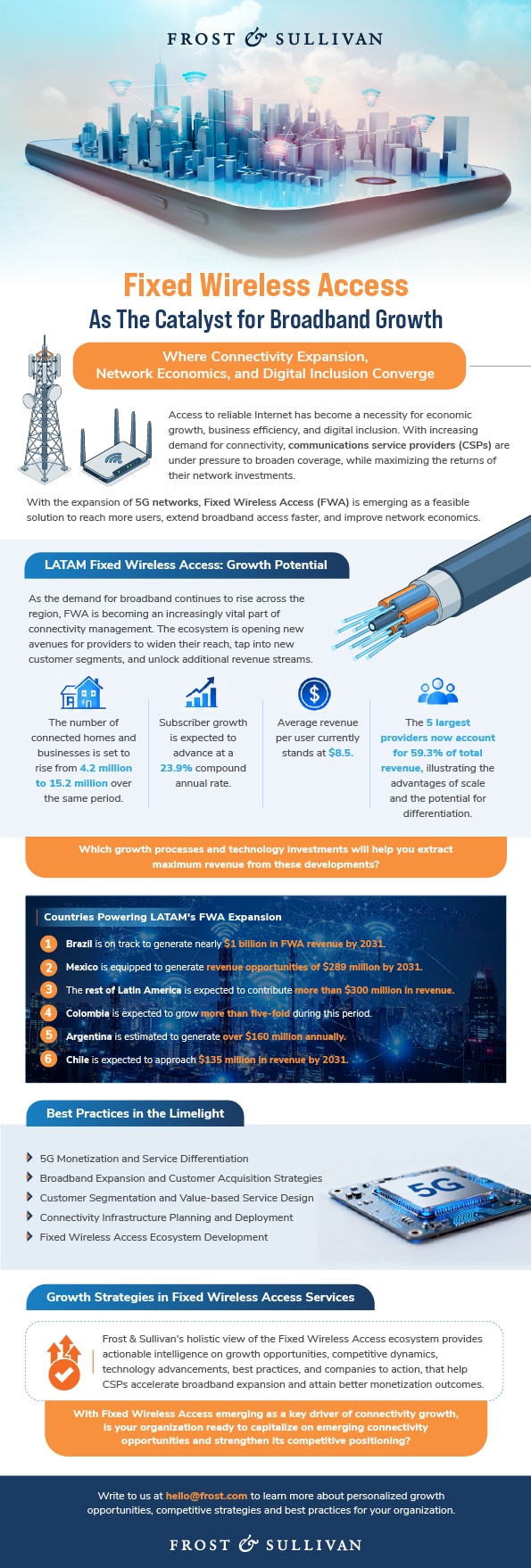
This transition is opening new avenues for Fixed Wireless Access (FWA) services. Once viewed only as a solution for underserved areas, FWA has since been known as a strategic platform for broadband deployment, allowing carriers to offer wireless broadband services faster, more flexibly and cost-effectively, compared to other traditional solutions.
The Headwinds Accelerating Fixed Wireless Access Adoption
1) Rising Demand for Broadband Connectivity
- Remote work, digital learning, cloud applications, and streaming services continue to increase bandwidth consumption.
- For governments, connectivity is now a vital pillar of economic development and digital inclusion.
2) Faster and More Cost-effective Deployment
- Fixed Wireless Access can be implemented faster than traditional wired infrastructure.
- Providers can utilize existing cellular infrastructure to improve coverage without significant civil work.
Is your organization prepared to capitalize on emerging technologies and business models, to survive and thrive through this transformation?
Click here to access our detailed Growth Opportunity Analytics.
The Strategic Imperatives Redefining Broadband Connectivity
· Disruptive Technologies
5G FWA breakthroughs are elevating broadband performance to new heights. Higher speeds, lower latency, beamforming, advanced network efficiency, massive multiple input, multiple output (MIMO) frameworks are allowing providers to deliver exceptional broadband experiences. This opens new opportunities for operators to leverage 5G monetization by extending broadband services to residential, business, and public sector applications.
· Competitive Intensity
Latin America’s telecommunications landscape remains highly concentrated, with 3 to 4 established providers controlling most of the connectivity services in the region. At the same time, competition is intensifying from Fiber to the Home (FTTH) providers, satellite connectivity solutions, regional internet service providers, and alternative broadband technologies. Differentiation is no longer only about coverage or price. Customer experience, service quality, speed of deployment and value-added services are also becoming key competitive differentiators.
· Innovative Business Models
Providers are building personalized offerings for residential customers, small and medium-sized enterprises (SMEs), enterprise users, industrial operations, and government organizations. This evolution is creating opportunities to go beyond basic connectivity and develop higher value solutions based on specific customer requirements.
Do you have the growth strategies needed to monetize 5G investments, strengthen competitive positioning, and deliver greater customer value?
The Future of Broadband Expansion Through Fixed Wireless Access
Listen to our growth podcast on Fixed Wireless Access today!
Critical FWA Growth Barriers Providers Must Address
1) Intense Competition from FTTH
In urban areas that already have high network coverage, fiber is now the preferred broadband solution. Given that fiber suppliers are continuing to improve pricing and service offerings, FWA operators face increasing pressure to differentiate themselves on speed, flexibility, customer experience and value-added services.
2) Lack of High-speed Broadband Infrastructure
Fixed Wireless Access performance is significantly dependent on the quality of the underlying network infrastructure. In many rural areas, inadequate backhaul capacity may hinder service performance. Operators have difficulty in providing the benefits of premium 5G fixed wireless services.
3) Spectrum Scarcity and High Licensing Costs
To deliver high performance, fixed wireless services require adequate spectrum access. However, spectrum availability, auction delays, and license fees influence the pace of network expansion, and the ability to scale services in the long run.
4) High Cost of Customer Premises Equipment
The cost of advanced 5G routers and customer premises equipment (CPE) is much higher, compared to traditional broadband modems. As a result, device affordability may limit adoption rates in price sensitive regions, especially when operators need to subsidize hardware to bring new customers on board.
Access Frost & Sullivan’s Growth Opportunity Analysis to learn from AT&T, Tigo, Claro, and more!
Beyond Broadband: The Growth Opportunities Emerging Across Fixed Wireless Access Services
1. FWA Test and Measurement Solutions
Network performance is becoming a competitive differentiation as FWA transitions from best-effort connectivity to enterprise-grade broadband. Providers will no longer be able to use existing, traditional mobile network testing standards. They need advanced tools to evaluate signal strength, beamforming accuracy, interference levels, and user experience before the services are distributed.
The transition to 5G Fixed Wireless is creating demand for:
- Platforms for automated network testing and validation
- Massive MIMO and beamforming optimization solutions
- Software for installation and line-of-sight verification
- Predictive maintenance and network analytics capabilities
2. FWA Services for Rural and Remote Areas
Geography, population densities, and infrastructure limitations, continue to be barriers for broadband connectivity in majority of Latin America. For many of these places, fiber deployment is not economically or operationally feasible. Fixed wireless services is becoming a viable choice for providing broadband connectivity to underserved communities, remote enterprises, and public institutions.
High-impact applications include:
- Broadband services to rural households
- Connectivity for SMEs operating outside urban regions
- Energy, Mining & Agriculture operations in remote areas
- Schools, health care facilities & government agencies
3. Fiber and 5G Fixed Wireless Access: Hybrid Connectivity Models
Rather than evaluating them as competing technologies, major operators are increasingly combining FWA and fiber to create more robust and flexible connectivity infrastructures. Hybrid deployments allow organizations to use fiber as the primary link, and FWA as a backup solution. This will enhance business continuity and prevent the possibility of expensive service outages.
Key areas of adoption include:
- Retail chains requiring continuous point of sale operations
- Banking networks providing ATMs and branch connectivity
- Enterprise branch offices
- Industrial plants that are distributed across the region
- Multi-site organizations that need network redundancy
Click here to access our detailed Growth Opportunity Analytics.
Ready to Lead the Transformation?
- Schedule a Growth Strategy Dialog: Align your growth roadmap with Frost & Sullivan’s Visionary Growth Pipeline™ Dialog.
- Engage with Growth Experts: Co-design AI-enabled, data-driven operating models that scale industry-specific and commercial impact.
- Showcase Your Transformational Leadership: Position your organization as a transformation leader through Frost & Sullivan’s Transformational Growth Leadership platform.
- Join the Growth Council: Collaborate with industry leaders shaping the future of your ecosystem.
- Explore Best Practices Recognition: Be recognized for excellence in growth strategy, execution, and customer impact.
- Benchmark Your Industry Positioning on the Frost Radar™: Benchmark your growth performance and innovation strength against industry competitors.
- Tell Your Story: Accelerate awareness, engagement, and revenue growth through integrated brand and demand generation strategies.
Fixed Wireless Access: Frequently Asked Questions
1. Will Fixed Wireless Access eventually replace FTTH?
While Fixed Wireless Access (FWA) continues to improve, most providers view it as a complementary technology rather than a replacement for Fiber to the Home (FTTH). The future of broadband is likely to be multi-technology, with fiber, FWA, satellite, and other connectivity solutions working together to address different customer, geographic, and performance requirements.
2. What role does 5G network deployment play in broadband expansion?
Successful 5G network deployment extends beyond mobile services. It creates the foundation for new broadband delivery models, including FWA. As coverage expands, operators can connect more customers without large-scale infrastructure projects, improving deployment efficiency while supporting digital inclusion, enterprise connectivity, and regional economic development.
3. Why is customer premises equipment becoming a strategic differentiator?
Customer premises equipment (CPE) is evolving from a simple connectivity device into a platform for service differentiation. Advanced CPE solutions can improve signal quality, simplify installation, enable premium speed tiers, and support AI-driven network optimization. As competition increases, CPE innovation can directly influence customer satisfaction, retention, and profitability.