This blog is based on the analysis titled, Growth Opportunities in AI-based Simulation Modeling in Healthcare, authored by Frost & Sullivan’s growth expert, Heena Juneja, and lead analyst Ashish Anil from the TechVision –Information and Communication Technology team.
Healthcare systems are operating in an increasingly complex environment where patient care, clinical training, and hospital operations must adapt to rising patient volumes, expanding clinical data, and evolving treatment protocols. Yet many healthcare organizations still rely on traditional simulation environments that struggle to reflect the dynamic conditions of modern healthcare systems. Physical simulations can be expensive, difficult to scale, and limited in their ability to replicate rare clinical scenarios or complex operational challenges.
Artificial intelligence (AI)-based simulation modeling is emerging as a critical capability for addressing these gaps. By creating dynamic, data-driven virtual environments, healthcare organizations can simulate surgical procedures, evaluate clinical workflows, and test operational scenarios before implementing decisions in real care settings. These models enable healthcare providers to analyze potential outcomes, improve clinical preparedness, and optimize resource allocation while reducing operational risks.
Unlock Growth Opportunities in AI-Based Healthcare Simulation
- Identify growth opportunities in Artificial Intelligence (AI)-based simulation for predictive care and hospital operations
- Explore technologies enabling scalable, data-driven clinical training and decision-making
- Understand how simulation models improve resource optimization and operational efficiency
- Gain insights into real-world applications, innovation pathways, and strategic priorities shaping healthcare systems
What Is Driving the Need for AI-based Simulation Modeling?
This shift is being enabled by several technological capabilities:
- Predictive insights: AI-driven simulation models analyze clinical and operational data to forecast outcomes and support proactive decision making.
- Scalable simulations: Advanced models can run complex healthcare scenarios with high accuracy while reducing computational costs.
- Multi-modal data integration: Simulation environments combine medical imaging, clinical records, and Internet of Things (IoT) device data to create realistic virtual healthcare systems.
- Continuous learning: Machine learning (ML) enables simulation models to adapt as new healthcare data and feedback become available.
- Automated model optimization: AI algorithms automatically generate and refine simulation models, reducing manual modeling effort and development time.
Are you exploring emerging technologies that improve clinical training, operational efficiency, and decision-making across healthcare systems?
Listen to Our Growth Podcast on AI-based Simulation Modeling in Healthcare Here
The Impact of the Top 3 Strategic Imperatives on AI-based Simulation Modeling in Healthcare
- Transformative Megatrends: Rising Healthcare Complexity and Workforce Gaps
- Aging populations and increasing chronic disease burden are increasing the demand for scalable healthcare solutions.
- Global shortages of clinicians are accelerating the need for efficient clinical training and operational planning tools.
- Disruptive Technologies: Immersive and Predictive Simulation Platforms
- Augmented reality (AR), virtual reality (VR), robotics, AI, and digital twins are reshaping medical training and healthcare planning.
- These technologies enable immersive simulation environments for surgical training, diagnostics, and hospital workflow planning.
- Industry Convergence: Collaborative Ecosystems for Healthcare Simulation
- Collaboration between technology providers, medical technology companies, hospitals, academic institutions, and cloud providers is accelerating innovation.
- Cross-industry partnerships enable access to diverse healthcare datasets and advanced computing capabilities.
Is your team consistently exploring innovative models or convergence opportunities that can improve clinical training and healthcare operations?
| Evolution of Simulation Modeling
Simulation modeling has progressed from niche engineering applications to advanced digital environments that replicate real-world systems and support predictive decision making. ü 1960–1985 | Limited Applications – Simulation used for narrow engineering problems led by specialized experts. ü 1985+ | Simulation as a Tool – Adopted to support design and engineering analysis across industries. ü 2000+ | Simulation-Based System Design – Enabled system-level modeling across multidisciplinary environments. ü 2015+ | Digital Twins – Virtual models linked to real operational data enable predictive insights and lifecycle optimization. |
| Download the sample analysis to explore growth opportunities shaping AI-based simulation modeling in healthcare. |
Key Technology Developments & Companies to Action Accelerating AI-based Simulation Modeling
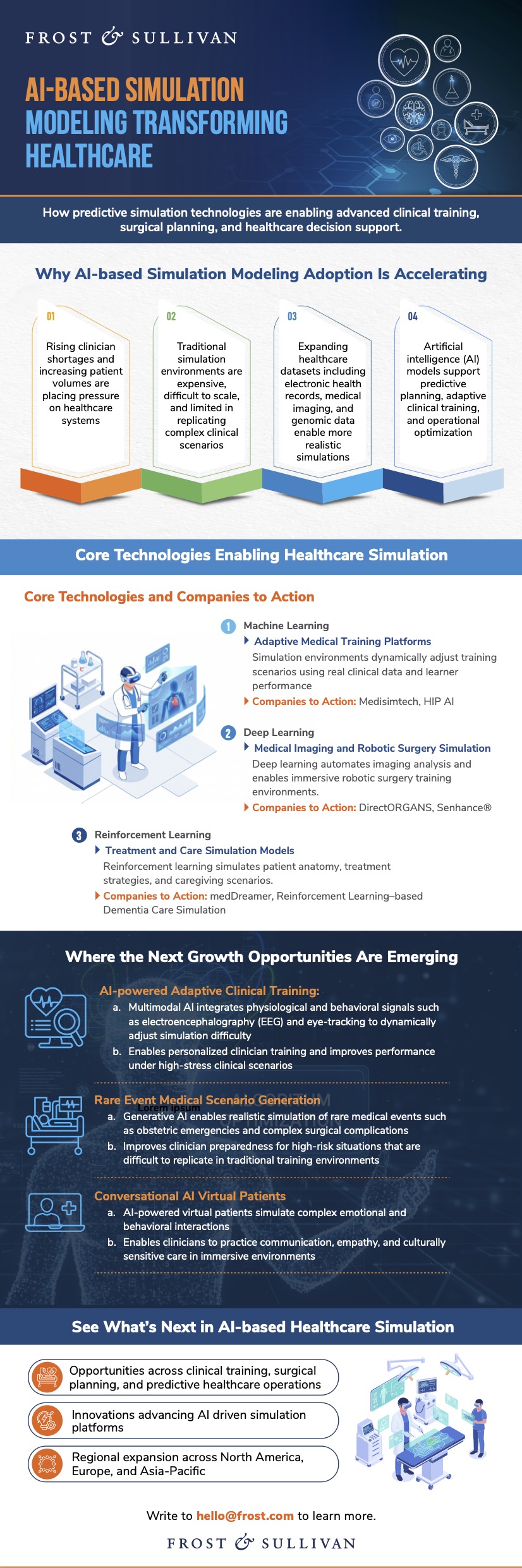
- Machine Learning: Enabling Adaptive Clinical Training and Surgical Planning
- Medisimtech Simulation Platform uses ML and predictive analytics to create adaptive simulation environments that adjust training scenarios based on real clinical data and learner performance.
Application: Medical training - HIP AI integrates ML and computer vision to simulate implant positioning and alignment during hip replacement surgery using fluoroscopic imaging.
Application: Orthopedic procedure simulation
- Medisimtech Simulation Platform uses ML and predictive analytics to create adaptive simulation environments that adjust training scenarios based on real clinical data and learner performance.
- Deep Learning: Advancing Imaging and Robotic Surgery Simulation
- DirectORGANS uses deep learning to automate contouring of organs-at-risk during computed tomography simulation for radiotherapy planning.
Application: Medical imaging simulation - Senhance® Simulation provides surgeons with a virtual environment to practice robotic surgery using deep learning, machine vision, and augmented intelligence.
Application: Robotic surgery training
- DirectORGANS uses deep learning to automate contouring of organs-at-risk during computed tomography simulation for radiotherapy planning.
- Reinforcement Learning: Supporting Treatment and Care Decision Modeling
- medDreamer applies reinforcement learning to simulate patient anatomy and evaluate treatment strategies within virtual environments.
Application: Treatment simulation - Reinforcement learning-based dementia care simulation models patient behavior and caregiver actions to improve care strategies and optimize healthcare resources.
Application: Care delivery simulation
- medDreamer applies reinforcement learning to simulate patient anatomy and evaluate treatment strategies within virtual environments.
Are you exploring technologies and partnerships that can unlock growth opportunities in AI-based healthcare simulation modeling?
Revealed: Growth Opportunities and Technology Priorities
Against this backdrop, priorities in AI-based healthcare simulation are shifting toward adaptive training environments, scenario generation, and communication-focused simulations. Frost & Sullivan finds that:
- Cognitive load–adaptive simulation using multimodal AI is gaining traction.
Multimodal AI can combine physiological and behavioral data, such as electroencephalography (EEG) signals and eye-tracking, to dynamically adjust simulation difficulty and personalize clinician training experiences. - AI generated rare-event simulations are expanding clinical preparedness.
Generative AI can create realistic rare-event scenarios, enabling clinicians to train for high-risk situations that are difficult to replicate in traditional simulation environments. - Conversational AI and VR are enabling clinician–patient communication training.
AI-driven virtual patients and VR environments help clinicians practice empathy, communication, and patient interaction in immersive training scenarios.
Are you exploring new diversification opportunities emerging from AI-based healthcare simulation technologies?
Frequently Asked Questions:
- What is AI-based simulation modeling in healthcare?
AI-based simulation modeling in healthcare uses advanced algorithms and predictive analytics to create virtual environments that replicate clinical procedures, patient interactions, and hospital workflows. These simulations allow healthcare organizations to test scenarios, improve clinician training, and optimize decision making without affecting real patient care.
- How is AI simulation used in healthcare training?
AI-powered simulations enable clinicians to practice procedures and respond to complex clinical scenarios in virtual environments. These systems can adapt training difficulty, simulate rare medical events, and provide real-time feedback, helping clinicians improve skills and preparedness.
- What technologies enable AI-based healthcare simulations?
Technologies supporting AI-based simulation modeling include ML, deep learning, reinforcement learning, digital twins, and VR. These technologies integrate multi-modal healthcare data such as medical imaging, electronic health records, and sensor data to create realistic simulation environments.
- What growth opportunities are emerging in AI-based healthcare simulation?
Key growth opportunities include cognitive load adaptive simulations using multimodal AI, AI generated rare event simulations for clinician training, and conversational AI-powered VR environments that improve clinician patient communication and empathy training.
Ready to Lead the Transformation?
- Book a Growth Strategy Session: Align your growth roadmap with Frost & Sullivan’s visionary Growth Pipeline™ Dialog.
- Engage with Growth Experts: Co-design AI-enabled, data-driven operating models that scale industry-specific and commercial impact.
- Share Your Transformation Story: Position your organization as a transformation leader through Frost & Sullivan’s Transformational Growth Leadership platform.
- Join the Growth Council: Collaborate with industry leaders shaping the future of your ecosystem.
- Nominate for the Best Practices Recognition: Be recognized for excellence in growth strategy, execution, and customer impact.
- Demonstrate Industry Positioning on the Frost Radar™: Benchmark your growth performance and innovation strength against industry competitors.
- Activate Brand & Demand Growth: Accelerate awareness, engagement, and revenue growth through integrated brand and demand generation strategies.