This blog is based on the analysis, Self-powered Sensors in Internet of Things Devices: Innovations and Emerging Opportunities authored by Frost & Sullivan’s growth expert, Varun Babu and, lead analyst Swati Mishra from the TechVision – Sensors & Instrumentation team.
Self-powered Sensors Enabling Batteryless Internet of Things
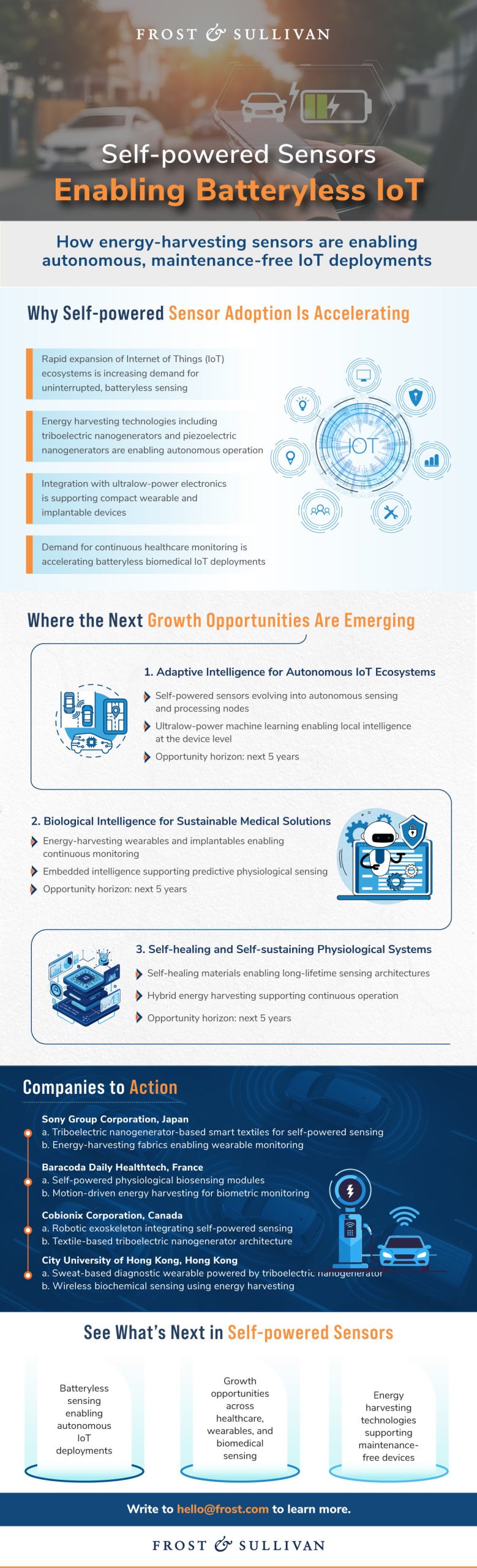
The rapid expansion of Internet of Things (IoT) ecosystems is increasing demand for uninterrupted sensing solutions that operate without conventional batteries. Self-powered sensors are emerging as a foundational technology for next generation, batteryless IoT deployments, particularly across biomedical and healthcare applications.
Energy-harvesting technologies including triboelectric nanogenerators and piezoelectric nanogenerators are converting ambient energy into usable electrical power. These capabilities are enabling autonomous sensing devices that operate continuously without battery replacement, supporting deployment in remote, miniaturized, and hard-to-access environments.
Self-powered Sensors Enabling Batteryless Internet of Things
Access:
- Strategic imperatives accelerating self-powered sensor adoption
- Energy harvesting technologies enabling batteryless IoT deployments
- Growth opportunities across healthcare, wearables, and autonomous sensing
Integration with ultralow-power electronics and wireless communication architectures is expanding adoption across wearable health monitoring, implantable medical devices, diagnostics, and distributed healthcare ecosystems. These sensing systems are supporting sustainable, maintenance-free, and resilient IoT deployments.
As batteryless sensing becomes viable, how will organizations scale autonomous IoT deployments?
Listen to the Growth Podcast: Self-powered Sensors and Batteryless Internet of Things
Strategic Imperatives Shaping Self-powered Sensors in IoT Devices
- Disruptive Technologies
- Eliminating dependence on finite batteries is enabling fully autonomous IoT sensing deployments
- Supporting operation in hard-to-reach, hazardous, and ultra-miniaturized environments
- Redefining sensor lifetime, form factor, and energy autonomy across IoT architectures
- Transformative Megatrends
- Climate resilience, precision healthcare, and sustainability mandates are increasing demand for continuous sensing
- Hyper-connectivity is requiring scalable deployment across billions of IoT nodes
- Circular economy and carbon-neutral goals are accelerating adoption of batteryless sensing solutions
- Industry Convergence
- Convergence of materials science and microelectronics is enabling energy-harvesting sensor architectures
- Integration with artificial intelligence (AI) and wireless communication is supporting autonomous IoT sensing networks
- Cross-disciplinary collaboration is creating new value chains across flexible electronics and biomedical systems
Which growth opportunities are emerging as batteryless sensing scales across IoT deployments?
Key Growth Drivers for Self-powered Sensors in IoT Devices
- Self-powered sensors are gaining momentum as healthcare demand, autonomous IoT deployments, and energy harvesting innovations accelerate batteryless sensing adoption. These drivers are shaping next-generation biomedical and distributed monitoring ecosystems.
- Continuous health monitoring demand: Rising chronic disease prevalence and preference for home-based monitoring are increasing adoption of self-powered vital sensors, sweat analyzers, implantable diagnostics, and motion-driven wearables
- Battery-free IoT deployments: Autonomous nodes across healthcare, smart homes, and industrial sensing are reducing battery replacement needs and lowering maintenance costs
- Energy harvesting advancements: Material innovation and hybrid harvesting architectures are improving power density, efficiency, and device miniaturization for biomedical and wearable applications
Are these drivers accelerating your batteryless IoT sensing strategy?
Challenges Influencing Self-powered Sensor Adoption
Despite strong momentum, power limitations, development complexity, and regulatory pathways are influencing deployment timelines across biomedical IoT applications.
- Limited power density: Triboelectric nanogenerators and piezoelectric nanogenerators face variability due to environmental fluctuations, restricting high-power applications
- Development complexity: Multidisciplinary requirements across materials science, electronics, and biocompatibility are increasing costs and slowing market entry
Clinical and regulatory timelines: Lengthy approval pathways for implants and wearable biomedical sensors are delaying commercialization
Which barriers are shaping your self-powered IoT sensor deployment roadmap?
|
Self-powered Sensors: Enabling Batteryless IoT
|
|
Companies to Action: Self-powered Sensor Innovation
- Sony Group Corporation, Japan — Energy-harvesting smart textiles using conductive–dielectric fiber laminates functioning as triboelectric nanogenerators for self-powered sensing and smart clothing applications
- Cobionix Corporation, Canada — Robotic exoskeleton with textile-integrated sensors and triboelectric nanogenerators enabling self-powered sensing and human–robot interaction
- Baracoda Daily Healthtech, France — Self-powered physiological biosensing module using triboelectric nanogenerator-based energy harvesting for motion and biometric monitoring
- City University of Hong Kong, Hong Kong — Sweat-based diagnostic wearable using triboelectric nanogenerator-driven sweat extraction and wireless biochemical monitoring
Which partnerships could accelerate your batteryless sensing roadmap?
Growth Opportunities in Self-powered Sensors for IoT Devices
- Adaptive Intelligence for Autonomous IoT Sensor Ecosystems
Self-powered sensors using triboelectric nanogenerators and piezoelectric nanogenerators are evolving into intelligent nodes capable of autonomous sensing and local processing. These architectures are enabling scalable, maintenance-free IoT deployments across industrial and healthcare environments.
- Key Actions for Vendors:
Developing interoperability frameworks for self-powered sensors
Prioritizing ultralow-power machine learning models
Building modular energy harvesting and sensing platforms
- Biological Intelligence for Sustainable Medical Solutions
Self-powered implantable and wearable devices are integrating nanoscale energy harvesting with embedded intelligence. These systems are supporting continuous physiological monitoring and predictive energy management for sustainable healthcare deployments.
- Key Actions for Vendors:
Developing soft-matter and biofluidic sensing architectures
Establishing pipelines for ultralow-power edge models
Partnering with clinicians for predictive monitoring solutions
- Longevity through Self-healing and Self-sustaining Physiological Systems
Self-powered sensors combined with self-healing materials and low-power intelligence are enabling long-lifetime physiological monitoring. These architectures are supporting autonomous repair, energy regulation, and sustained sensing performance.
- Key Actions for Vendors:
Accelerating hybrid energy harvester development
Scaling self-healing nanocomposites and stretchable electronics
Establishing certification frameworks for long-lifetime systems
Frequently Asked Questions (FAQs)
- What are self-powered sensors in IoT devices?
Self-powered sensors are batteryless IoT devices that generate electricity from ambient sources such as motion, heat, light, radio frequency, or pressure. These sensors operate autonomously without battery replacement and support continuous monitoring across healthcare, wearables, and distributed sensing environments.
- How do self-powered sensors enable batteryless IoT deployments?
Self-powered sensors use energy-harvesting technologies including triboelectric nanogenerators and piezoelectric nanogenerators to convert ambient energy into usable power. This enables always-on sensing, reduces maintenance requirements, and supports deployment in remote or hard-to-access environments.
- What are the key advantages of self-powered IoT sensors?
Self-powered sensors reduce maintenance costs, eliminate battery replacement, and support compact device designs. These capabilities enable scalable IoT deployments, continuous monitoring, and sustainable sensing across wearable, implantable, and infrastructure applications.
- What are the main applications of self-powered sensors?
Applications include wearable health monitoring, implantable medical devices, diagnostics, motion-driven wearables, and distributed healthcare ecosystems. These sensors are also expanding into smart environments and autonomous IoT sensing deployments.
Ready to Lead the Transformation?
- Book a Growth Strategy Session: Align your growth roadmap with Frost & Sullivan’s visionary Growth Pipeline™ Dialog.
- Engage with Growth Experts: Co-design AI-enabled, data-driven operating models that scale industry-specific and commercial impact.
- Share Your Transformation Story: Position your organization as a transformation leader through Frost & Sullivan’s Transformational Growth Leadership platform.
- Join the Growth Council: Collaborate with industry leaders shaping the future of your ecosystem.
- Nominate for the Best Practices Recognition: Be recognized for excellence in growth strategy, execution, and customer impact.
- Demonstrate Industry Positioning on the Frost Radar™: Benchmark your growth performance and innovation strength against industry competitors.
Activate Brand & Demand Growth: Accelerate awareness, engagement, and revenue growth through integrated brand and demand generation strategies.