This blog is based on a recent analysis, “Rear-seat Entertainment Market, United States, 2026–2032,” authored by Aaryan Vikram, Frost & Sullivan’s Mobility Growth Expert specializing in the connected vehicles domain.
The US rear-seat entertainment (RSE) industry is entering a period of rapid technological advancement and cross-industry convergence. Passengers are expecting the back seat to deliver the same digital richness they experience at home, like streaming, gaming, productivity, and personalized wellness, all available on demand.
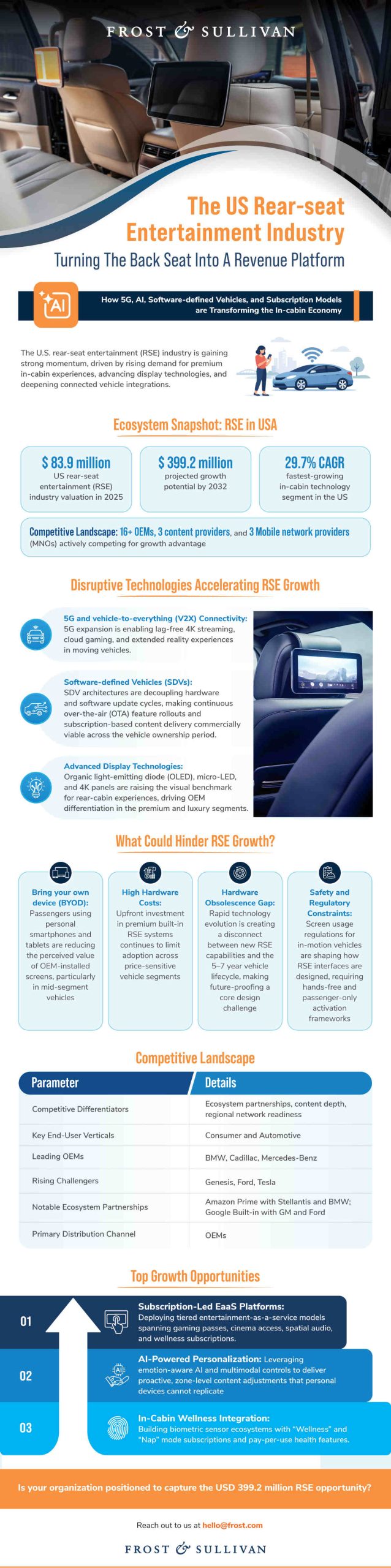
The US RSE industry, valued at USD 83.9 million in 2025, is advancing toward USD 399.2 million by 2032, expanding at a CAGR of 29.7%.
The merging of software-defined vehicle (SDV) infotainment architectures, 5G connected car infrastructure, and evolving passenger behavior is building an ecosystem inside the rear cabin that operates on an entirely different logic from the DVD-player era.
Megatrends Redefining In-cabin Digital Experiences
Four mega trends are shaping how OEMs, content providers, and mobile network operators (MNOs) are investing in RSE platforms for the US:
- Ubiquitous 5G and Edge Computing: 5G connected car networks and edge computing are enabling lag-free 4K and 8K streaming, cloud gaming, and extended reality (XR) experiences in moving vehicles. Vehicle-to-network (V2N) communication is ensuring reliable data exchange between vehicles and cloud servers, maintaining streaming quality as vehicles move between network coverage areas, making seamless high-bandwidth in-cabin entertainment a commercial reality for the first time.
- AI-powered In-cabin Personalization and Affective Computing: Emotion-aware in-vehicle infotainment systems are using AI and cabin cameras to detect when passengers are tired, stressed, or disengaged, then automatically adjusting lighting and content to improve their state. Multimodal interaction is enabling rear passengers to control apps, climate, and media through voice commands or gestures.
- Monetized Service Ecosystem and Ad-tech: OEMs are deploying features-on-demand (FoD) monthly subscriptions including gaming passes, cinema tiers, and premium spatial audio access, creating recurring income tied to how passengers use the cabin rather than what hardware was installed at the point of sale. In-cabin advertising platforms are emerging, serving location-aware promotions for nearby restaurants, activities, and services.
- Immersive Hardware and Digital Wellness: Organic light-emitting diode (OLED) and microLED displays are incorporating blue-light filtering and flicker-free technology to protect passenger eye health during extended journeys. Biometric-synced comfort systems, integrating seat sensors and wearables, are tracking heart rate and posture, suggesting digital detox breaks, guided breathing exercises, and stretching routines to reduce fatigue and motion sickness.
Are you identifying the right technology and content partnerships to capitalize on these megatrends?
Top Growth Opportunities
- AI-driven Personalization and Independent RSE Intelligence
The rear cabin is evolving into what passengers and industry leaders are increasingly framing as a “third living room” or a “mobile boardroom.” AI-powered profile recognition, voice and gesture controls, and digital ecosystem mirroring are enabling passengers to resume entertainment, manage work tools, and adjust settings seamlessly across home and vehicle environments without any manual reconfiguration. Moreover, SDV-based architectures, high-speed in-vehicle Wi-Fi, and cloud-ready connectivity are the critical technical enablers.
- Rear-seat Wellness and Productivity on Demand
In the premium sports utility vehicle (SUV) and luxury sedan segment of the US, rear-seat entertainment systems are evolving into integrated productivity and wellness platforms. Video conferencing, biometric seat sensors detecting tiredness and motion sickness, and subscription-based features including “Wellness” and “Nap” modes are creating high-margin, recurring service opportunities that go well beyond traditional content delivery. OEMs and technology partners developing non-invasive biometric monitoring, on-demand health integrations, and pay-per-use wellness programs are building distinct competitive advantages in the premium RSE domain.
Is your organization harnessing the wellness and personalization aspects of the RSE to create a competitive edge?
The rear seat is becoming the most valuable real estate in the Vehicle. OEMs committing now to AI integration, wellness platform development, and entertainment-as-a-service monetization models are building the recurring revenue pipelines and passenger loyalty that will define competitive leadership in the US RSE industry through 2032.
Frequently Asked Questions
1. What role do SDV architectures play in enabling next-generation RSE?
SDV architectures shift RSE capabilities from fixed, hardware-dependent systems to flexible, over-the-air (OTA) upgradeable platforms. This allows OEMs to continuously add new features, content partnerships, and monetization models — such as features-on-demand (FoD) gaming passes or wellness subscriptions.
2. What is the BYOD challenge for RSE systems?
The Bring Your Own Device (BYOD) trend involves passengers using personal smartphones and tablets instead of OEM-installed screens, reducing the perceived value of built-in RSE systems — particularly in mid-segment vehicles where embedded systems do not clearly outperform personal devices.
3. What is entertainment-as-a-service (EaaS) in the automotive context?
EaaS refers to subscription and pay-per-use models where passengers pay monthly or per trip for access to premium RSE content, including streaming, cloud gaming, spatial audio, and wellness features, generating recurring OEM revenue beyond the initial vehicle sale.
4. How is wellness integration reshaping rear-seat entertainment?
Rear-seat systems are incorporating biometric sensors, seat-integrated wearables, and AI-driven adaptive environments that monitor passenger heart rate and posture, and offer features like “Nap” and “Wellness” modes to reduce fatigue and motion sickness during travel.
5. Who are the leading OEMs in the US rear-seat entertainment industry?
BMW, Cadillac, and Mercedes-Benz are leading the US RSE competitive landscape in 2025, supported by notable ecosystem partnerships including Amazon Prime integrations with Stellantis and BMW, and Google Built-in deployments with GM and Ford.
Ready to Lead the Transformation?
- Schedule a Growth Strategy Dialog: Align your growth roadmap with Frost & Sullivan’s Visionary Growth Pipeline™ Dialog.
- Engage with Growth Experts: Co-design AI-enabled, data-driven operating models that scale industry-specific and commercial impact.
- Showcase Your Transformational Leadership: Position your organization as a transformation leader through Frost & Sullivan’s Transformational Growth Leadership platform.
- Join the Growth Council: Collaborate with industry leaders shaping the future of your ecosystem.
- Explore Best Practices Recognition: Be recognized for excellence in growth strategy, execution, and customer impact.
- Benchmark Your Industry Positioning on the Frost Radar™: Benchmark your growth performance and innovation strength against industry competitors.
- Tell Your Story: Accelerate awareness, engagement, and revenue growth through integrated brand and demand generation strategies.