This blog is based on the analyses titled, The CPaaS Revolution: APIs, AI, and a New Era of Communication and Frost Radar™: Communications Platform-as-a-Service, authored by Frost & Sullivan’s growth expert, Krishna Baidya from the Unified Communications team.
Not long ago, business communication systems behaved like closed boxes—useful but disconnected from the rest of the operation. But today, enterprises want something smarter. They want to automate workflows, boost productivity, and personalize interactions. This need is pushing providers to turn communications from a reactive function into a proactive one that facilitates digital transformation and customer experience (CX). Enter Communications Platform-as-a-Service (CPaaS), a flexible toolkit that helps businesses weave messaging, voice, video etc. into existing business processes, bringing dynamic engagement to every touchpoint.
Revealed: 2025’s Top 20 CPaaS Vendors
Don’t wait for the next wave of CPaaS to pass you by — get an insider’s view and start planning your programable communications strategy today.
What’s In It for You?
- Growth Opportunities and Best Practices to implement beyond 2025.
- Technology Strategies of 23 leading CPaaS vendors.
Further, the provider ecosystem itself is undergoing a transformation. What started as a scattered environment of basic messaging application programing interfaces (APIs) has matured into a rich ecosystem of intelligent platforms. Vendors are expanding well beyond messaging, adding AI-integration, customer data management, workflow orchestration, and verticalized solutions into their portfolios.
Strategic Imperatives Accelerating the CPaaS Revolution
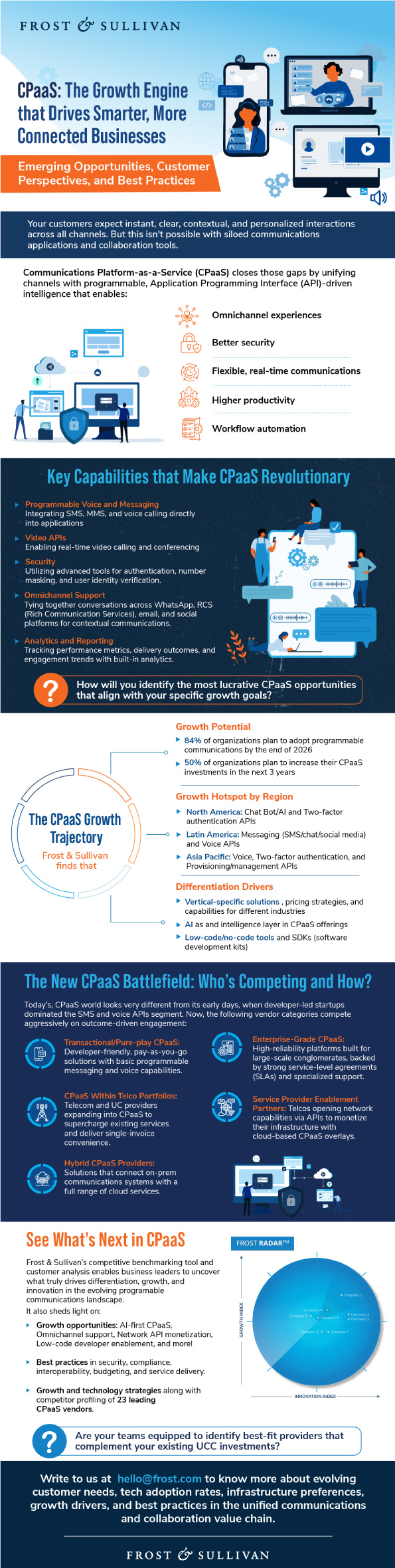
Today, the CPaaS world looks very different from its early days, when developer-led startups dominated the SMS and voice APIs segment. In 2025, the landscape has broken free of its early SMS-and-voice roots, expanding into a multidimensional battleground where Unified Communications and Collaboration (UCC) vendors, AI developers, and telcos come together. The result? A convergence where these forces necessitate ecosystemic change:
- Innovative Business Models: Buyers are done paying for “just APIs” and transactional services. Instead, they seek quantifiable results—lower costs, higher retention rates, network monetization, and faster value. This is bringing to light AI-powered orchestration that pulls isolated data together for greater impact on operations.
- Compression of Value Chains: The ability to innovate isn’t locked within the provider ecosystem anymore. Developer-friendly tools and no-code platforms are empowering marketing, CX, and operations teams to design and deploy communication workflows themselves.
- Disruptive Technologies: Generative AI (GenAI) and Agentic AI are no longer just nice-to-have. Providers are being pushed to infuse these into messaging, voice, and engagement layers so that businesses can make real-time decisions, automate conversations, and hyper-personalize experiences (for customers and employees).
- Transformative Megatrends: The proliferation of programmable communications means that security, compliance, and trust matter more than ever before. As a result, providers are working to embed secure routing, number masking, identity verification, and fraud controls directly into their platforms.
- Industry Convergence: The walls between CPaaS, Contact Center-as-a-Service (CCaaS), and Unified Communications-as-a-Service (UCaaS) are coming down. This encourages providers to adopt more modular, composable architectures that unify customer interaction, marketing automation, and workforce collaboration into a single solution.
The question is – Which providers, solutions, and tools will help you bring home the advantages of best-in-class CPaaS?
CPaaS for Boosting Customer Engagement- All You Need to Know
Best Practices that Can Guarantee Growth
Certain strategies naturally emerge as differentiators as more and more enterprises embed CPaaS deeper into their workflows. These best practices help optimize platform reliability, scalability, and customer confidence:
- AI built into every layer: Integrating automated threat detection, conversational AI, predictive analytics, workflow automation, and adaptive security into core services. Also leveraging AI to extend APIs beyond transactional tasks into innovative functions for journey orchestration.
- Demonstrating proof-of-value: Creating dynamic dashboards and metrics for performance analytics and ROI tracking that show quantifiable CX results. Further, using robust frameworks for compliance, dependability, and service-quality assurance that support CPaaS adoption will also reduce risks.
- Maximizing trust and security: Incorporating identity validation, traffic monitoring, consent controls, and advanced fraud analytics into core services to combat data security, spam, and fraud related threats. Supporting this with clear data practices and guardrails will boost compliance and build enterprise trust.
Are your CPaaS tools ready to deliver intelligence, reliability, and trust at scale?
CPaaS Growth Opportunities You Can’t Afford to Miss
Looking ahead, beyond best practices, these growth opportunities will help providers develop flexible tools that give rise to richer, more connected customer experiences.
- AI-first Innovation: Moving beyond call transcription by developing vertical-specific CPaaS offerings, AI-ready building blocks, and workflow templates for enterprises. This means focusing on automated campaign management, sentiment analytics, dynamic content personalization, contextual analytics, AI-ready fraud detection and mitigation, and ethical AI.
- Omnichannel, Rich Messaging: Facilitating alignment and orchestration across WhatsApp, Apple Messages, RCS, OTT messaging, SMS, voice, video, and email through strategic partnerships and co-development initiatives with tomorrow’s device makers, telcos, and OTT platforms.
- Monetizing Network APIs: Collaborating with carriers and mobile network operators to package their network APIs along with customized communications solutions/bundles for sectors like banking, financial services, logistics, and media. This will support applications like instant fraud alerts, smart asset tracking, and network optimization.
- Developer Enablement with Low-code Tools: Creating user-friendly low-code/no-code options, including drag-and-drop connectors, visual workflow builders, and pre-built templates that plug directly into Customer Relationship Management (CRM), Enterprise Resource Planning (ERP), CCaaS, and UCaaS systems. This will open up new opportunities for providers in mid-market enterprises and regulated sectors.
- In-built Security and Compliance: Expanding past traditional security measures like encryption and multi-factor authentication by investing in advanced capabilities such as AI-powered fraud detection, digital identity tools, SIM swap detection, call-risk scoring, silent mobile verification, and customizable compliance modules.
How will you calculate the ROI potential of these growth opportunities to select the right ones for your organization?
Cracking the CPaaS Equation with Frost & Sullivan
In conclusion, as CPaaS becomes central to digital engagement, winners won’t be just those with the most features, but those who tie these features and channels together for competitive advantage. Valuable CPaaS solutions let both technical and non-technical teams create sophisticated communications workflows without deep coding expertise, empowering organizations to move faster than customer expectations. Frost & Sullivan is fully equipped to help your teams thrive through this transformation — Are you ready to get started?
Get in touch with our Unified Communications and Collaboration experts to unlock customized growth opportunities, best practices, and CPaaS tools for your organization’s 2030 growth goals.
Alternatively, you can also write to us at [email protected].