This blog is based on Frost & Sullivan’s recent analysis, “Biometric Solutions Market, Global, 2024–2030, authored by Tara Semon from the Security Practice Area.
More than 80% of data breaches involve compromised credentials, highlighting the growing limitations of traditional authentication methods such as passwords and access tokens. As cyber threats become more sophisticated and digital ecosystems expand, enterprise leaders are encountering challenges in strengthening identity verification while maintaining seamless and secure user experiences.
Where are the next growth opportunities emerging in biometric identity solutions?
Download the full analysis to stay ahead of the transformation.
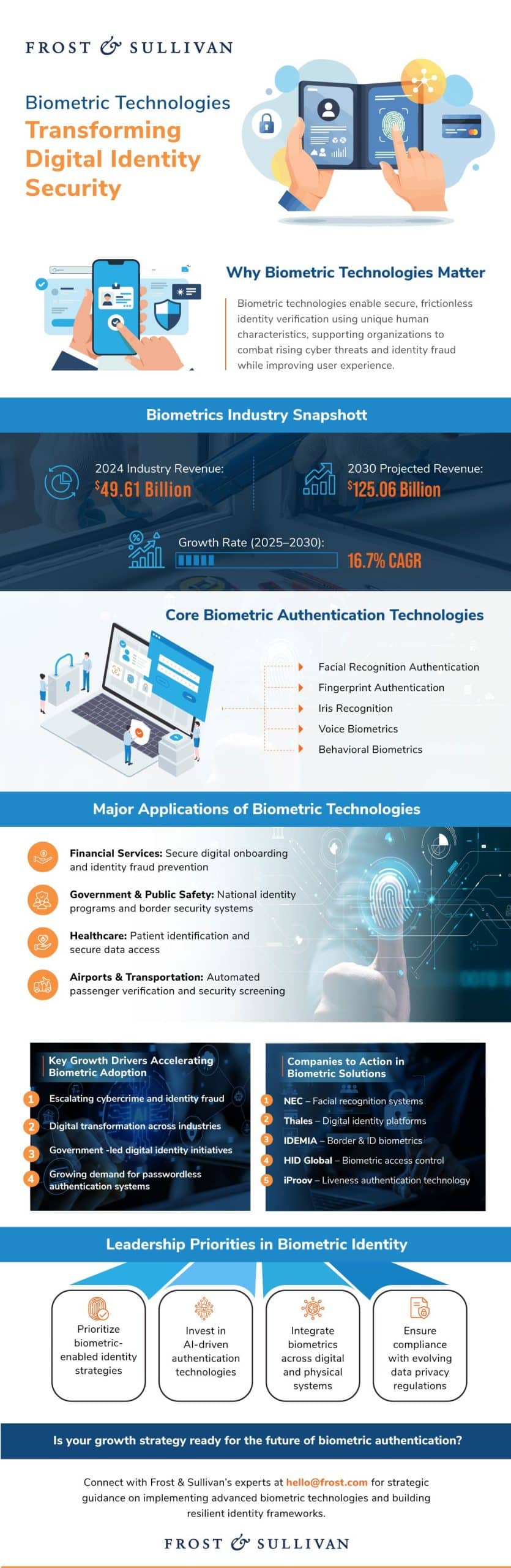
Biometric technologies are emerging as a strategic response to this challenge. Global biometric solutions revenue is projected to grow from $49.6 billion in 2024 to $125.1 billion by 2030, reflecting accelerating adoption across industries seeking more reliable identity verification. Organizations that are integrating biometric authentication into their identity strategies are better positioned to enhance security, improve operational efficiency, and create new growth opportunities in the evolving digital identity landscape.
What strategic priorities will shape the next phase of biometric innovation?
Listen to Our Growth Podcast Episode on the Future of Biometric Authentication
Why Biometric Solutions Matter in the AI-driven Identity Era
Biometric authentication verifies identity using unique physiological or behavioral characteristics such as facial features, fingerprints, iris patterns, voice recognition, and behavioral interactions. As cyber threats and AI-enabled fraud become more sophisticated, organizations are turning to biometrics to strengthen identity verification.
Unlike passwords or physical credentials, which can be forgotten, stolen, or duplicated, biometric identifiers are inherently linked to individuals, enabling stronger and more reliable authentication. As a result, biometric authentication technologies are becoming essential across industries including banking and financial services, government and public safety, healthcare, airports and border control, and retail.
Facial recognition and fingerprint technologies currently dominate adoption due to their integration with smartphones and enterprise systems. Meanwhile, multimodal and behavioral biometrics are emerging as advanced solutions that enable continuous and more secure identity verification in increasingly digital environments.
Strategic Imperatives Reshaping Biometric Solutions
Transformative Megatrends
Rapid digitalization across industries is expanding the need for trusted digital identities. Organizations are integrating biometric authentication into platforms that support secure remote access, digital transactions, and online services.
Geopolitical Chaos
Increasing cybersecurity threats, cross-border fraud, and regulatory mandates are driving organizations to adopt stronger authentication frameworks that can withstand evolving threats.
Disruptive Technologies
Advancements in AI, machine learning, and sensor technologies are improving the accuracy and reliability of biometric authentication while enabling new identity verification models.
Download the Full Analysis to Explore Strategies Shaping Biometric Authentication
Emerging Technologies Transforming Biometric Identity Verification
- AI-powered Liveness Detection: Advanced AI algorithms help detect spoofing attempts using photos, videos, or deepfakes, strengthening authentication reliability.
- Multimodal Biometric Authentication: Combining multiple biometric identifiers, such as facial recognition, voice recognition, and fingerprint scanning, enhances security and reduces authentication errors.
- Behavioral Biometrics: Continuous identity verification based on user behavior patterns enables organizations to detect suspicious activity without disrupting user experience.
- Quantum-ready Security Frameworks: Emerging quantum-safe encryption technologies protect biometric data against future cybersecurity threats.
Key Growth Drivers in the Biometric Solutions Ecosystem
- Escalating Cybersecurity Risks: The growing sophistication of cybercrime, including account takeovers, deepfakes, and synthetic identities, is driving demand for more advanced authentication solutions.
- Expansion of Digital Identity Programs: Governments and financial institutions are investing in biometric-enabled digital identity systems to improve service delivery and strengthen identity verification.
- Rapid Growth of Mobile and Cloud Platforms: Mobile devices equipped with biometric sensors are becoming central to passwordless authentication, enabling secure access to applications and digital services.
- Increasing Focus on User Experience: Organizations are prioritizing authentication systems that enhance convenience while maintaining high security standards.
What strategies will define leadership in the evolving biometric ecosystem?
Access the full analysis to understand where the next opportunities lie.
Challenges and Barriers to Biometric Adoption
Despite growing adoption, several factors continue to influence biometric implementation. Data privacy and security concerns remain a key challenge, as biometric identifiers are unique and permanent. Organizations must comply with regulations such as the General Data Protection Regulation (GDPR) and the Health Insurance Portability and Accountability Act (HIPAA), which govern the collection, storage, and use of sensitive biometric data.
Implementation costs and integration complexity also pose barriers. Deploying biometric systems often requires specialized hardware, software integration, and ongoing support, while integrating these technologies with legacy Information Technology (IT) infrastructure can require significant upgrades.
Growth Opportunities Redefining the Biometric Ecosystem
- AI-Driven Identity Analytics: Advanced analytics platforms are enabling biometric systems to deliver deeper insights into user behavior and security risks.
- Contactless Authentication Technologies: Touchless biometric solutions such as facial recognition are gaining traction in sectors requiring high-speed identity verification.
- Continuous Authentication Models: Behavioral biometrics and AI-enabled monitoring systems are supporting persistent identity verification across digital platforms.
Competitive Environment in Biometric Solutions
The biometric solutions industry is highly fragmented, with more than 250 vendors globally competing across digital and physical identity applications. Competition is largely driven by authentication accuracy, innovation capabilities, system reliability, and cost efficiency. Vendors are differentiating through technologies such as AI-enabled facial recognition, multimodal authentication, liveness detection, and behavioral biometrics.
Leading Companies Shaping the Industry Include:
- NEC – Advancing large-scale facial recognition and government identity solutions
- Thales – Delivering integrated digital identity and security platforms
- IDEMIA – Providing biometric solutions for border control, payments, and public safety
- HID Global – Expanding biometric-enabled access control and identity management
How can organizations unlock new opportunities in the biometric identity ecosystem?
Access Frost & Sullivan’s analysis to navigate the evolving biometric solutions landscape.
The Future of Biometric Identity Security
Despite these challenges, the long-term growth outlook for biometric authentication methods remains extremely strong. As digital transformation continues and cybersecurity threats evolve, biometrics are being viewed as an essential component of next-generation identity management.
Several emerging developments are expected to shape the future of the industry:
- AI-enhanced authentication systems capable of real-time fraud detection
- Contactless biometric technologies that support seamless user experiences
- Integration with Internet of Things (IoT) ecosystems to enable secure access across connected devices
- Quantum-safe encryption frameworks designed to protect biometric data from future cyber threats
These innovations will further strengthen the role of biometrics in digital identity ecosystems.
Frequently Asked Questions
- What is biometric authentication?
Biometric authentication is a security process that verifies an individual’s identity using unique physiological or behavioral characteristics such as fingerprints, facial features, iris patterns, voice recognition, or typing behavior. - What is the purpose of biometrics?
The primary purpose of biometrics is to provide secure and reliable identity verification. By using characteristics unique to each individual, biometrics help prevent unauthorized access, reduce fraud, and enable seamless authentication across digital and physical systems. - How can I enable fingerprint biometric authentication?
Biometric fingerprint authentication can be enabled by registering a user’s fingerprint through a biometric sensor integrated into a device or system. Once the fingerprint is stored securely, the system compares future fingerprint scans with the registered template to verify the user’s identity. - What is the difference between biometric authentication and biometric identification?
Biometric authentication confirms whether a person is who they claim to be by comparing their biometric data to a stored template (one-to-one verification). Biometric identification, on the other hand, determines a person’s identity by comparing their biometric data against a database of multiple records (one-to-many matching). - Which is the most widely recognized mode of biometric identification?
Fingerprint recognition is one of the most widely recognized and commonly used biometric identification methods due to its reliability, ease of use, and integration into devices such as smartphones, access control systems, and identity verification platforms.
Ready to Lead the Transformation?
- Book a Growth Strategy Session: Align your growth roadmap with Frost & Sullivan’s visionary Growth Pipeline™ Dialog.
- Engage with Growth Experts: Co-design AI-enabled, data-driven operating models that scale industry-specific and commercial impact.
- Share Your Transformation Story: Position your organization as a transformation leader through Frost & Sullivan’s Transformational Growth Leadership platform.
- Join the Growth Council: Collaborate with industry leaders shaping the future of your ecosystem.
- Nominate for the Best Practices Recognition: Be recognized for excellence in growth strategy, execution, and customer impact.
- Demonstrate Industry Positioning on the Frost Radar™: Benchmark your growth performance and innovation strength against industry competitors.
- Activate Brand & Demand Growth: Accelerate awareness, engagement, and revenue growth through integrated brand and demand generation strategies.