This blog is based on our analysis – Top 10 Growth Opportunities in Power and Distributed Energy, 2025 and Top 10 Growth Opportunities for Energy Storage, 2025 authored by Frost & Sullivan’s Growth Expert, Jonathan Robinson and Lucrecia Gomez, from the Energy team.
Why Today’s Power Systems Are Reaching a Breaking Point
Today, power systems are under mounting strain as electrification, modular data centers, and the rollout of clean energy are driving the demand for electricity. At the same time, growing shares of variable renewables are stretching grid operations and challenging traditional planning models. These structural pressures make flexible energy systems, grid-enhancement technologies, and battery storage solutions essential for maintaining reliability and capturing new revenue opportunities.
Looking ahead, energy providers face growing pressure to manage congestion and maintain resilience amid periods of volatility. This blog explores how targeted investments, strategic partnerships, and innovations can deliver measurable impact in 2026 and beyond.
Explore how transformative megatrend, innovative business models, and disruptive technologies are reshaping the Power & Energy sector.
Is your organization ready with the right tools and technologies to lead the energy transition?
Power Generation & Distribution in 2026: What Leaders Need to Know – Tune In 🎧
Transforming the Energy Landscape: Opportunities at Glance
Companies to Action Leading the Energy Transition
These innovators are shaping the energy future, with strategies that others can emulate:
- Amazon: Holding the largest contracted renewable capacity globally, reaching 34 GW through power purchase agreements (PPAs).
- Sonnen: Delivering virtual power plant (VPP) solutions to residential customers while leading energy storage in Europe.
- Tesla: Leveraging advanced software with its energy hardware, using the Autobidder platform to autonomously monetize batteries across energy markets.
Is your team leveraging the right partnerships and collaborations to convert emerging megatrends into competitive advantages?
Where to Invest: Growth Opportunities in the Power & Energy Ecosystem
With energy systems transforming rapidly, companies must prioritize the investments and strategies that will maximize returns. The following areas highlight key opportunities:
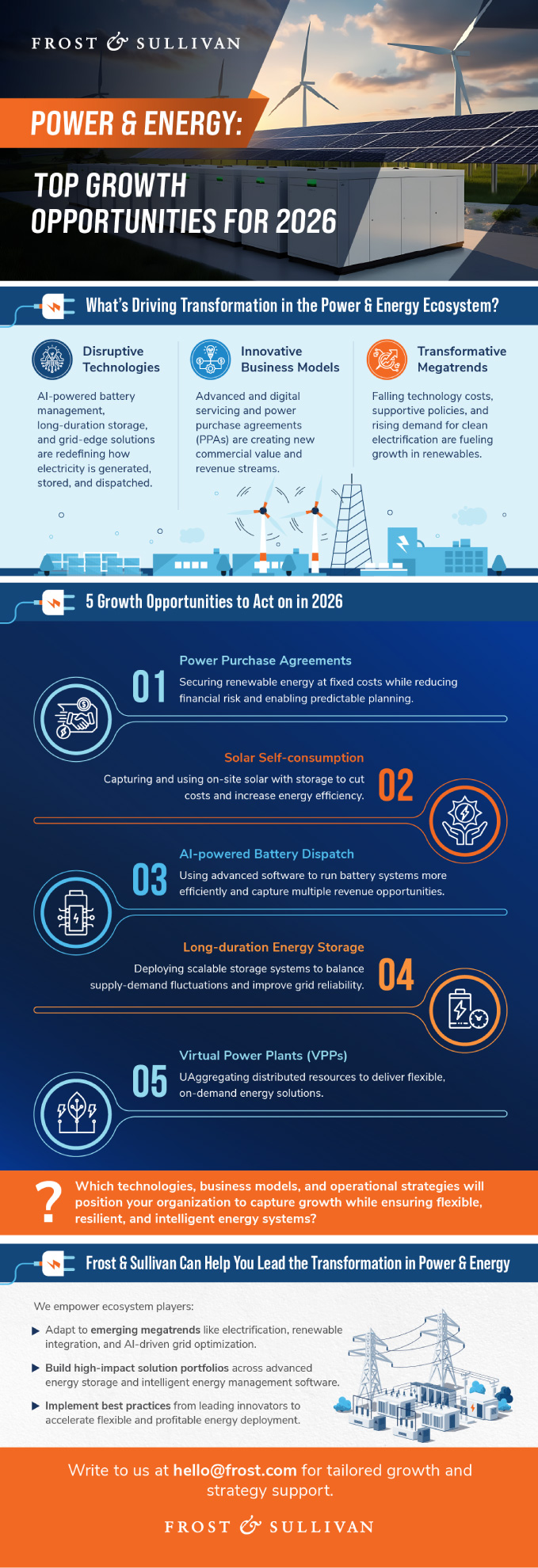
- Rise of PPAs—Alternative Financing Options
PPAs are emerging as a critical tool for companies to access renewable energy while combating financial and reputational risk. By agreeing to purchase a set amount of electricity at a predetermined price over a defined period, organizations can secure clean energy supply and help developers obtain the funding needed for large-scale renewable projects. Already, technology leaders have contracted 100 GW of renewable capacity through PPAs, driven by the need to power energy-intensive data centers and meet ambitious clean energy commitments.
Why PPAs?
- Corporate pressure to cut emissions is fueling strong demand for renewable energy.
- PPAs provide financial stability that enables developers to fund large-scale renewable projects.
- Risk mitigation benefits that help companies avoid penalties and reputational damage.
- Rapid growth of data centers in Asia-Pacific is creating demand for clean energy contracts.
- Growing adoption of PPAs unlocks new revenue areas for developers and service providers in underpenetrated regions.
- Solar Self-consumption on the Rise
Higher electricity prices, lower returns from selling power to the grid, and supportive incentives are driving strong adoption of residential solar photovoltaic (PV) systems paired with BESS. In countries like Germany and California, the percentage of new residential PV projects with storage has surged in recent years, reflecting households’ desire to store and consume more energy. Commercial and industrial uptake is growing as well, supported by advancements in distributed energy resource management systems (DERMS), VPPs, and value-stacking strategies that make self-consumption increasingly attractive.
Why Solar Self-consumption?
- Solar PV paired with BESS can be offered as a bundled solution.
- Growing retrofit opportunities in Australia, Germany, and Japan expand potential.
- Rising competition is pushing providers to deliver innovative solutions and services.
- Hybrid inverters that manage both PV and BESS maximize system efficiency.
- Inverters serve as the gateway for households and businesses to fully leverage solar-plus-storage systems.
- AI-powered Software to Optimize Battery Dispatch
As battery energy storage systems (BESS) adoption grows, integrators and asset owners are using AI-powered software to optimize battery dispatch and improve margins. Software and services also create recurring revenue and open cross-selling opportunities, while helping providers stand out amid margin pressures and rising competition from vertically integrated cell manufacturers. Advanced AI and machine learning (ML) platforms are now essential for both behind-the-meter (BTM) and front-of-the-meter (FTM) batteries, allowing operators to manage multiple revenue streams as electricity markets become more complex.
What’s Driving Growth?
- Energy trading know-how is encouraging integrators, vendors, and large asset owners to adopt AI/ML software.
- AI and ML improve forecasting and optimization, enhancing battery performance.
- SaaS and asset management models give operators and integrators flexible options.
- Growing BESS deployments and changing regulations are creating new software opportunities.
- Better forecasts, higher automation, and integrated platforms help companies expand share and stay competitive.
Are you implementing the right best practices to capitalize on these emerging growth opportunities?
Next Steps on Your Power & Energy Growth Journey
In 2026, the power and energy ecosystem will increasingly rely on flexible energy systems, advanced battery storage, and AI-driven digital intelligence to meet rising energy demand and decarbonization goals. As companies navigate grid constraints, volatile demand, and evolving regulations, acting on these growth opportunities will be critical to unlocking new revenue streams and maintaining a competitive edge.
What bold steps will you take today to capture growth in the rapidly evolving energy ecosystem?
Frequently Asked Questions (FAQs)
What is distributed energy?
Distributed energy refers to electricity generated, stored, or managed close to where it is used, rather than at large central power plants. It includes rooftop solar, batteries, electric vehicles, and flexible loads that improve grid efficiency and resilience.
Why is battery energy storage critical to the energy transition?
Battery energy storage is critical to the energy transition because it stores excess renewable electricity and delivers it when demand is high. This improves grid reliability, reduces congestion, and enables greater use of solar and wind power.
What are virtual power plants (VPPs) and how do they work?
Virtual power plants are software-driven systems that aggregate distributed energy resources such as solar panels, batteries, and electric vehicles. They coordinate these assets in real time to balance supply and demand and provide grid services.
How is AI used in battery energy storage systems?
AI is used in battery energy storage systems to optimize charging and discharging decisions. It analyzes market prices, weather forecasts, and grid conditions to maximize revenue, improve performance, and extend battery life.
Ready to Lead the Transformation?
- Book a Growth Strategy Session: Align your growth roadmap with Frost & Sullivan’s visionary Growth Pipeline™ Dialog.
- Engage with Growth Experts: Co-design AI-enabled, data-driven operating models that scale industry-specific and commercial impact.
- Share Your Transformation Story: Position your organization as a transformation leader through Frost & Sullivan’s Transformational Growth Leadership platform.
- Join the Growth Council: Collaborate with industry leaders shaping the future of your ecosystem.
- Nominate for the Best Practices Recognition: Be recognized for excellence in growth strategy, execution, and customer impact.
- Demonstrate Industry Positioning on the Frost Radar™: Benchmark your growth performance and innovation strength against industry competitors.
- Activate Brand & Demand Growth: Accelerate awareness, engagement, and revenue growth through integrated brand and demand generation strategies.