This blog is based on the analysis Trend Opportunity Profiles—Alternative Funding Mechanisms Driving the Start-Up Economy, authored by Frost & Sullivan’s growth expert, Sukriti Mahna and Bhavesh Prasad from the TechVision – Megatrend team.
A Structural Shift in Capital Formation
Capital formation is undergoing a fundamental transformation. Traditional pathways built around bank lending, venture capital, and collateral-heavy financing are no longer sufficient for the pace, scale, and diversity of today’s start-up economy. Digital-first businesses, asset-light models, and globally distributed teams are pushing funding systems to evolve.
Alternative funding mechanisms are emerging as a response to this shift. Models such as revenue-based funding, crowdlending platforms, metaverse financing, robo-advisory–enabled capital allocation, and decentralized exchanges are redefining how capital is accessed, deployed, and scaled. Enabled by platform economics, blockchain infrastructure, and data-driven risk models, these mechanisms are redefining how capital is accessed, deployed, and scaled. What was once peripheral is becoming central to start-up growth strategies across industries.
Alternative funding mechanisms are rapidly moving from niche adoption to strategic necessity, enabling start-ups and growth-stage firms to scale faster, preserve ownership, and access global liquidity.
What’s In It for You?
- Strategic insights into emerging funding models beyond venture capital and bank lending
- Growth opportunities across revenue-based financing, metaverse financing, and decentralized exchanges
- Best practices to navigate regulation, risk, and scalability in decentralized funding ecosystems
[Access the full Trend Opportunity Profile on Alternative Funding Mechanisms]
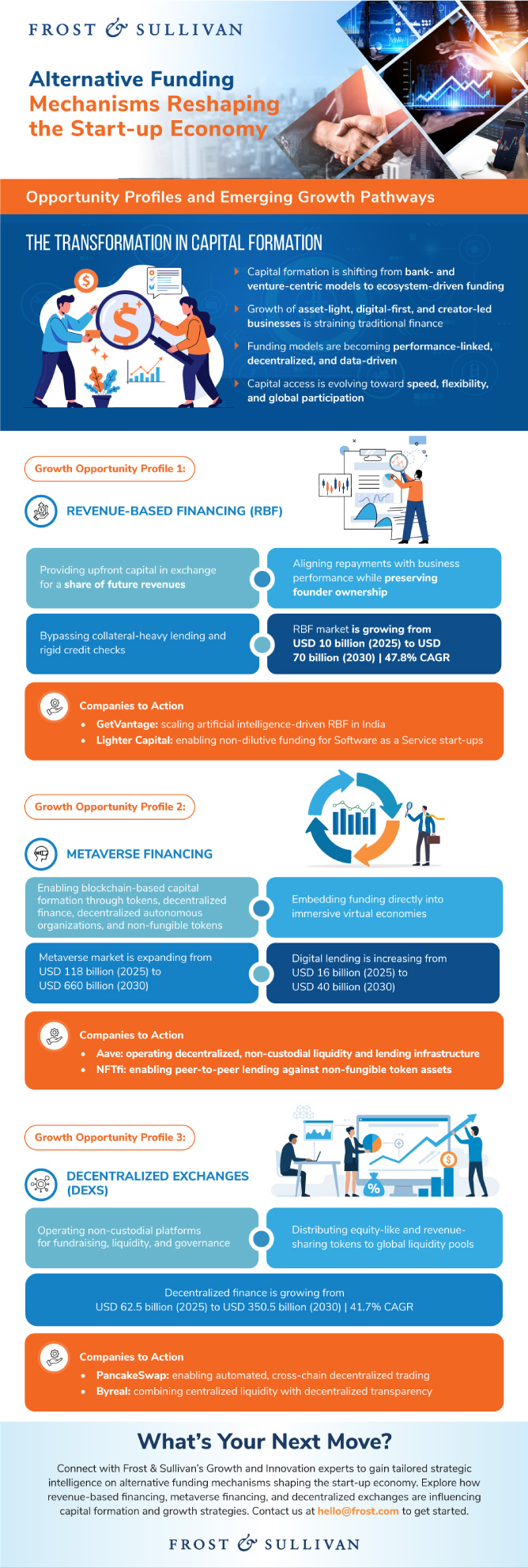
Strategic Imperatives Reshaping the Start-up Funding Landscape
- Disruptive Technologies Redefining Capital Access: Application programming interfaces, artificial intelligence-driven underwriting, and decentralized finance (DeFi) architectures are streamlining funding processes, accelerating access to capital, and enabling data-led risk assessment across early-stage and underserved start-ups.
- Industry Convergence Reshaping Funding Ecosystems: The convergence of financial services, digital platforms, and embedded finance is expanding funding beyond traditional intermediaries, integrating capital directly into operational and commercial workflows.
- Transformative Megatrends Redefining Competitive Dynamics: Digital democratization, evolving regulation, and geopolitical uncertainty are intensifying competition in start-up financing, pushing institutions to balance innovation with compliance through adaptive risk and monitoring frameworks.
| Key Industry Statistics Signalling Momentum
Market signals clearly indicate that alternative funding mechanisms are moving into the mainstream.
These trajectories highlight a sustained shift toward decentralized, programmable, and performance-linked funding models. |
Growth Drivers Accelerating Adoption
Several forces are pushing alternative funding mechanisms forward. Demand for non-dilutive capital is rising as founders seek to preserve ownership. Digital platforms are reducing friction in underwriting, onboarding, and capital deployment. Artificial intelligence-driven risk models are enabling lenders to serve smaller and higher-risk businesses more efficiently.
At the ecosystem level, global participation and 24/7 accessibility are expanding the investor base beyond traditional geographic and institutional boundaries.
[Explore the Trend Opportunity Profile on Alternative Funding Mechanisms]
Companies to Action
Organizations translating these models into scalable impact include:
- GetVantage, applying artificial intelligence-driven underwriting to deliver RBF aligned with revenue performance.
- Lighter Capital, offering non-dilutive funding tailored to Software as a Service business.
- Aave, providing decentralized liquidity and lending infrastructure for on-chain finance.
- NFTfi, enabling peer-to-peer lending backed by non-fungible token assets.
- PancakeSwap and Byreal, advancing decentralized and hybrid exchange models for global liquidity access.
Growth Opportunity: DeFi-enabled Working Capital in Metaverse Ecosystems
As metaverse economies scale, creators are increasingly operating as micro-enterprises, managing virtual land, tokenized intellectual property, and recurring in-world revenue streams across immersive platforms. The metaverse market is projected to grow from approximately USD 118 billion in 2025 to nearly USD 660 billion by 2030, creating sustained demand for liquidity solutions that can match the always-on nature of virtual economies. DeFi-powered working capital directly addresses this gap by allowing creators to unlock capital against future earnings, tokenized assets, and transaction flows embedded within metaverse environments.
Adoption is gaining traction across North America, Western Europe, and Asia-Pacific, where mature decentralized finance ecosystems, strong creator economies, and regulatory sandboxes are accelerating experimentation. By embedding lending, revenue sharing, and automated payouts into smart contracts, DeFi-powered models enable continuous, programmable cash-flow management without reliance on centralized platforms or traditional financial institutions. This shift moves creator monetization away from one-time digital asset sales toward sustainable, finance-enabled ecosystems where capital access, governance, and incentives are aligned in real time.
Navigating the Future of Alternative Funding
As alternative funding mechanisms reshape start-up growth, advantage will come from integrating these models into capital, risk, and operating strategies. Organizations that align funding innovation with performance, governance, and ecosystem participation will scale more effectively. Frost & Sullivan is ready to support this transition — are you prepared to lead the next phase of capital transformation?
Ready to Lead the Transformation?
- Book a Growth Strategy Session: Align your growth roadmap with Frost & Sullivan’s visionary Growth Pipeline™ Dialog.
- Engage with Growth Experts: Co-design AI-enabled, data-driven operating models that scale industry-specific and commercial impact.
- Share Your Transformation Story: Position your organization as a transformation leader through Frost & Sullivan’s Transformational Growth Leadership platform.
- Join the Growth Council: Collaborate with industry leaders shaping the future of your ecosystem.
- Nominate for the Best Practices Recognition: Be recognized for excellence in growth strategy, execution, and customer impact.
- Demonstrate Industry Positioning on the Frost Radar™: Benchmark your growth performance and innovation strength against industry competitors.
- Activate Brand & Demand Growth: Accelerate awareness, engagement, and revenue growth through integrated brand and demand generation strategies.