This blog is based on the recent Frost & Sullivan analysis, “Global Pharmacovigilance and Safety Testing Outsourcing Services Market, forecast to 2030,” authored by Aarti Siddhesh Chitale, Industry Analyst, Healthcare & Life Sciences Practice.
Pharmacovigilance (PV) and safety testing cover the end-to-end processes that monitor, assess, and prevent adverse drug reactions, including data capture, reporting, regulatory compliance, and risk management.
Today, pharmaceutical companies and clinical research organizations (CROs) face growing operational pressure. Rising volumes of adverse event (AE) reports, fragmented datasets from multiple sources, and increasingly complex regulatory requirements are stretching internal PV capabilities. At the same time, patient-centric safety expectations continue to rise.
Explore how technology, data, and partnerships are transforming pharmacovigilance in Frost & Sullivan’s latest podcast.
With pharmacovigilance operations evolving so rapidly, is your organization equipped with the right tool and technologies to stay compliant and future-ready?
What’s Driving Transformation in Pharmacovigilance and Safety Testing?
Industry Convergence
- AI, machine learning, and cloud solutions are transforming PV and safety testing. Multi-omics databases, especially in pharmacogenomics, are increasingly applied to support personalized therapies.
- This shift fosters partnerships between CROs, pharma companies, tech vendors, and diagnostics players to build AI-powered PV platforms and advanced multi-omics capabilities.
Competitive Intensity
- CROs have traditionally managed end-to-end drug development, but pure-play PV vendors are now capturing a significant share of the market, around 30–35%.
- Meanwhile, technology and eClinical solution providers are expanding their PV landscape with tech-enabled platforms.
Transformative Megatrends
- The global R&D pipeline is increasingly focused on novel biologics, driving the shift toward personalized therapies.
- This megatrend is fueling “precision pharmacovigilance,” where CROs and PV vendors design tailor-made solutions for adverse event monitoring and drug safety assessment, making PV more patient-focused and proactive than ever.
So, which growth processes and strategies will help your teams adapt to these industry headwinds?
The Future of Drug Safety Monitoring at a Glance
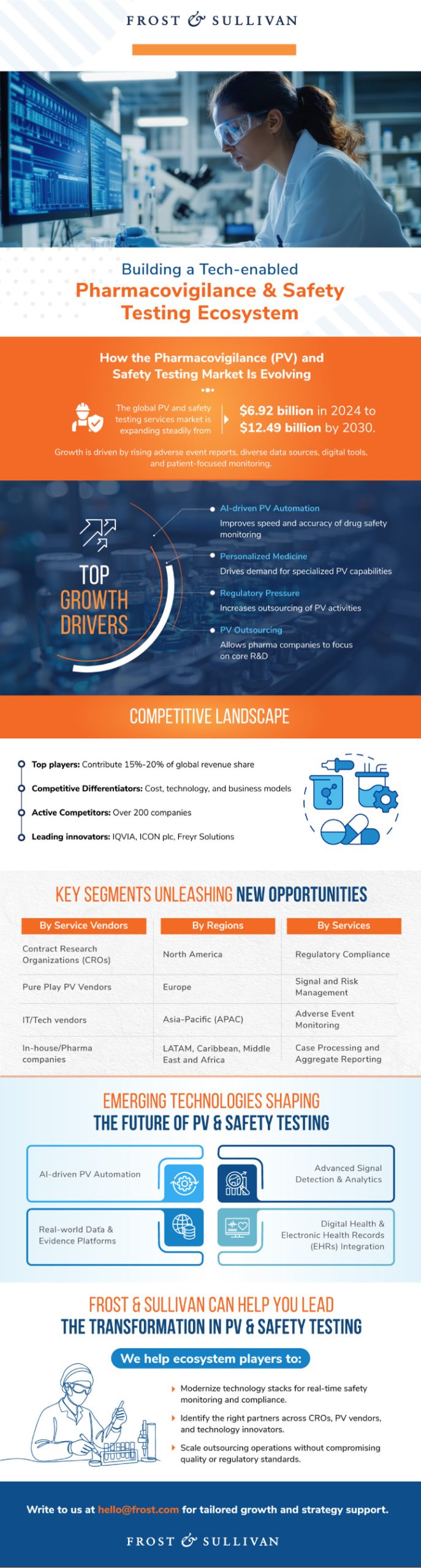
From mature to emerging markets, regional megatrends show where companies can focus to maximize growth and ROI:
North America: Leading the Global PV Landscape
North America is the largest and most established market. The US Food and Drug Administration (FDA) sets rigorous safety standards through initiatives like the Sentinel Initiative and FAERS, helping companies spot and respond to adverse events quickly. Widespread use of electronic health records, real-world evidence, and AI-powered PV platforms allows companies to monitor drug safety more efficiently and make decisions faster.
Europe: Driving Regulatory Rigor
Europe has strengthened transparency and risk management with the EU Pharmacovigilance Legislation and EudraVigilance database. Emphasis on risk minimization measures (RMMs) and risk management plans (RMPs) has made post-marketing surveillance more coordinated and robust.
Asia-Pacific: Rapid Expansion and Outsourcing Hub
Asia-Pacific is experiencing fast growth in PV services. Japan and South Korea are well-established markets, while India is emerging as a global outsourcing hub, offering cost-effective services and a large, skilled workforce to support PV operations.
Latin America: Modernizing PV Frameworks
Brazil (ANVISA) and Mexico (COFEPRIS) are modernizing their PV systems to align with global standards. However, underreporting of adverse drug reactions remains a challenge in some areas due to limited awareness and resources.
Middle East & Africa: Building Foundations for the Future
Although still emerging, the MEA region is advancing rapidly. Countries like the UAE and Saudi Arabia are implementing structured PV systems, while the African Medicines Agency (AMA) and World Health Organization (WHO) partnerships are strengthening PV infrastructure, particularly in sub-Saharan Africa.
Are you implementing best practices to maximize ROI across high-growth regions?
Emerging Opportunities in Pharmacovigilance and Safety Testing Industry
- Pharmacovigilance-as-a-Service
As drug pipelines expand, tracking and managing adverse events has become more complex than ever. Outsourcing PV is emerging as a key strategy, with over 55% of PV operations already handled by specialized vendors and the market expected to grow at a 10.4% CAGR through 2030. To capitalize on this shift, pharmaceutical companies and CROs are:
- Partnering with AI-enabled PV vendors to access patient-focused, end-to-end platforms.
- Licensing eClinical technology to automate adverse events capture and simplify reporting.
- Using real-time patient data from tech-enabled devices to monitor safety proactively.
- Precision Pharmacovigilance for Precision Medicine
Precision medicine is reshaping healthcare, and PV is evolving alongside it. By using genomic, phenotypic, and real-world data, companies can better anticipate adverse events, tailor treatments, and improve patient outcomes. To make the most of this shift, providers are:
- Building multi-disciplinary PV teams to include patients, providers, regulators, and PV vendors for seamless AE reporting and trend identification.
- Conducting pharmacogenomics studies to predict individual drug responses and enhance safety in advanced therapies.
- Partnering with genomics and diagnostics players to personalize patient recruitment and ensure accurate AE assessment.
- Safety Monitoring Services for Digital Therapeutics
Digital therapeutics (DTx) is offering evidence-based software to prevent, manage, and treat a variety of conditions. While traditional side effects may be lower, software glitches or interface issues can still have serious impacts, making careful post-market monitoring essential. To take advantage of these advancements, providers are:
- Building real-world evidence programs to involve clinicians, DTx developers, and regulators for accurate risk-benefit assessment.
- Leveraging AI and blockchain to track adverse events in real time and safeguard safety data.
- Partnering with technology vendors to apply predictive analytics and adaptive PV strategies for patient-specific monitoring.
Which of these opportunities will have the maximum impact on your organization, and how will you measure it?
Key Takeaways for Modernizing PV Operations
Today, PV and drug safety are evolving faster than ever. Companies that act decisively can unlock the full potential by:
- Using smart PV platforms: AI, cloud, and eClinical tools help capture and manage adverse events faster and more accurately.
- Focusing on precision PV: Real-world, genomic, and patient data make safety monitoring more personalized and effective.
- Building strategic partnerships: Collaborate with CROs, tech vendors, and diagnostics experts to expand capabilities and accelerate results.
To sum it up, organizations that modernize their PV operations today will be the ones leading the way in operational efficiency and regulatory readiness.
Frequently Asked Questions (FAQs)
What is pharmacovigilance?
Pharmacovigilance (PV) is the process of monitoring and managing adverse drug reactions (ADRs) to keep patients safe. It helps healthcare companies detect risks early, improve drug safety, and meet regulatory standards throughout a medicine’s lifecycle.
What are the four stages of pharmacovigilance?
Pharmacovigilance typically follows four stages:
- Data Collection: Gather reports of adverse events from trials, healthcare providers, and patients.
- Assessment & Evaluation: Analyze reports to identify risks, trends, and severity.
- Risk Management: Develop strategies to reduce safety risks and protect patients.
- Reporting & Compliance: Submit Individual Case Safety Reports (ICSRs), Periodic Safety Update Reports (PSURs), and Risk Management Plans (RMPs) to regulators.
What is outsourcing pharmacovigilance?
Outsourcing PV means partnering with specialized vendors or CROs to handle safety operations, including adverse event reporting, case processing, and regulatory submissions. This helps companies save costs, improve efficiency, and stay audit ready.
What is the difference between pharmacovigilance and drug safety?
- Pharmacovigilance: Systematic monitoring and analysis of adverse drug reactions across a drug’s lifecycle.
- Drug Safety: Practical measures taken to ensure a medicine is safe, including monitoring, labeling, and risk mitigation.
Ready to Lead the Transformation?
- Book a Growth Strategy Session: Align your growth roadmap with Frost & Sullivan’s visionary Growth Pipeline™ Dialog.
- Engage with Growth Experts: Co-design AI-enabled, data-driven operating models that scale industry-specific and commercial impact.
- Share Your Transformation Story: Position your organization as a transformation leader through Frost & Sullivan’s Transformational Growth Leadership platform.
- Join the Growth Council: Collaborate with industry leaders shaping the future of your ecosystem.
- Nominate for the Best Practices Recognition: Be recognized for excellence in growth strategy, execution, and customer impact.
- Demonstrate Industry Positioning on the Frost Radar™: Benchmark your growth performance and innovation strength against industry competitors.
- Brand & Demand: Accelerate awareness, engagement, and revenue growth through integrated brand and demand generation strategies.