This blog is based on the recent Frost & Sullivan analysis, “Growth Opportunities in Cell and Gene Therapeutics Market, forecast to 2030,” authored by Surbhi Gupta, Industry Principal, Healthcare & Life Sciences Practice.
Cell and gene therapy (CGT) encompasses advanced therapeutic approaches that modify or replace genetic material and cells to treat, prevent, or potentially cure diseases. These therapies span in vivo and ex vivo gene therapies, gene-modified cell therapies, and next-generation platforms like CRISPR-based editing and allogeneic “off-the-shelf” solutions.
Today, biopharma companies face increasing complexity in scaling CGT from clinical success to commercial reality. High manufacturing costs, intricate supply chains, evolving regulatory frameworks, and the need for specialized infrastructure are creating significant operational challenges. At the same time, demand is rising across oncology, rare diseases, and now broader indications like cardiovascular and neurological disorders.
Future-proof Your CGT Strategy
Explore how innovation, manufacturing, and regulatory shifts are shaping the future of cell and gene therapy.
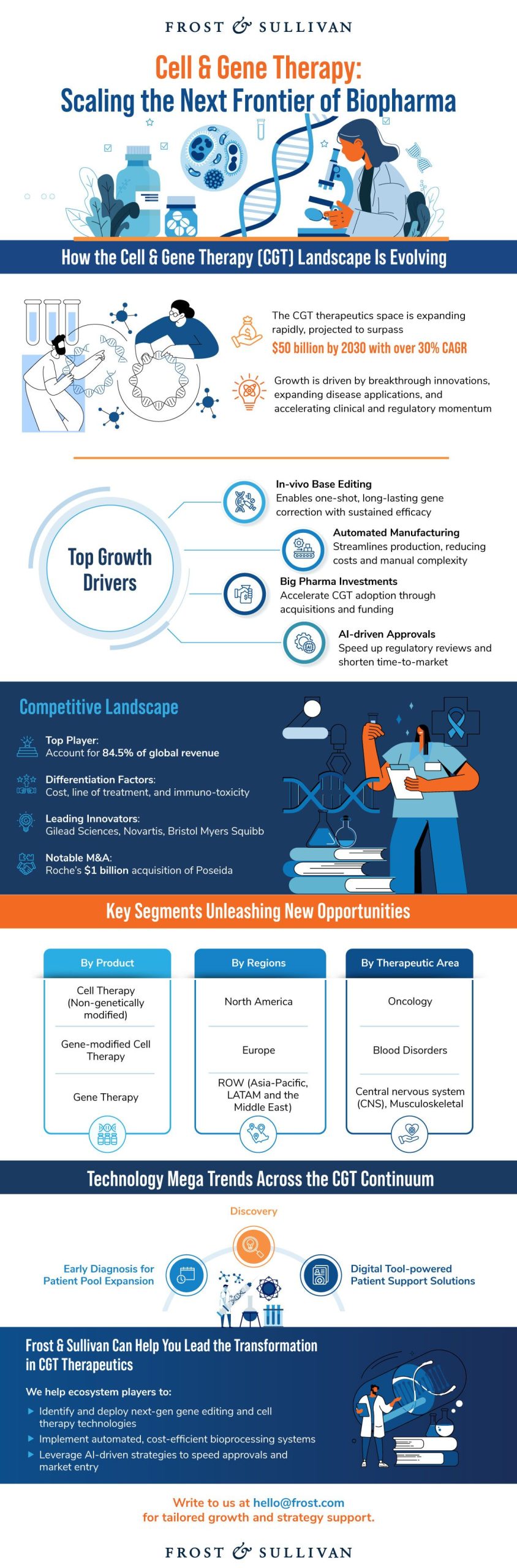
With the global CGT therapeutics space projected to surpass $50 billion by 2030, organizations that invest early in scalable platforms and manufacturing innovation will be best positioned to lead. To meet this shift, companies are adopting automated smart-factory bioprocessing, in vivo gene editing technologies, and digitally integrated quality and regulatory frameworks. These advancements enable faster development cycles, improved scalability, and more efficient global market access.
With CGT evolving at this pace, is your organization equipped with the right capabilities, partnerships, and platforms to scale and compete?
Tune into our latest podcast episode on Cell and Gene Therapy Evolution.
Strategic Imperatives Shaping the CGT Therapeutics Industry
These emerging imperatives will push businesses to rethink CGT development, commercialization, and scale:
- Next-gen Platforms & Automation: Advanced gene editing and “lights-out” manufacturing are shifting CGT from lab innovation to scalable, standard care. Platforms like Intellia’s NTLA-2002 and automated systems like Cellares’ Cell Shuttle are accelerating clinical progress and reducing CMC risks.
- Outcome-based Business Models: High-cost, one-time therapies are driving the shift toward value-based pricing and reimbursement. Agreements like CASGEVY and Lyfgenia under the CMS CGT Access Model are aligning payment with long-term patient outcomes and expanding adoption across the United States.
- Manufacturing as a Bottleneck: As pipeline activity accelerates, scalable bioprocessing capacity is emerging as the key constraint. Smart factories, automation, and digitally skilled workforces are becoming critical to achieving higher throughput, lower costs, and faster commercialization.
So, which growth processes and strategies will help your teams adapt to these industry headwinds?
The CGT Landscape – At a Glance
Key Challenges and Strategies to Overcome in Clinical Trials
- Patient Recruitment & Endpoint Alignment: Ultra-rare populations and evolving regulatory expectations make recruitment and trial design complex, while payers increasingly expect durable outcomes. Companies are addressing this by using real-world data and natural history studies to build external controls, adopting hybrid and decentralized trial models, and aligning early with regulators and HTAs.
- Manufacturing Changes & Supply Chain Complexity: Frequent process changes, strict chain-of-identity requirements, and complex logistics create risks for comparability and trial continuity. To manage this, organizations are standardizing CMC approaches, aligning early with regulators on comparability, and strengthening partnerships with specialized logistics providers.
- Long-term Follow-up & Durability Evidence: Extended monitoring requirements create challenges in patient retention, data continuity, and payer confidence. In response, companies are designing registry-led trials, enabling remote monitoring and data portability, and aligning early on outcomes-based reimbursement models.
- Operational Start-up & Capacity Constraints: Regulatory approvals, site readiness, and limited CGT infrastructure often delay trial initiation and enrollment. These challenges are being addressed through parallel regulatory submissions, tiered site network models, and centralized logistics coordination.
Are your clinical and operational models equipped to handle the next phase of CGT trial complexity?
Regional Hotspots: How CGT Regulations and Access Models Are Evolving
- North America leads in CGT approvals, supported by accelerated frameworks like Regenerative Medicine Advanced Therapy (RMAT), Fast Track, and Breakthrough designations, enabling faster commercialization through flexible regulatory pathways.
- Europe takes a more centralized and methodical approach under the European Medicines Agency (EMA)’s Advanced Therapy Medicinal Products (ATMPs) framework, where programs like PRIME support innovation, but rigorous evaluations often extend approval and access timelines.
- Asia-Pacific (APAC) is emerging as the fastest-growing region, driven by regulatory agility and government support, with Japan leading early access pathways and China and South Korea accelerating reforms.
- Latin America is gradually building regulatory frameworks, with countries like Brazil aligning to global standards, though access remains limited and largely dependent on case-by-case approvals.
Are you implementing best practices to maximize ROI across high-growth regions?
Emerging Opportunities in Cell and Gene Therapy
- Regulatory Advisory Services for Accelerated Approvals
As CGT pipelines expand, navigating regulatory requirements and accelerated approval pathways is becoming increasingly complex. This is driving demand for specialized advisory models that can streamline submissions, align global strategies, and reduce time-to-market.
To capitalize on this opportunity, biopharma companies and ecosystem players are:
- Partnering with regulatory experts to design accelerated approval strategies and manage early Food and Drug Administration (FDA) engagement.
- Integrating real-world evidence and natural history data to strengthen submissions and support surrogate endpoints.
- Building globally aligned regulatory packages to support multi-region approvals and initiatives like FDA–EMA collaboration.
- AI-driven Bioprocess Optimization
Rising variability, batch failures, and high production costs are putting pressure on CGT manufacturing. AI is shifting bioprocessing from reactive to predictive, enabling tighter control over quality, yield, and process efficiency.
Leading players are already moving in this direction by:
- Using predictive analytics to identify batch failure risks and optimize process parameters in real time.
- Integrating AI with automated and robotic systems to enable closed-loop, self-correcting manufacturing.
- Leveraging simulation and digital models to accelerate process development and reduce experimental cycles.
- Create Integrated Vector and Plasmid Manufacturing Hubs
Fragmented supply chains for plasmid DNA and viral vectors are creating long lead times, high costs, and delays in CGT development. Integrated manufacturing hubs are emerging as a solution, enabling end-to-end control, faster scale-up, and improved operational efficiency across the value chain.
Companies are responding to this shift by:
- Co-locating plasmid, vector, and cell therapy manufacturing to streamline tech transfer and reduce dependencies.
- Consolidating partnerships with single-hub providers to improve traceability, quality control, and regulatory compliance.
- Investing in standardized, scalable platforms and regional manufacturing hubs to reduce timelines and lower cost of goods.
Which of these opportunities will have the maximum impact on your organization, and how will you measure it?
CGT: The Shift from Innovation to Industrialization
Cell and gene therapy will be defined less by scientific discovery and more by the ability to industrialize it. The real challenge now lies in simplifying complexity across manufacturing, regulation, and access without slowing down innovation.
What’s emerging is a clear divide: organizations that treat CGT as a series of bespoke breakthroughs will struggle to scale, while those that build repeatable platforms, integrated operations, and globally aligned strategies will move faster and more efficiently.
Frequently Asked Questions (FAQs)
How many cell and gene therapies have been approved by the FDA?
As of early 2026, the FDA has approved more than 35 cell and gene therapies, including CAR-T cell therapies and multiple gene therapies for rare and genetic diseases. The number is increasing steadily as new therapies receive approval each year.
Is gene therapy 100% safe?
Gene therapy is not 100% safe. While many approved therapies have demonstrated favorable safety profiles, risks such as immune responses, off-target genetic effects, and long-term uncertainties remain. Regulatory agencies require extensive clinical testing and long-term follow-up to monitor safety.
What is the difference between a cell and a gene?
A gene is a unit of DNA that contains instructions for making proteins, while a cell is the smallest functional unit of the body that carries out biological processes. Gene therapy targets and modifies genes, whereas cell therapy involves modifying or replacing entire cells.
What is the success rate of gene therapy?
There is no single success rate for gene therapy, as outcomes vary widely by disease, therapy type, and patient population. Some therapies, particularly for rare genetic disorders and certain blood cancers, have shown high response rates and durable outcomes, but long-term effectiveness continues to be studied.
Ready to Lead the Transformation?
- Book a Growth Strategy Session: Align your growth roadmap with Frost & Sullivan’s visionary Growth Pipeline™ Dialog.
- Engage with Growth Experts: Co-design AI-enabled, data-driven operating models that scale industry-specific and commercial impact.
- Share Your Transformation Story: Position your organization as a transformation leader through Frost & Sullivan’s Transformational Growth Leadership platform.
- Join the Growth Council: Collaborate with industry leaders shaping the future of your ecosystem.
- Nominate for the Best Practices Recognition: Be recognized for excellence in growth strategy, execution, and customer impact.
- Demonstrate Industry Positioning on the Frost Radar™: Benchmark your growth performance and innovation strength against industry competitors.
- Brand & Demand: Accelerate awareness, engagement, and revenue growth through integrated brand and demand generation strategies.