This blog is based on our analyses – Future of Bio-pharma Industry, 2040; Building Digital Healthcare Ecosystems: The Future of Digital Health, 2040; Pioneering a Connected, Personalized, and Sustainable Healthcare Ecosystem: The Future of MedTech, 2040; authored by Frost & Sullivan’s Growth Experts, Bejoy Daniel, Anantharaman Viswanathan, and Alejandra Parra from the Healthcare & Life Sciences Practice.
Healthcare systems are being stretched by rising demand, aging populations, and rapid advances in connected technologies. The familiar episodic care model is no longer enough for continuous monitoring, personalized treatment, and faster clinical decision-making.
In response, MedTech leaders are doubling down on intelligent diagnostics, smart hospital capabilities, and remote patient monitoring platforms. In parallel, biopharma teams are reworking discovery pipelines and scaling advanced therapies, while digital health innovators focus on interoperable ecosystems that connect providers, patients, and data without friction.
Get actionable intelligence into the technologies, care models, and opportunities reshaping MedTech, biopharma, and digital health through 2040.
If you are shaping strategy across MedTech, biopharma, or digital health, this is your opportunity to understand the technologies, business models, and growth shifts that will define healthcare leadership through 2040.
How will your healthcare strategy evolve in the future driven by personalized and outcome-based care?
Strategic Imperatives Driving Transformation Across the Healthcare Ecosystem
- Medical Technology
Customer Value Chain Compression: AI and digital twins are dissolving traditional boundaries across R&D, manufacturing, and post-market monitoring. As workflows become more connected end-to-end, reliance on fragmented handoffs and physical intermediaries continues to decline.
Transformative Megatrends: Advances in AI, 6G connectivity, and quantum computing are enabling always-on, data-driven healthcare ecosystems. These capabilities are strengthening real-time analytics, remote monitoring, and continuous decision support across care environments.
- Bio-pharma
Disruptive Technologies: Emerging modalities like omni-omics, PROTACs (Proteolysis Targeting Chimeras), and RNA-targeted small molecules are reshaping early-stage discovery. These platforms are also accelerating startup-led innovation and expanding the range of viable therapeutic pipelines.
Industry Convergence: Smaller, virtual biopharma players are pushing innovation forward but remain deeply dependent on CROs and outsourcing ecosystems. This is steadily redefining how partnerships are structured, governed, and scaled across the value chain.
- Digital Health
Industry Convergence: Providers, payers, retailers, and technology firms are increasingly aligning near-home care models. This convergence is reshaping access by embedding care delivery more directly into consumer environments and everyday workflows.
Innovative Business Models: Per-member-per-month (PMPM) and per-episode pricing models are gaining traction, especially when tied to measurable KPIs and real-world outcomes. Over time, procurement decisions will increasingly favor solutions that can demonstrate sustained performance and value delivery.
So, which growth processes and strategies will help your teams adapt to these industry headwinds?
The Evolution of Healthcare Delivery
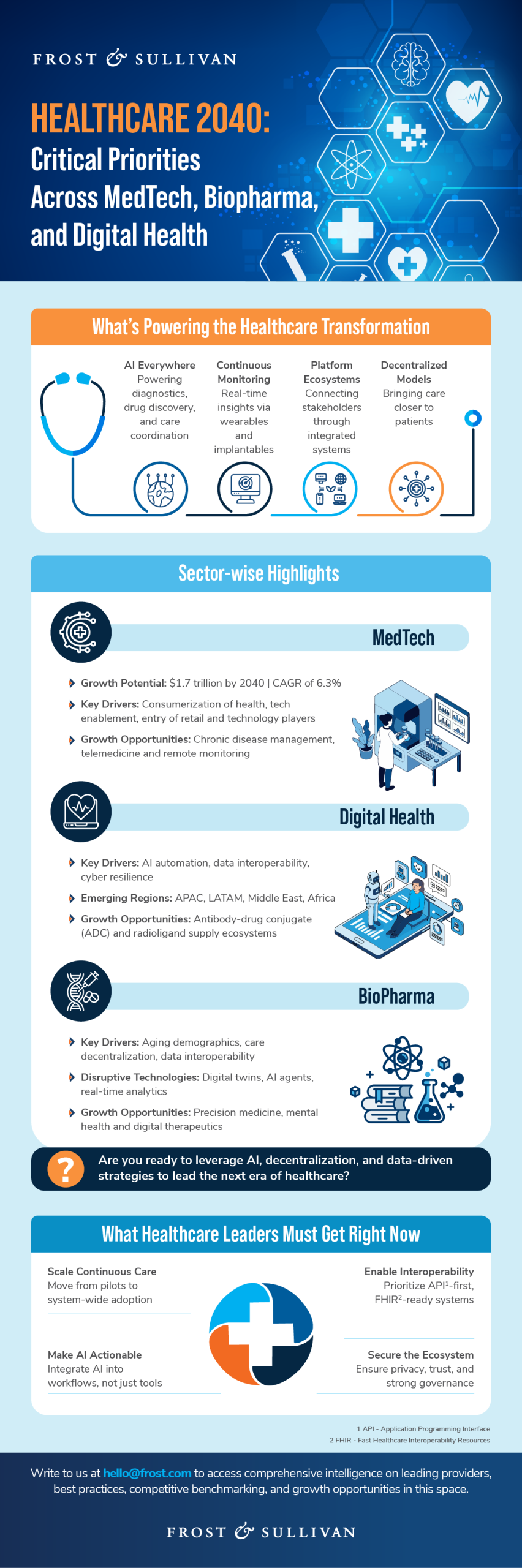
Where to Invest: Healthcare Opportunities for 2026 and Beyond
- Medical Technology
Chronic Disease Management
Chronic diseases like diabetes, cardiovascular disorders, and heart failure continue to rise globally, pushing healthcare systems toward continuous monitoring, proactive intervention, and home-based care delivery. Bio-wearables, remote monitoring platforms, and digital therapeutics are strengthening personalized, connected disease management models and opening clear opportunities across the MedTech ecosystem.
To act on this shift, providers are:
- Investing in AI-integrated bio-wearables and implantable sensors to support continuous monitoring and proactive management of chronic conditions.
- Accelerating remote therapeutic devices and virtual care platforms to expand access to home-based chronic disease management and improve patient adherence.
- Developing digital therapeutics and predictive analytics solutions focused on personalized prevention, early detection, and long-term disease management.
- Bio-pharma
ADC and Radioligand Supply Ecosystems
As antibody-drug conjugates (ADCs) and radioligand therapies (RLTs) expand across oncology, supply chain resilience is becoming a critical competitive advantage. Rising demand for isotopes, payloads, linkers, and specialized manufacturing infrastructure is pushing biopharma companies to strengthen production capabilities and secure reliable global supply networks.
To build a competitive edge here, biopharma companies are:
- Securing dual-source isotope and payload supply chains and expanding regional manufacturing hubs to improve scalability and supply reliability.
- Investing in conjugation, radiopharmacy, and high-containment manufacturing capabilities to support growing ADC and RLT pipelines.
- Developing integrated supply and logistics models that accelerate commercialization and reduce operational bottlenecks for oncology therapies.
- Digital Health
Mental Health and Digital Therapeutics
Rising mental health demand and clinician shortages are accelerating adoption of digital therapeutics, remote interventions, and stepped-care delivery models. Providers are combining digital assessment tools, coaching, therapy, and connected care platforms to improve access and deliver more personalized behavioral health support.
To stay ahead in this space, healthcare providers, payers, and digital health companies are:
- Launching stepped-care models that combine digital therapeutics, coaching, and licensed clinical support for mental health management.
- Building real-world evidence pipelines to demonstrate measurable improvements in patient outcomes, engagement, and care accessibility.
- Expanding AI-driven assessment and remote care tools to deliver more personalized, scalable, and accessible behavioral health services.
Which of these opportunities will have the maximum impact on your organization, and how will you measure it?
Lead the Shift Toward Connected, Outcome-driven Care
As MedTech, biopharma, and digital health continue to evolve, the focus will increasingly shift toward continuous care models, interoperable ecosystems, and outcome-driven strategies that improve both patient outcomes and operational efficiency.
Organizations that align early with these shifts will be better positioned to accelerate innovation, strengthen partnerships, scale personalized care, and navigate the changing healthcare landscape through 2040.
Frequently Asked Questions (FAQs)
What does Medical Technology do?
Medical Technology (MedTech) focuses on developing devices, diagnostics, and digital tools that support disease detection, monitoring, and treatment. It includes innovations such as imaging systems, surgical robotics, wearables, implantable devices, and diagnostic platforms that improve clinical accuracy, patient outcomes, and care delivery efficiency.
What is the difference between pharma and biopharma?
Pharma typically refers to traditional drug development based on chemical compounds, while biopharma focuses on biologics derived from living systems. Biopharma includes advanced therapies such as monoclonal antibodies, cell and gene therapies, and recombinant proteins, often supported by biotechnology and AI-driven drug discovery.
Is digital health the same as AI?
No, digital health is a broader field that includes telemedicine, mobile health apps, wearable devices, remote monitoring, and interoperable health platforms. AI is a part of digital health, used to analyze data, support clinical decisions, personalize care, and improve operational efficiency, but digital health extends beyond AI to include the full care ecosystem.
What does the healthcare ecosystem consist of?
The healthcare ecosystem includes interconnected stakeholders such as hospitals, clinicians, patients, payers, MedTech companies, biopharma firms, and digital health providers. It also includes enabling technologies like data platforms, diagnostics, medical devices, and care delivery systems that work together to support prevention, diagnosis, treatment, and long-term health management.
Ready to Lead the Transformation?
- Book a Growth Strategy Session: Align your growth roadmap with Frost & Sullivan’s visionary Growth Pipeline™ Dialog.
- Engage with Growth Experts: Co-design AI-enabled, data-driven operating models that scale industry-specific and commercial impact.
- Share Your Transformation Story: Position your organization as a transformation leader through Frost & Sullivan’s Transformational Growth Leadership platform.
- Join the Growth Council: Collaborate with industry leaders shaping the future of your ecosystem.
- Nominate for the Best Practices Recognition: Be recognized for excellence in growth strategy, execution, and customer impact.
- Demonstrate Industry Positioning on the Frost Radar™: Benchmark your growth performance and innovation strength against industry competitors.
- Accelerate Brand & Demand Growth: Accelerate awareness, engagement, and revenue growth through integrated brand and demand generation strategies.