Elizabeth Koff, Managing Director, Telstra Health, and Farhoud Salimi, Chief Technology Officer, Telstra Health, in conversation with Ravi Krishnaswamy, Managing Director, Frost & Sullivan, Asia Pacific
Download this Transformational Growth Leadership Discussion with Elizabeth Koff and Farhoud Salimi
Telstra Health believes the future of healthcare lies in moving beyond fragmented data and traditional interoperability towards real-time, connected intelligence that improves outcomes, enhances experiences, and supports a more sustainable healthcare system. Through initiatives such as Corus iX™, investment in Fast Healthcare Interoperability Resources (FHIR)-enabled platforms, and the modernization of My Health Record, Telstra Health is helping build the foundations for more connected, interoperable, and patient-centered care
In this Transformational Growth Leadership discussion, Ravi Krishnaswamy speaks with Elizabeth Koff and Farhoud Salimi about the evolution of connected care, exploring real-time data interoperability, AI-enabled insights, patient empowerment, associated security and governance, and the role of open standards in creating an exemplar connected care ecosystem.
“Once everyone is speaking the same language and working to the same standards, that’s when you unlock the greatest opportunity for innovation across the sector.”
— Farhoud Salimi, Chief Technology Officer, Telstra Health
From Fragmented Care to Connected Care
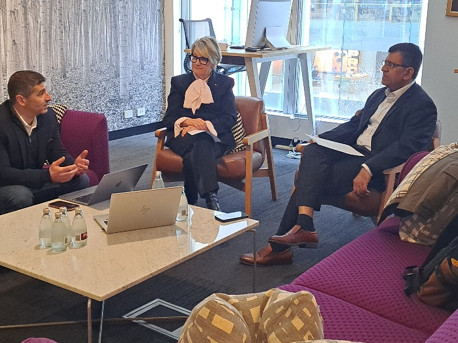
Ravi Krishnaswamy: When we talk about connected care, it can sometimes feel like an abstract technology aspiration. From your experience in healthcare delivery, what would a truly connected care ecosystem look like in practice?
Elizabeth Koff: Based on my extensive experience in healthcare service delivery, I have firsthand seen the lack of continuity of care from one practitioner to another and how fragmented the ecosystem is. This fragmentation not only increases clinical risk but also decreases the productivity as clinicians and providers spend valuable time tracking down results and locating information. Ultimately, it leads to a less satisfactory and challenging experience for both patients and healthcare professionals. That is why real-time data sharing has the potential to transform healthcare. Instead of dealing with missing results and delays that can impact clinical decisions and treatment pathways, providers can access the information they need when they need it. In a connected care ecosystem, fragmented data is replaced by real-time intelligence that supports more informed, timely, and coordinated care.
We describe this as a care intelligence system because it represents the kind of connected data-driven healthcare experience our platform is designed to deliver.
The True Value of Connected Care
Ravi Krishnaswamy: In that envisioned connected care model, how would success be measured or defined? Would it be defined by better patient outcomes, improved patient experience, greater operational efficiency, increased workforce productivity, or by creating value across all these areas?
Elizabeth Koff: Success should be measured by creating value across all those dimensions, with better health outcomes remaining the foremost objective for every clinician and healthcare system. However, in the pursuit of improved clinical outcomes, we can sometimes overlook two equally important aspects of care: the patient experience and the clinician experience.
These elements are intrinsically connected. Throughout my career, I have been a strong advocate for value-based healthcare, which is fundamentally about achieving better health outcomes while enhancing the experiences of both patients and clinicians, all within a cost-effective and sustainable model of care.
At the same time, we cannot lose sight of the economic realities of healthcare delivery. Health systems around the world are under increasing pressure from workforce shortages, ageing populations, rising rates of chronic disease, and growing demand for services. As a result, healthcare must evolve and transform.
We firmly believe that a connected data ecosystem, one that links patients, providers, and care settings, is the foundation for that transformation. By enabling the seamless flow of information, it has the potential to improve outcomes, enhance experiences, increase productivity, and create a more sustainable healthcare system for the future.
The Value Equation in Healthcare
Ravi Krishnaswamy: There is often an assumption that higher healthcare spending should naturally lead to better outcomes. Based on your experience, is that really the case, or is the issue less about how much we spend and more about how effectively we use those resources?
Elizabeth Koff: I do not believe that higher healthcare spending, on its own, is the solution. In Australia, healthcare spending already represents approximately 10% of GDP and maintaining that level of investment is becoming increasingly challenging. More importantly, higher levels of spending do not necessarily translate into better health outcomes.
The United States illustrates this point well. Despite healthcare expenditure approaching 20% of GDP, that investment has not consistently resulted in the strongest health outcomes compared with other developed nations. The key issue, therefore, is not the amount being spent, but how effectively healthcare resources are allocated and utilized.
This is where connected care has the potential to create significant value. By digitally connecting patients, providers, and care settings across the healthcare ecosystem, we can reduce fragmentation, improve coordination, and enhance operational efficiency. In doing so, we can create a more integrated model of care that delivers better outcomes, improves experiences for both patients and clinicians, and supports a more sustainable healthcare system overall.
Building a More Connected Healthcare Ecosystem
Ravi Krishnaswamy: There is no single healthcare system that can be considered perfect. From your perspective, what would an ideal healthcare system look like?
Elizabeth Koff: Many have tried to define the “ideal” healthcare system, but the reality is that no single model can claim that title. The effectiveness of any health system is influenced by a complex combination of factors, including funding structures, models of care, government policy, workforce capability, and clinician preferences. While some countries excel in certain areas, no healthcare system performs optimally across every dimension. Each has its own strengths, challenges, and trade-offs.
From my perspective, one area that deserves greater focus is prevention. Healthcare systems are often understandably focused on meeting immediate care delivery needs, but increasing investment in preventive health has the potential to deliver the most significant long-term impact on population health outcomes.
At Telstra Health, we support the Australian Government’s national bowel, cervical and lung cancer screening programs through the operation of the National Cancer Screening Register (NCSR), a national digital platform that underpins the delivery of these programs. The NCSR enables the secure exchange of screening information between healthcare providers, pathology laboratories, radiology providers and government stakeholders, while supporting participant follow-up and providing nationally consistent data and reporting to help inform program monitoring and data-driven continuous improvement. This is critical in the transformation of the prevention space.
Placing Patients at the Center of Connected Care Ecosystem
Ravi Krishnaswamy: So far, our discussion has focused primarily on healthcare providers and clinicians. In a connected care ecosystem, where does the patient fit, and what role do they play?
Elizabeth Koff: Today, our focus is largely business-to-business. However, one of the key initiatives we are delivering with the government is the modernization of My Health Record, Australia’s national digital health record. It is designed to provide individuals with a comprehensive view of their healthcare journey, including their care history, test results, and medications.
Empowering patients and consumers will be fundamental to the future of healthcare. Through our partnership with the Australian Digital Health Agency, we are helping transform My Health Record into a more dynamic, accessible, and user-centric platform. By providing both clinicians and patients with access to timely and relevant health information, we can enable individuals to take a more active role in managing their health while supporting more informed and connected care across the healthcare system.
Trust as the Foundation of Connected Care
Ravi Krishnaswamy: As healthcare organizations increasingly adopt AI and the demand for real-time intelligence continues to grow, how can they balance innovation with security, privacy, governance, and, most importantly, patient trust?
Farhoud Salimi: This is a challenge facing nearly every health technology organization today. At the heart of AI in healthcare is the issue of data completeness. For AI models to generate meaningful, reliable insights, they need access to a comprehensive and accurate patient record.
When AI is trained on partial or fragmented datasets, the likelihood of producing inaccurate or incomplete insights increases significantly. This can erode confidence in technology and create hesitation among both patients and clinicians to trust and adopt AI-driven solutions.
To address this, modern standards and interoperable platforms can help create a more complete and consensual patient record that supports the responsible use of AI. And consent is a key word. Patients must remain in control of how their data is used, with the ability to opt in or opt out as they choose. Equally important is ensuring that the information remains accurate, current, and reflective of their latest health status.
Ultimately, building trust in AI requires more than advanced technology. It depends on high-quality data, strong governance, robust privacy and security measures, and a transparent approach that places patient consent and choice at the center of the healthcare ecosystem.
Cybersecurity as the Foundation of Connected Care
Ravi Krishnaswamy: Data quality and consent are critical foundations. As these technologies continue to evolve, how do we address the growing security challenges that come with them?
Farhoud Salimi: From a cybersecurity perspective, the landscape is becoming increasingly complex and challenging to navigate. Recent developments have demonstrated how advanced AI models can find ways to circumvent safeguards and controls designed to govern their behavior. While the pace of innovation is extraordinary, the reality is that the attack side is currently evolving faster than the defense side, creating new risks and challenges for organizations.
That is why we invest significant time and effort in ensuring our systems remain secure, resilient, and aligned with industry standards, supported by the expertise and backing of Telstra. All data is encrypted and protected in accordance with current security best practices and standards, and we continue to strengthen our capabilities to address emerging threats and meet evolving security requirements.
Connected Care Requires Everyone to Move Together
Ravi Krishnaswamy: And how do you see the role of healthcare providers, governments, patients, and tech partners evolve to create a truly connected care system?
Elizabeth Koff: Transforming healthcare will require collaboration across the entire ecosystem. Healthcare providers, governments, patients, and technology partners must work together, because the models that have served us well in the past may not be the ones that best meet the needs of the future. Recognizing and adapting to that reality will be critical.
Today, healthcare operates within well-established systems and care pathways. Clinicians are accustomed to working within them, and patients are familiar with receiving care through these channels. However, building healthcare systems that are fit for the future will require us to rethink some of those established approaches and embrace new ways of delivering care.
One of the most significant shifts will be the rise of the informed patient. We are already witnessing this through the increased accessibility and utilization of AI-powered health information and advisory tools. Patients are arriving at consultations better informed about their health conditions and more engaged in their healthcare decisions than ever before.
This presents clear opportunities. Better-informed patients can have more meaningful conversations with their clinicians, ask more relevant questions, and play a more active role in managing their health. At the same time, there are risks, including the potential for inaccurate self-diagnosis, unnecessary anxiety, or self-treatment based on incomplete or unreliable information. Managing this balance will be an important responsibility for the healthcare sector.
And when it comes to AI in healthcare, we consistently arrive at the same conclusion: the clinician must remain in the loop. While AI can enhance decision-making and improve efficiency, not every process or clinical decision can, or should, be automated. Clinician oversight remains essential because the stakes in healthcare are simply too high.
At its core, healthcare is about improving and protecting lives. Patient harm, particularly when it results in loss of life, is the most serious risk any health system must guard against. This underscores the importance of ensuring that every technology, product, and service is developed and deployed with rigorous standards of safety, compliance, governance, and trust.
Building the Foundations of Connected Care through Collaboration and Standards Development
Ravi Krishnaswamy: With innovation in healthcare technology moving faster than regulatory change, how do you collaborate with regulators to balance innovation, compliance, and patient safety?
Farhoud Salimi: The landscape in Australia has evolved significantly over the past five years.
Government agencies, including the Department of Health and the Australian Digital Health Agency, have worked closely with the broader healthcare sector through initiatives such as the Sparked Accelerator. The objective is to bring government, industry, and healthcare providers together to co-design standards that are not only technically robust but also practical, implementable, and proven in real-world settings.
The first critical element is collaboration. Building a community that actively contributes to the design, implementation, and continuous refinement of standards helps ensure they remain relevant and deliver meaningful value across the healthcare ecosystem.
The second element is accountability. Collaboration helps create alignment and momentum, but regulation plays an equally important role in driving adoption. We are increasingly seeing government agencies phase out legacy standards and introduce new ones, with clear timelines for organizations to achieve compliance.
This approach helps elevate the entire sector onto a common foundation, creating greater consistency in how health information is captured, shared, and exchanged across the system.
As these standards mature, they increasingly enable a “share by default” approach and support the real-time exchange of patient information. Once that foundation is established, innovation becomes much easier to scale across the healthcare ecosystem.
Success requires both collaboration and regulation. When the healthcare ecosystem aligns around common standards, it creates the foundation for interoperability, connected care, and innovation at scale.
The Role of Industry in Shaping Connected Care
Ravi Krishnaswamy: Beyond enabling technology, how can organizations like Telstra Health lead the adoption of industry standards, foster innovation, and help shape the future of connected healthcare?
Elizabeth Koff: One of the most important contributions we can make is ensuring that our products and platforms are connected, interoperable, and aligned with the standards we champion across the healthcare industry.
While it may seem unusual for a technology provider to advocate for open standards and seamless integration, I believe this is fundamental to the future of healthcare. The more easily systems can connect and exchange information, the stronger and more effective the healthcare ecosystem becomes. This creates greater value for healthcare providers, partners, and ultimately the patients they serve.
Historically, parts of the healthcare sector have operated in siloed environments, with limited integration and information sharing between organizations. That approach is rapidly evolving as it’s not sustainable. Participating in standards bodies and contributing to the development of new standards is essential, but it is important that our own products and platforms are aligned with, and exemplify, those standards in practice.
This is where industry leadership becomes critical. It’s not enough to help shape the standards of the future; organizations must also be early adopters and demonstrate their value through real-world implementation. Through Corus iX™, we have implemented many of these standards in production, supporting electronic requesting and helping healthcare providers streamline workflows, reduce manual processes, and improve connectivity across the healthcare ecosystem. We are also incorporating the latest FHIR standards across our platforms, including the next generation of the Corus™ platform. This ensures that both clinician-facing and patient-facing experiences are built on a common, interoperable framework, enabling more seamless exchange of information and greater connectivity across the continuum of care.
Thus, our role is not just to develop technology, but to help make connected care a reality. By turning industry standards into practical solutions that clinicians and patients can use every day, we can help accelerate meaningful and lasting transformation across healthcare.
From Passive Data to Prediction: The Future of Connected Care
Ravi Krishnaswamy: Looking ahead, what do you see as the next major frontier in connected care.
Elizabeth Koff: Looking ahead, I believe predictive and personalized medicine will be among the most transformative developments in healthcare.
Today, we are still addressing some fundamental challenges, such as ensuring access to reliable, real-time information about a patient’s care history, upcoming appointments, and treatment journeys. Before we can fully unlock the potential of advanced technologies, we must first establish a foundation of accurate, accessible, and trusted data.
Data integrity is foundational to the future of healthcare. Without confidence in the quality, completeness, and accuracy of health information, it is difficult to develop reliable predictive models or support informed clinical decision-making.
Once that foundation is established, the opportunities become significant. Healthcare can move beyond simply understanding past events to anticipating future outcomes. This could enable earlier identification of individuals at risk of conditions such as cardiovascular disease, as well as more personalized treatment approaches based on a patient’s genetic profile, health history, and individual care needs.
The future of healthcare will increasingly be defined by a shift from reactive care to proactive, predictive, and personalized care.
Turning the Vision of Connected Care into a Reality in Australia
Ravi Krishnaswamy: Looking to the future, what would a successful connected care ecosystem in Australia look like, and what impact or legacy would you like Telstra Health to have in helping shape that future?
Elizabeth Koff: For me, success would mean every Australian having seamless access to their health information whenever and wherever it is needed, with the same information readily available to the clinicians providing their care.
Access to timely, accurate, and trusted health information is fundamental to delivering safer, more coordinated care and improving outcomes and experiences for both patients and providers.
When I think about Telstra Health’s legacy, I hope we are remembered for helping realize the vision of connected healthcare. Although that vision appears straightforward, it has required overcoming significant challenges, particularly in an environment where healthcare systems and technologies were often developed in isolation and lacked interoperability. Currently through our investment in FHIR-based platforms and industry-leading interoperability standards, we are building the digital foundation required for a truly connected healthcare ecosystem, enabling partnerships, information sharing, and innovation at scale.
At its core, I would like Telstra Health to be known as an organization that helped make connected care a reality, improving access to information, strengthening care coordination, and delivering better outcomes for patients across Australia.
Taking Interoperability Beyond Borders
Ravi Krishnaswamy: Do you believe connected care will eventually extend beyond national borders, enabling the secure exchange of health information across countries?
Farhoud Salimi: I believe connected and patient-centered healthcare is the next trajectory healthcare is increasingly moving towards.
We are already seeing increasing collaboration around initiatives such as the International Patient Summary, bringing together healthcare stakeholders from Australia, New Zealand, the Asia-Pacific region, the United Kingdom, and the United States. The aim is to establish a standardized and secure approach to sharing essential health information across borders when needed.
Importantly, this vision is being enabled by the same interoperability standards that are driving connected care domestically. While there is still significant work to do in strengthening connectivity within individual healthcare systems, I can certainly envision a future in which people can securely access and share their health information wherever they are in the world. Whether an individual requires emergency treatment overseas or seeks care while travelling, clinicians should be able to access the relevant information needed to deliver safe, timely, and informed care.
Closing Reflection: From Interoperability to Connected Intelligence
The future of healthcare depends on moving beyond fragmented systems toward a truly connected, intelligence-driven ecosystem. While interoperability is the essential foundation that enables the secure exchange of health information across providers, care settings, and patients, the ultimate goal is far greater. It is about transforming shared data into actionable insights that improve clinical decisions, enhance patient experiences, strengthen workforce productivity, and support sustainable healthcare delivery.
For Telstra Health, this evolution begins with building the right foundations: open standards, interoperability, data completeness, patient consent, security, and trust. Through initiatives such as FHIR-enabled platforms, eRequests, Corus iX™, and the modernization of My Health Record, Telstra Health is helping turn the vision of connected care into a practical reality. By focusing on real-world implementation rather than technology for its own sake, the organization is enabling healthcare providers, patients, and governments to securely share information, improve care coordination, and unlock the value of connected intelligence across the healthcare ecosystem.
As these foundations mature, healthcare can progress beyond simply capturing and sharing information to generate meaningful insights that support more proactive and personalized care. The ability to anticipate health risks, enable earlier interventions, and tailor treatments to individual needs has the potential to transform outcomes for both patients and providers. Realizing this vision, however, will require continued collaboration across governments, healthcare organizations, technology partners, clinicians, and patients, supported by strong governance, trust, and human oversight.

About Elizabeth Koff AM
Elizabeth Koff AM is the Managing Director of Telstra Health, where she leads the company’s digital health strategy and transformation. Prior to joining Telstra Health, she served as Secretary of NSW Health for six years, leading Australia’s largest health system through the COVID-19 pandemic and overseeing initiatives in value-based care, eHealth transformation, data and analytics, and health infrastructure. She was appointed a Member of the Order of Australia in 2022 for her contribution to public health administration and governance.
Farhoud Salimi is the Chief Technology Officer of Telstra Health, where he leads the company’s technology agenda and enterprise technology capabilities. He joined Telstra Health in 2023 from eHealth NSW, where he served as Executive Director, Service Delivery (CTO). With more than 20 years of experience across the public and private sectors, he has been recognized for his technology leadership, including for his role in the mass vaccination systems rollout during the COVID-19 pandemic.

About Farhoud Salimi

About Ravi Krishnaswamy
Ravi Krishnaswamy is the Managing Director of Frost & Sullivan Asia Pacific, where he leads the firm’s operations and strategic growth initiatives across the region. He brings more than 25 years of experience spanning energy transition, sustainability, smart infrastructure, industrial automation, and smart manufacturing, with extensive experience advising organizations on growth, strategy, and emerging technologies
Ready to Lead the Transformation?
- Schedule a Growth Strategy Dialog: Align your growth roadmap with Frost & Sullivan’s Visionary Growth Pipeline™ Dialog.
- Engage with Growth Experts: Co-design AI-enabled, data-driven operating models that scale industry-specific and commercial impact.
- Showcase Your Transformational Leadership: Position your organization as a transformation leader through Frost & Sullivan’s Transformational Growth Leadership platform.
- Join the Growth Council: Collaborate with industry leaders shaping the future of your ecosystem.
- Explore Best Practices Recognition: Be recognized for excellence in growth strategy, execution, and customer impact.
- Benchmark Your Industry Positioning on the Frost Radar™: Benchmark your growth performance and innovation strength against industry competitors.
- Tell Your Story: Accelerate awareness, engagement, and revenue growth through integrated brand and demand generation strategies.
Annexure: Enabling Intelligent and Connected Manufacturing Ecosystems
As healthcare systems move from fragmented data exchange toward real-time intelligence, the industry is increasingly focused on interoperability, trusted data foundations, AI-enabled decision-making, open standards, security, and more connected models of care. Frost & Sullivan research provides strategic insight into these shifts and the growth opportunities emerging across the digital healthcare ecosystem.
📌 Growth Opportunities in the Healthcare Cloud Market, Global
📌 Top 5 Growth Opportunities in Smart Hospitals, 2026