This blog is based on the analyses titled, Global AI Mega Trends and Enterprise Reality, The AI Maturity Imperative, and 10 Growth Opportunities in AI Technologies and Platforms, authored by Frost & Sullivan’s growth expert, Karyn Price from the AI & Data Analytics team.
The AI equation for most organizations today isn’t adding up completely. In the past, leaders approved AI budgets. Teams launched pilots. Dashboards were built. But when the quarter closed, the business looked largely the same. The problem wasn’t access to AI. It was integration and orchestration.
Going forward, AI is expected to show up everywhere: customer experience, operations, finance, security, and supply chains. It can’t just answer questions or automate a task. It has to make sense of siloed processes, coordinate work across systems, anticipate what’s coming next, and respond fast enough to matter. Features that once felt impressive—instant responses, speech recognition, predictive analytics, intelligent automation—are becoming table stakes. And that’s where the next wave of AI strategy will be won or lost.
Press Play on AI Growth
Our latest AI technology podcast sheds light on:
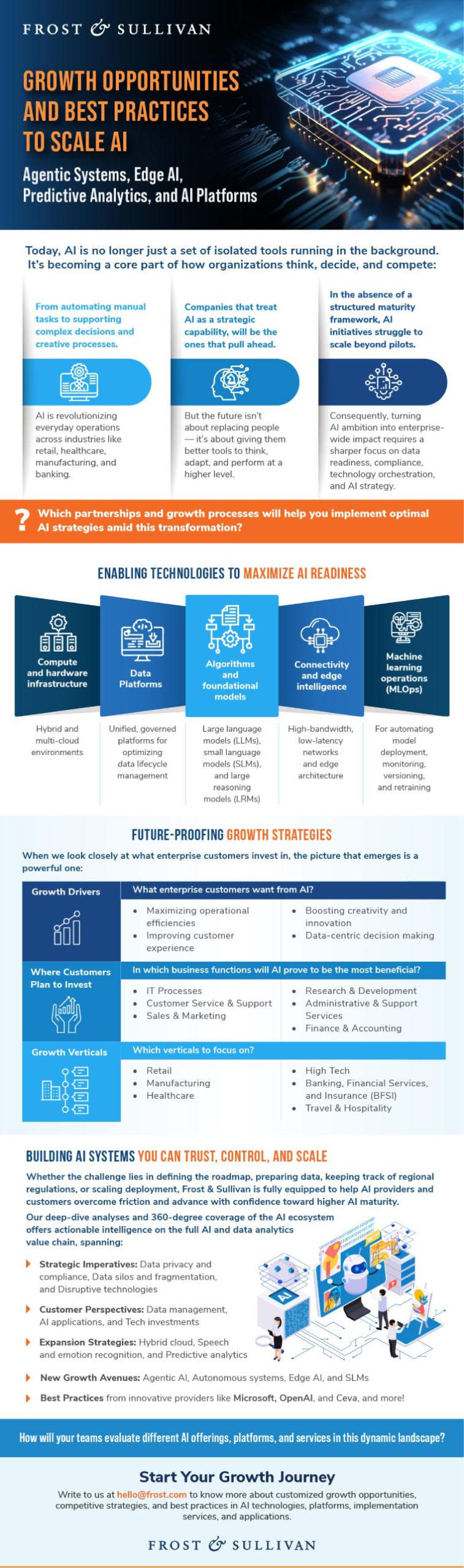
- Strategic Imperatives: Data privacy and compliance, Breaking data silos, and Disruptive Technologies
- Innovation Strategies: Hybrid cloud, Speech and emotion recognition, and Predictive analytics
- Growth Opportunities: Agentic AI, Autonomous systems, Edge AI, and Small Language Models
- Best Practices from innovative providers like Microsoft, OpenAI, and Ceva.
What’s Accelerating the AI Revolution?
This change isn’t being driven by a single breakthrough in models or hardware. It’s being driven by:
- Productivity pressures: Tight margins, labor shortages, economic uncertainty, and rising costs are forcing organizations to automate not just physical processes, but knowledge work itself.
- Customer expectations: Buyers expect always-on, conversational, and hyper-personalized experiences across channels. Delivering that consistently is impossible without embedding AI into customer-facing and back-office systems.
- Data deluge: Connected devices, sensors, applications, and networks generate more data than humans can realistically analyze. Just storing it isn’t enough. Enterprises want systems that can reason over it, connect the dots, recommend actions, predict outcomes, and act autonomously.
- Technology democratization: Low-code and no-code platforms, Application Programming Interfaces (APIs), and copilots are putting advanced capabilities into the hands of non-technical users, not just data scientists or engineers. This means that AI isn’t viewed as a niche (or optional) capability anymore.
The real question is — Do you have a structured framework in place to turn AI potential into operational reality?
🎧 Listen to Our Growth Podcast on AI Technologies and Platforms Here!
Is Your AI Strategy Ready for Enterprise-wide Scale?
Download the Whitepaper for Latest Analytics on AI Strategy and AI Adoption!
Frost & Sullivan’s 4-step AI Maturity Framework
Our AI maturity framework helps enterprises overcome friction and advance with confidence toward higher AI maturity. This also serves as a clear guide for providers to align offerings, prioritize investments, and deliver impact where customers need it most.
| Maximizing AI Maturity and Readiness | ||||
| 1 | Strategy and Roadmap Articulation | Articulation of goals and expected AI outcomes, with business and technology stakeholders driving initiatives | → | Over 73% of organizations still don’t have a mature, enterprise-wide AI strategy |
| 2 | Data Readiness | Preparation, integration, and consolidation of data for AI and machine learning (ML) deployments (in data lakes/warehouses) | → | Only 12% have ubiquitous data readiness to support AI |
| 3 | Regulatory Compliance and Policy Alignment | Setting clear policies and rules for compliance with government regulations or other industry standards | → | Across industries, just 21% of organizations have reached enterprise-level maturity |
| 4 | Technology Implementation | Implementing AI across multiple business functions and applications | → | Only 23% of organizations report ubiquitous technology implementation |
Revealed: Growth Opportunities and Technology Priorities
Against this backdrop, enterprise priorities are evolving too. Frost & Sullivan finds that:
- Speech recognition and analytics top the list.
Why? Because when AI can listen, interpret, and respond in real time, it stops feeling like an isolated system. Think of virtual assistants and voice-driven analytics unlocking new applications that text or image-based AI alone cannot.
- Emotion recognition and predictive analytics also find themselves in the limelight.
This is because these technologies promise foresight, not hindsight. Enterprises want to anticipate customer needs, detect risk early, and adjust experiences as situations evolve.
- None of this works without hybrid cloud.
Speech, emotion-aware analytics, and predictive systems demand flexibility—keeping sensitive data close, running inference where latency matters, and scaling when needed. Hybrid cloud enables all three, without forcing enterprises into all-in public or on-prem trade-offs.
How will your teams identify and evaluate new growth opportunities emerging from these headwinds?
Best Practices for Capitalizing on the Agentic AI Opportunity
If earlier waves of AI helped enterprises analyze, predict, and generate, agentic AI is about doing. When software can decide, act, and adapt on its own, technical capability alone isn’t enough for differentiation. Trust, control, and accountability move to the forefront. Now, these best practices can turn agentic AI into a more scalable, defensible business strategy:
- Task-specific AI agents: Enterprises can run into cost, reliability, and governance hurdles with generalist, do-everything agents. Purpose-built, deterministic agents designed for a single task are easier to control, cheaper to run, and far more predictable inside business workflows.
- Multi-AI agent collaboration: Efficiency gains show up when agents work together instead of operating in isolation. This is because orchestrated agents can split responsibilities, step in when one fails, and carry entire processes like onboarding or risk checks without human oversight.
- Agent-as-a-Service (AaaS): Enterprises prefer consuming agents as managed services rather than building orchestration, security, and monitoring capabilities from scratch. AaaS shortens time to value and makes autonomous AI usable even without deep in-house expertise.
- Outcome-based pricing: Pricing tied to results such as tickets resolved or workflows completed brings quantifiable clarity on value. These models make it easier to justify scale, reduce internal pushbacks, and align provider incentives with business outcomes.
What AI capabilities should you build in-house versus which ones should you consume through AaaS to scale faster?
Best Practices for Capitalizing on Edge AI
Not all AI decisions can wait, and not all data can travel. This is bringing about a change in data processing. Earlier, data flowed upward, models reasoned centrally, and decisions came back down. Edge AI flips that model. Unlike cloud-based AI, the edge operates under strict limits: compute, power, memory, and connectivity are all limited, and observability is widespread across thousands of devices. Practices that succeed in a data center might not apply when it comes to managing remote endpoints. This brings to light the following best practices:
- Designing for resource constraints: At the edge, smaller and more focused small language models (SLMs) consistently win. What matters is how reliably a model performs under tight compute, power, and latency constraints.
- Compressing the value chain: Running inference locally cuts out round trips to the cloud, lowers bandwidth costs, and lets systems respond immediately. In practice, this can only work when OEMs, software vendors, and integrators work together to align hardware, models, and SDKs from the start.
- Determinism and safety: Automotive and industrial applications demand predictable latency and safety guarantees. Domain-specific accelerators optimized for perception, sensor fusion, and real-time decision-making outperform general compute in these environments.
Frost & Sullivan’s AI & Data Analytics Opportunity Universe
Our 360-degree analyses offers actionable intelligence on Applications and Use Cases, AI Implementation and Managed Services, AI Technologies and Platforms, and more! Read on:
Download the Whitepaper to Know More About AI Adoption, AI Strategy, and Quantum AI.
Ready to Lead the Transformation?
- Book a Growth Dialog:Align your AI and data analytics strategy with Frost & Sullivan’s Growth Pipeline™ Dialog.
- Engage with Growth Experts:Co-design AI-enabled, data-driven tools and platforms that scale commercial impact for different industries.
- Share Your Transformation Story: Position your organization as a transformation leader in AI tech, implementation services, and applications through Frost & Sullivan’s Transformational Growth Leadership program.
- Join the Growth Council:Collaborate with tech infrastructure, services, platform, and solution providers shaping future ICT ecosystems.
- Nominate for Best Practices Recognition:Be recognized for excellence in AI strategy, execution, and customer impact.
- View Industry Positioning on the Frost Radar™:Benchmark your growth performance and innovation strengths against your top competitors.
- Activate Brand & Demand Growth:Accelerate awareness, engagement, and revenue growth through integrated brand and demand generation strategies.
AI & Data Analytics: Frequently Asked Questions
- How can businesses measure ROI from their AI investments?
This can be measured by tracking direct cost savings, productivity gains, time savings, error reductions, revenue growth, and improved customer experience. Other key metrics include automation rates, operational efficiencies, conversion lift, and faster decision cycles. Lastly, tracking baseline and post-deployment performance using an AI maturity and implementation framework is also essential to track the ROI of AI.
- What are AI agents and why are they important in 2026?
AI agents are autonomous systems that plan, design, and execute tasks across tools and workflows. Unlike basic chatbots, these AI agents can initiate actions, reason, and adapt to changing inputs. They are important because they turn AI isolated AI tools and functions into operational digital workers that can exponentially scale productivity across industries like CX, BFSI, healthcare, retail, cybersecurity, manufacturing, and mobility.
- How will AI platforms evolve over the next five years, through to 2030?
AI platforms will shift from standalone tools to more integrated and orchestrated systems. This means synchronized foundation models (large language models [LLMs] and SLMs), APIs, workflow automation tools, governance tracking, and real-time data integration. Competitive advantages will depend on scalability, security, interoperability, and quantifiable outcomes, not just model performance.
- Which are the most important AI technologies with the potential to transform industries?
Key AI technologies shaping the future include generative AI (GenAI), multimodal AI, AI agents, LLMs, SLMs, and edge AI. GenAI creates content and code, multimodal AI processes multiple data types, and AI agents execute tasks autonomously. Together, these technologies move AI to enterprise-wide intelligence systems, especially across segments like healthcare, financial services, manufacturing, retail, and telecommunications.
🎧 Listen to Our Growth Podcast on the Future of AI to Know More!