This blog is based on the competitive assessment and customer analysis titled, Frost Radar™: Carrier Managed Network Services, 2025 and Global Managed Network Services: Voice of Customer Survey, authored by Frost & Sullivan’s growth expert, Amrit Singh from the Enterprise Network Services team.
The Network Complexity Conundrum: Why the Right Partnerships Matter
Modern enterprise networks are a growing mix of platforms, connectivity technologies, tools, and providers, which are not always unified. While this variety gives organizations more options and agility, it also introduces many layers of complexity that internal IT teams struggle to manage. In fact, it’s not uncommon for teams to spend more time liaising with vendors than optimizing network performance. This difficulty increases with each new software update, security patch, and integration. Teams find it challenging to juggle compatibility issues, keep track of end-of-support dates, and prioritize upgrades across multiple vendor ecosystems. For smaller or lean organizations, just keeping everything running smoothly can drain time and resources that could otherwise be spent on core business priorities. And then there’s the contracts. Each vendor has its own service level agreements (SLAs), renewal terms, and escalation processes. Managing all of this can feel like trying to fit mismatched puzzle pieces together—frustrating, slow, and prone to mistakes.
Your MNS Guide Is Just One Click Away
Download now for actionable intelligence on:
- Strategic imperatives: Co-managed services, Consolidation of Network Security, Disruptive Technologies, and Network Automation
- Growth Strategies: Infrastructure upgrades, Quantum technology, and Private wireless networks
- Top 3 Growth Opportunities for providers
- Best practices from innovative MNS players like AT&T, Orange Business, and Verizon.
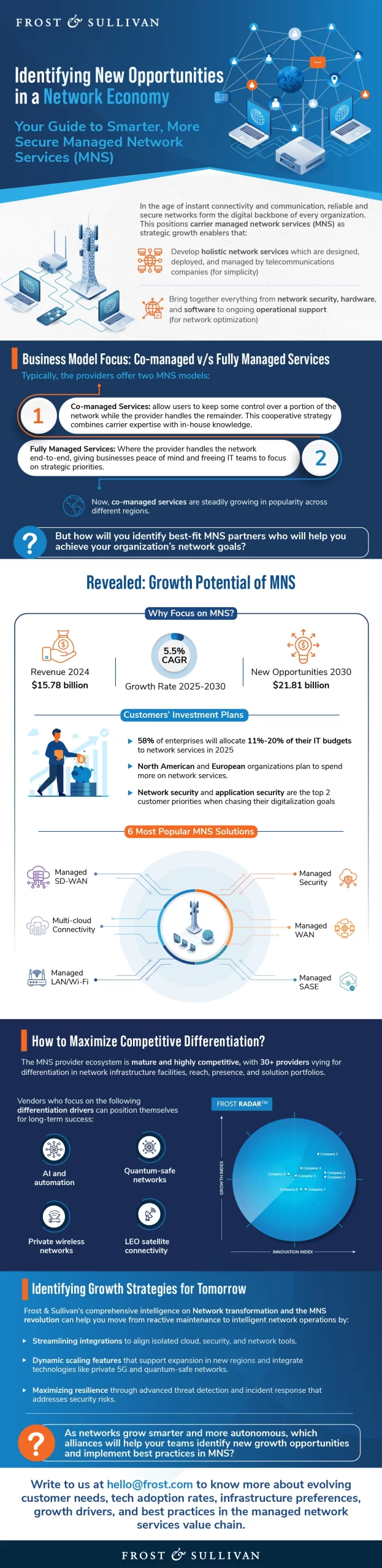
To untangle this complexity, many organizations bring in Managed Network Service (MNS) providers. By combining hardware, software, and services under one roof, these partners serve as a single point of accountability. Instead of juggling multiple suppliers, businesses work with a strategic ally who aligns network performance, security, and uptime with their business goals.
But, choosing an MNS partner is not just an operational decision, it’s a strategic one. The right partnership brings clarity, control, and agility to increasingly hybrid environments spanning cloud, edge, and on-premise infrastructure. Additionally, a good MNS vendor helps businesses transition from reactive maintenance to intelligent, predictive network operations by leveraging their expertise in Software-Defined Wide Area Networks (SD-WAN), Secure Access Service Edge (SASE), network automation, and real-time analytics.
A trusted MNS partner helps enterprises:
- Smoothen integrations: By aligning cloud, security, and network tools to work together, eliminating bottlenecks and enabling faster innovation.
- Reduce operational burden: By letting network experts take care of automation, optimization, and uptime, IT teams can concentrate on transformation, customer experience, and core business priorities.
- Scale with confidence: By supporting expansion in new regions, integrating emerging technologies such as private 5G or quantum-safe networks, and maintaining compliance without performance trade-offs.
- Build resilience: By leveraging advanced threat detection and incident response to minimize risks and ensure business continuity even during network disruptions or cyberattacks.
Which growth processes will help you identify optimal MNS partners for your organization?
Optimize Your Network. Strengthen Your Bottom Line
Click Here for Instant Access to Growth Opportunities in Managed Network Services.
How Managed Services Make Network Operations Easier
By managing daily network operations and guaranteeing performance, dependability, and security, an MNS provider essentially takes on the role of an extension of the enterprise IT team. Future-proof MNS solutions encompass the following:
- Network Infrastructure: Wide Area Network (WAN), Wi-Fi, Local Area Network (LAN), SD-WAN, cloud connectivity, and remote access.
- Network Security: Managed security, SASE, VPNs, threat monitoring, and compliance support.
- Advanced Features: Network automation, artificial intelligence for IT operations (AIOps), and edge computing.
- Operational Support: Monitoring, maintenance, installation, configuration, troubleshooting, and analytics.
- Personalized Solutions: Customized network technologies and solutions tailored to different business needs, delivered through NaaS (network-as-a-service)
Emerging Growth Frontiers
Providers looking to meet their revenue goals for 2030 cannot rely solely on infrastructure expansion in an increasingly mature, dynamic, and highly competitive MNS landscape. Growth now comes from better anticipating customer needs and harnessing emerging technologies to stay ahead. This means that carriers must concentrate on providing technology-driven, adaptive services that directly address the network issues that their clients encounter (fragmented visibility, compliance gaps, and rising overheads).
This brings to light the following avenues for provider differentiation:
- Infrastructure Upgrades: Delivering ultra-high-capacity connectivity using next-generation coherent optical technologies that can support data transmission speeds between 800 Gbps to 1 Tbps.
- Quantum Technology: Developing high-impact applications and use cases that are customized for data-sensitive customers (such as financial services).
- Private wireless networks and LEO satellite connectivity: Delivering stronger data protection, control, and privacy while extending reliable connectivity in remote or previously underserved regions.
As networks grow smarter and more autonomous, which growth opportunities will help your teams stay ahead of the curve?
Best Practices Every MNS Provider Should Know
Businesses rely on connectivity. It serves as the foundation for teamwork, customer connections, and innovation. Amid this shift, MNS providers are marching along as strategic growth partners, not just service enablers. But as competition intensifies and customer expectations evolve, following best practices isn’t just good business; it’s survival. How well a provider blends innovation, trust, and execution is what separates good providers from great ones.
Explore the opportunity universe in other segments of Enterprise Network Services:
Here are three best practices that separate leading providers from the rest:
- Fostering Vendor Partnerships: No two enterprise networks look the same. The strongest MNS providers understand this and offer a mix of technologies and services (managed security, SD-WAN, SASE, and fiber-based connectivity) that can adapt to different customer environments. Equally important are vendor alliances. Many enterprises prefer to keep certain legacy tools or partners, so providers that can accommodate these choices have a clear advantage.
- Empowering Customers with Smart Portals: Companies today want to be able to view and manage their networks in real time. AI and machine learning (ML)-powered smart customer portals enable that. They combine automation features, performance data, and predictive alerts to make daily network management easier. The payoff is quicker problem-solving and more confident IT teams.
- Delivering What You Promise (Every Time): A strong portfolio means little if service delivery falls short. Adhering to SLAs, ensuring compliance, delivering best-in-class security, and offering industry-specific support build trust and long-term customer loyalty. In complex multi-vendor environments, reliability and accountability become the ultimate differentiators.
Do you have the tools and analytical frameworks to measure the trust your customers place in your managed services?
Click Here for Instant Access to Growth Opportunities in Managed Network Services.
From Connection to Collaboration: Next Steps on Your Network Transformation
The transformation of MNS isn’t just about networks—it’s about relationships. As digital ecosystems grow more intelligent, what sets the next generation of MNS leaders apart won’t be their fiber routes or technology stacks—it will be their ability to anticipate what customers need before the network does. Because in a world where every connection counts, success isn’t measured by uptime alone, but by how seamlessly technology empowers people to move faster, think smarter, and grow together. The question then is, what can you do to thrive through this transformation?
We cover everything, from SD-WAN, SASE, and Dedicated Internet Access to Carrier Ethernet Services, Intelligent Network Automation, Network Access, and more.
Alternatively, you can also write to us at [email protected].