Innovation is a critical driver of growth, competitiveness, and long-term value creation. Across industries, companies continue to invest heavily in research and development (R&D) to advance new products, strengthen market positions, and respond to evolving customer and technology requirements. Yet comparable levels of investment do not always translate into comparable results.
While some organizations consistently accelerate product development, adopt emerging technologies more effectively, and achieve stronger commercialization outcomes, others struggle with lengthy development cycles, fragmented processes, and capability gaps. The difference often lies not in the amount invested, but in the operating models, governance frameworks, digital capabilities, and execution practices that shape innovation performance.
How does your R&D organization compare with high-performing innovation leaders?
- Benchmarking Insights from Leading R&D Organizations
- Operational Drivers of Innovation Performance
- Strategies to Improve R&D Productivity
Benchmarking engagements conducted by Frost & Sullivan across multiple industries reveal a consistent pattern: high-performing R&D organizations distinguish themselves through stronger operational discipline, digital maturity, and innovation execution.
Which operational practices enable leading companies to generate greater value from their R&D investments?
Beyond Investment: Understanding the R&D Performance Gap
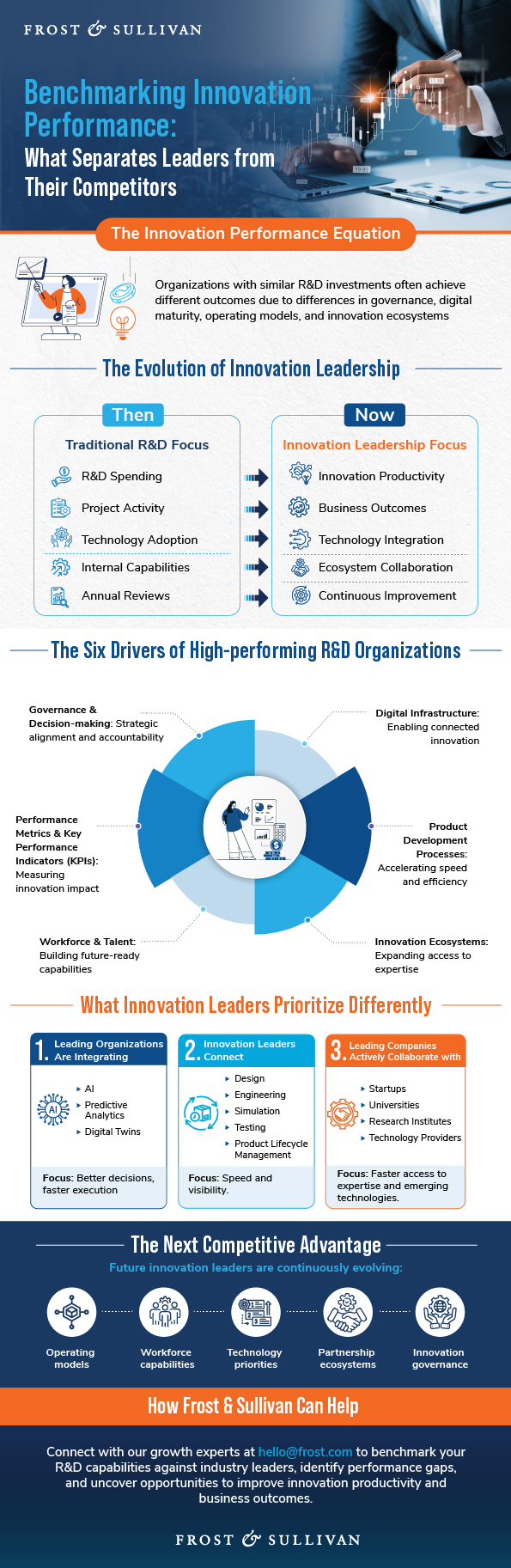
Companies with similar R&D investments often achieve markedly different innovation outcomes. While indicators such as revenue growth, product launches, patents, and partnerships provide valuable performance indicators, they offer limited visibility into the operational factors that drive innovation effectiveness.
Key factors influencing R&D performance include:
- Governance structures and decision-making frameworks
- Performance measurement and innovation key performance indicators (KPIs)
- Workforce capabilities and talent development strategies
- Digital infrastructure and technology adoption
- Product development methodologies
- External innovation partnerships and ecosystems
Five Benchmark Findings from High-performing R&D Organizations
- AI and Predictive Intelligence Are Becoming Core Innovation Capabilities
Leading companies are integrating AI, predictive analytics, and digital twins into product development, testing, and operational decision-making. Organizations that embed these technologies across R&D workflows often demonstrate greater innovation maturity and stronger execution capabilities.
- Digital Maturity Is Strengthening Innovation Performance
High-performing organizations are building connected digital environments that integrate engineering, design, simulation, testing, and product lifecycle management activities. This approach improves collaboration, enhances visibility across development processes, and supports greater operational efficiency.
- Innovation Ecosystems Are Expanding Access to Capabilities
Strategic collaboration with universities, startups, research institutions, and technology partners is supporting organizations to accelerate capability development and gain access to emerging technologies.
- Governance and Performance Discipline Drive Better Outcomes
Benchmarking consistently shows that stronger innovation outcomes are often linked to effective governance, well-defined performance metrics, and disciplined resource allocation rather than investment levels alone. Clear decision-making frameworks help ensure innovation efforts remain aligned with strategic objectives.
- Continuous Evolution Sustains Innovation Leadership
Leading organizations regularly reassess operating models, workforce capabilities, technology priorities, and partnership strategies to remain aligned with changing business requirements.
Explore the full benchmarking findings and industry case studies in the whitepaper.
What Benchmarking Reveals Beyond Traditional Performance Metrics
Many organizations rely on project reviews, financial metrics, and development milestones to assess R&D performance. While these indicators provide valuable information, they often fail to reveal underlying operational challenges.
Benchmarking exercises frequently uncover issues such as:
- Misaligned innovation metrics
- Fragmented development processes
- Capability gaps in emerging technologies
- Underutilized digital tools
- Ineffective collaboration models
- Governance inefficiencies
These challenges may not be visible through conventional performance reviews, yet they can significantly affect innovation productivity, development speed, and commercialization success. An external benchmarking perspective provides the context needed to identify these issues and prioritize improvement opportunities.
Benchmarking as a Catalyst for R&D Excellence
In an environment where innovation speed, execution, and adaptability influence competitive advantage, understanding how R&D capabilities compare with industry leaders has become a strategic imperative. Benchmarking provides organizations with an objective view of their strengths, gaps, and opportunities for improvement across critical dimensions of innovation performance.
By examining operating models, governance practices, digital maturity, workforce capabilities, and ecosystem engagement, benchmarking helps leaders identify the factors that drive stronger innovation outcomes. These insights support more effective decision-making, enabling organizations to prioritize investments, strengthen capabilities, and enhance the return on their innovation efforts.
The strongest performers are not always those that invest the most in R&D, but those that execute most effectively. Benchmarking provides the perspective needed to understand what drives that difference.
Frequently Asked Questions (FAQs):
How do you measure R&D performance?
R&D performance is measured by evaluating both innovation outcomes and operational effectiveness. Common metrics include time-to-market, new product revenue contribution, commercialization success rates, patent generation, project cycle times, portfolio performance, and alignment with strategic business objectives.
What is R&D efficiency?
R&D efficiency refers to an organization’s ability to maximize innovation outcomes while optimizing the use of resources such as funding, talent, technology, and time. Efficient R&D functions accelerate development, improve resource utilization, and deliver greater business value from innovation investments.
Why is benchmarking important for R&D organizations?
Benchmarking provides an objective view of how an organization’s R&D capabilities, processes, and performance compare with industry leaders. It helps identify performance gaps, uncover best practices, and prioritize initiatives that improve innovation effectiveness and business outcomes.
What factors differentiate high-performing R&D organizations?
High-performing R&D organizations often demonstrate strong governance, clearly defined performance metrics, advanced digital capabilities, effective innovation ecosystems, and disciplined execution. These factors enable them to accelerate innovation, improve productivity, and strengthen commercialization success.
How do AI and digital technologies improve R&D effectiveness?
AI, predictive analytics, digital twins, and connected digital platforms can enhance decision-making, streamline development processes, improve collaboration, accelerate testing and validation, and support more efficient product development across the innovation lifecycle.
How can organizations improve the return on their R&D investments?
Improving returns on R&D investments requires more than increasing budgets. Organizations can enhance outcomes by strengthening governance frameworks, adopting digital technologies, developing critical capabilities, optimizing development processes, and using benchmarking to identify opportunities for continuous improvement.
Ready to Lead the Transformation?
- Schedule a Growth Strategy Dialog: Align your growth roadmap with Frost & Sullivan’s Visionary Growth Pipeline™ Dialog.
- Engage with Growth Experts: Co-design AI-enabled, data-driven operating models that scale industry-specific and commercial impact.
- Showcase Your Transformational Leadership: Position your organization as a transformation leader through Frost & Sullivan’s Transformational Growth Leadership platform.
- Join the Growth Council: Collaborate with industry leaders shaping the future of your ecosystem.
- Explore Best Practices Recognition: Be recognized for excellence in growth strategy, execution, and customer impact.
- Benchmark Your Industry Positioning on the Frost Radar™: Benchmark your growth performance and innovation strength against industry competitors.
- Tell Your Story: Accelerate awareness, engagement, and revenue growth through integrated brand and demand generation strategies.