This blog is based on Frost & Sullivan’s recent analysis, “Managed Security Services Sector, Global, 2023–2028,” authored by Claudio Stahnke, Lucas Ferreyra, and Vivien Pua from the Security Practice Area.
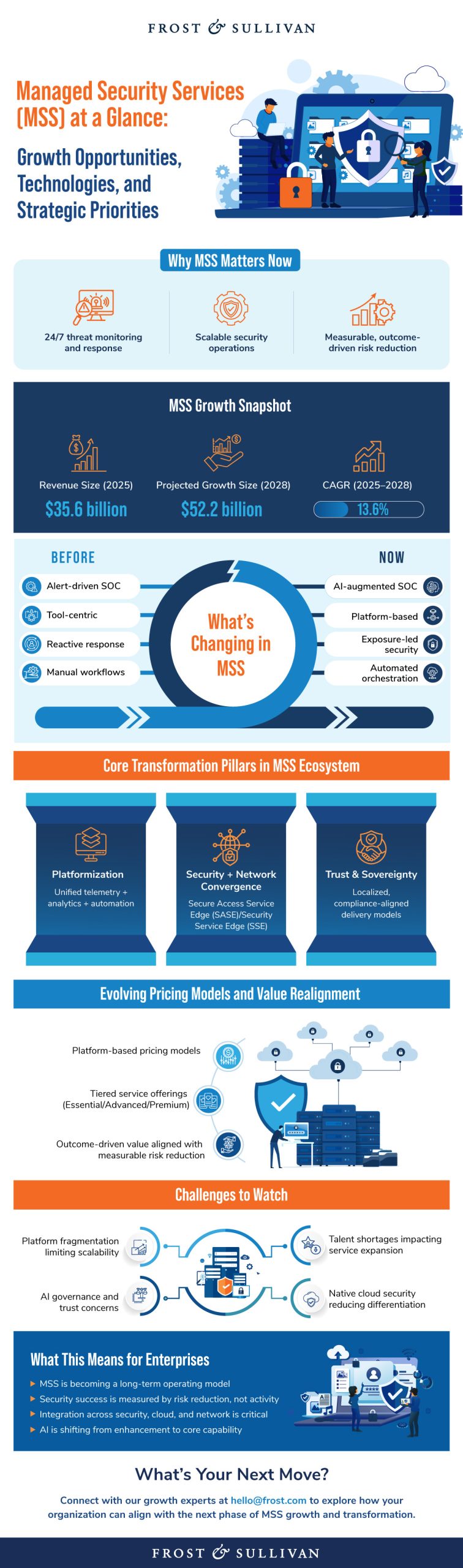
Cybersecurity is being reshaped by expanding attack surfaces, AI-enabled threats, and intensifying regulatory scrutiny. Managed security services (MSS) are reflecting this momentum, with spending expected to rise from approximately $35.6 billion in 2025 to over $52 billion by 2028, highlighting their growing strategic role in enterprise security operations.
At the same time, organizations are navigating complex hybrid, cloud, Sofware-as-a-Service (SaaS), and identity environments all while contending with persistent talent shortages and rising threat volumes.
Managed Security Services (MSS)
- Key Growth Drivers
- Core Technologies
- High-impact Growth Opportunities
For Chief Information Security Officers (CISOs), the focus is shifting from reactive response to continuous risk reduction, driving the need for integrated, intelligence-led operating models. MSS is increasingly being evaluated as a strategic extension of enterprise security operations rather than a traditional outsourcing approach.
Is your security strategy equipped to deliver continuous, measurable risk reduction at scale?
Listen to our growth podcast episode on Managed Security Services
Why MSS Is Emerging as a Core Pillar of Modern Cybersecurity Strategy
Managed security services are evolving into a foundational component of modern enterprise security architecture. Organizations are leveraging MSS to achieve persistent visibility, operational scalability, and alignment with regulatory requirements.
This evolution is driven by structural constraints, including limited access to skilled cybersecurity talent and the growing need for 24/7 monitoring across distributed environments. MSS is enabling organizations to bridge these gaps while advancing toward outcome-driven security models focused on resilience and measurable risk reduction.
Strategic Imperatives Reshaping the MSS Landscape
- Disruptive Technologies: AI is becoming the backbone of modern security operations, enabling automated triage, investigation, and response while improving efficiency and consistency.
- Industry Convergence: Security is converging with networking and cloud architectures. Models such as Secure Access Service Edge (SASE) are redefining MSS delivery through unified control planes and integrated telemetry.
- Customer Value Chain Compression: Enterprises are demanding transparency, accountability, and measurable outcomes. Managed security service providers are expected to align services with business impact, not just technical performance.
Key Growth Drivers Accelerating MSS Adoption
- Rising Operational Complexity: Hybrid IT, SaaS proliferation, and identity sprawl are increasing security management challenges.
- Cybersecurity Skills Shortage: Persistent talent gaps are prompting organizations toward managed and co-managed models.
- Escalating Threat Landscape: AI-enabled attacks, ransomware, and supply chain risks require continuous monitoring.
- Demand for Measurable Outcomes: Enterprises are prioritizing risk reduction, not just alert management
Access the full analysis to explore the MSS key growth drivers in detail.
Core Technologies Enabling Next-generation MSS
The evolution of MSS is underpinned by several critical technologies:
- AI-augmented Security Operations Centers (SOCs): Enabling automation and human-supervised workflows.
- Platformized MSS Architectures: Integrating telemetry, analytics, and orchestration into unified systems.
- Exposure Management Platforms: Providing continuous visibility into vulnerabilities, identity risks, and configurations.
- SASE and Secure Connectivity Frameworks: Combining networking and cloud security managed services.
Key Growth Opportunities Transforming the MSS Ecosystem
- AI-augmented, Human-supervised SOC Platforms: AI-driven automation is enabling MSS providers to scale operations while improving accuracy and efficiency.
- Exposure-led Security and Continuous Threat Exposure Management (CTEM): Organizations are accelerating toward proactive risk management, integrating exposure data into operational workflows.
- Sovereign and Regulation-aligned MSS Models: Demand for jurisdiction-aware services, localized data processing, and compliance-aligned operations is increasing, particularly in regulated sectors.
Download the full analysis to explore more growth opportunities in Managed Security Services.
Companies to Action Driving Growth in the MSS Industry
The MSS landscape is becoming highly competitive, with over 120 providers operating across global and regional segments. Vendors are differentiating through platform integration, AI capabilities, and regulatory alignment.
- IBM is leveraging AI, analytics, and threat intelligence to deliver integrated and scalable security operations.
- LevelBlue is emerging as a focused, pure-play MSSP following its spinout from AT&T, strengthening its position through acquisitions such as Trustwave and Cybereason. The company is building a platform-driven MSS model centered on managed detection and response, threat intelligence, and scalable SOC operations.
- Orange Cybersecurity is differentiating through sovereign and regionally anchored security services, particularly in Europe. Its strategy emphasizes trust, localized SOC capabilities, and compliance with stringent data residency and regulatory requirements.
Strategic Priorities for Industry Leaders to Operationalize MSS as a Scalable Security Model
To effectively leverage MSS, organizations will need to consider the following priorities:
- Positioning MSS as an operating model decision aligned with long-term security strategy
- Adopting platform-based architectures to reduce complexity and enhance scalability
- Focusing on measurable outcomes, including risk reduction and operational efficiency
- Evaluating AI capabilities rigorously, with emphasis on governance and explainability
- Integrating exposure management into daily operations for proactive risk mitigation
Organizations that align MSS with business priorities, embed it into their operating model, and prioritize platform-driven, AI-enabled capabilities will be better positioned to manage evolving threats and sustain long-term resilience.
Frequently Asked Questions
- What are managed security services?
Managed security services (MSS) are outsourced cybersecurity solutions where a third-party provider monitors, detects, and responds to threats on behalf of an organization. These services typically include 24/7 security operations, threat intelligence, incident response, and continuous monitoring across networks, endpoints, cloud, and identity environments.
- What is an example of a managed security service?
A common example is a managed security operations center (SOC), where a provider continuously monitors an organization’s systems, analyzes security events, and responds to potential threats. Other examples include managed detection and response (MDR), vulnerability management, and firewall or endpoint security management.
- What are the benefits of managed security services?
Managed security services offer several key benefits, including continuous threat monitoring, faster detection and response, access to specialized cybersecurity expertise, improved scalability, and support for regulatory compliance. They also enable organizations to focus on core business priorities while ensuring consistent and proactive risk management.
- 4. How is MSS different from traditional security outsourcing?
MSS is evolving beyond traditional outsourcing into a strategic operating model. Instead of simply managing alerts or tools, modern MSS integrates platforms, automation, and analytics to deliver continuous risk reduction and outcome-driven security operations.
- What role does artificial intelligence (AI) play in MSS?
AI is becoming central to MSS by automating threat detection, investigation, and response. AI-augmented security operations centers (SOCs) improve efficiency, reduce false positives, and enable scalable, human-supervised security operations.
Ready to Lead the Transformation?
- Book a Growth Strategy Session: Align your growth roadmap with Frost & Sullivan’s visionary Growth Pipeline™ Dialog.
- Engage with Growth Experts: Co-design AI-enabled, data-driven operating models that scale industry-specific and commercial impact.
- Share Your Transformation Story: Position your organization as a transformation leader through Frost & Sullivan’s Transformational Growth Leadership platform.
- Join the Growth Council: Collaborate with industry leaders shaping the future of your ecosystem.
- Nominate for the Best Practices Recognition: Be recognized for excellence in growth strategy, execution, and customer impact.
- Demonstrate Industry Positioning on the Frost Radar™: Benchmark your growth performance and innovation strength against industry competitors.
- Activate Brand & Demand Growth: Accelerate awareness, engagement, and revenue growth through integrated brand and demand generation strategies.