This blog is based on the analysis titled, Agentic AI in Service Automation Unlocking Efficiency and Personalization, authored by Frost & Sullivan’s growth expert, Heena Juneja, and lead analyst Avinab Das from the ICT, TechVision team.
Understanding the Shift Toward Intelligent Service Operations
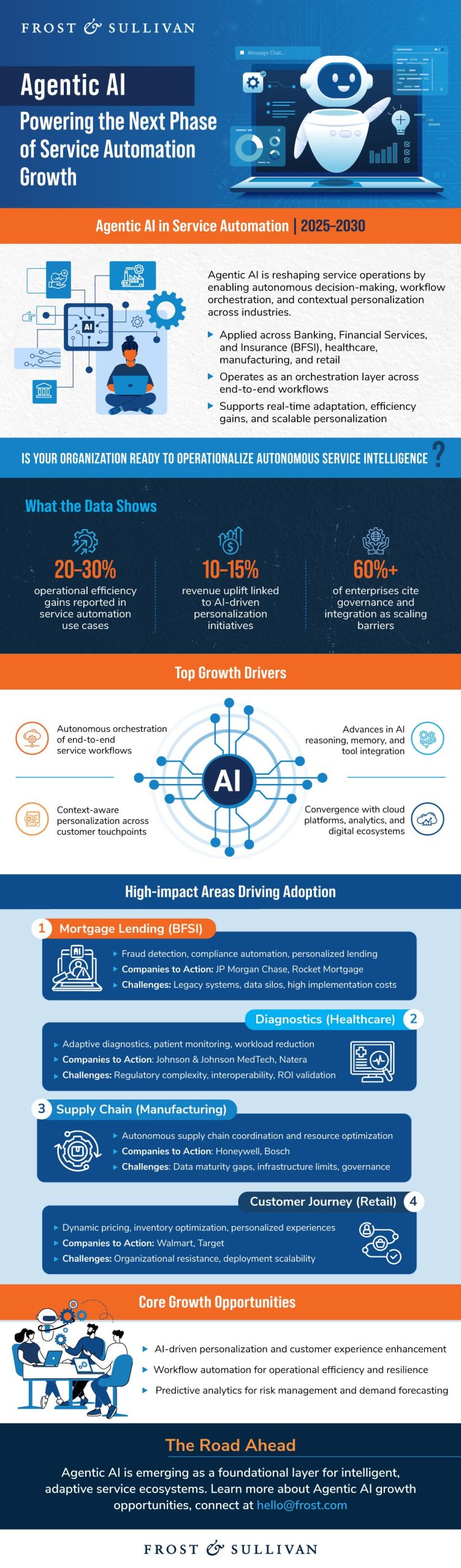
Service automation is entering a new era where Agentic Artificial Intelligence (AI), cloud platforms, and advanced analytics converge to redefine how services are delivered, coordinated, and scaled. This transformation reflects a structural evolution in how organizations pursue efficiency, personalization, and operational resilience. Agentic AI is gaining traction as enterprises move beyond rule-based automation toward systems capable of reasoning across goals, adapting to dynamic conditions, and orchestrating workflows across value chains. Adoption is accelerating across Banking, Financial Services, and Insurance (BFSI), healthcare, manufacturing, retail, and other service-intensive sectors, although maturity levels and implementation priorities vary significantly by industry.
Download the full analysis to access:
- Industry-specific adoption forecasts for Agentic AI in service automation
- Comparative benchmarking across BFSI, healthcare, manufacturing, retail, and other sectors
- Strategic imperatives shaping enterprise-scale deployment through 2030
- Growth opportunities in personalization, workflow automation, and predictive intelligence
What Is Driving the Shift Toward Agentic AI-enabled Services?
Several forces are shaping this transformation:
- Rising service complexity: Growing operational scale and cross-channel service demands are straining traditional automation models.
- Advances in AI capabilities: Improvements in reasoning, memory, and tool integration are enabling autonomous, multi-step decision-making.
- End-to-end workflow integration: Agentic AI supports coordinated execution across front-office, middle-office, and back-office functions.
- Demand for contextual personalization: Enterprises are adopting adaptive systems that tailor interactions in real time across customer journeys.
How are organizations aligning Agentic AI adoption with their service, risk, and growth priorities?
Explore Industry Perspectives on Agentic AI in the Growth Podcast
Strategic Imperatives Shaping Agentic AI Adoption
As Agentic AI shifts from pilot programs to enterprise-scale service automation, organizations are reassessing how autonomy, governance, and value creation intersect across service ecosystems. Three strategic imperatives are emerging as central to sustainable adoption.
- Customer value chain compression: Streamlining intermediaries to improve efficiency, scalability, and service responsiveness while supporting personalized outcomes
- Competitive differentiation: Building trust, reliability, and modular system architectures to sustain leadership amid intensifying innovation pressure
- Technology convergence: Integrating Agentic AI with cloud platforms, digital twins, and advanced analytics to enable coordinated, real-time decision-making
How are organizations aligning these imperatives with long-term service and growth strategies?
Growth Drivers Accelerating Agentic AI in Service Automation
Several structural drivers are accelerating interest in agentic AI-enabled service models across industries.
- Advances in foundational AI: Improved reasoning, memory, and tool integration enabling autonomous, multi-step task execution
- Demand for hyper-automation: End-to-end workflow orchestration to improve operational efficiency and resilience
- Platform convergence: Seamless integration with cloud infrastructure, digital twins, and spatial computing supporting scalable deployments
- Personalization expectations: Growing demand for contextual, real-time interactions across customer-facing services
- Democratization of tools: Accessible platforms and emerging standards lowering barriers to enterprise adoption
Which of these drivers will have the greatest impact on service transformation through 2030?
Barriers to Adoption: Governance, Integration, and Trust
Despite growing momentum, several challenges continue to shape adoption timelines and deployment decisions.
- Data privacy and governance risks: Handling sensitive information in autonomous systems limits trust, particularly in regulated industries
- Integration complexity: Fragmented architectures and platform silos hinder enterprise-wide deployment
- AI literacy gaps: Workforce readiness, reskilling, and change management challenges slow operational integration
- Transparency and accountability concerns: Decision traceability and algorithmic bias complicate governance frameworks
- Regulatory uncertainty: Evolving compliance requirements delay implementation and constrain innovation
How can your organization balance autonomy, control, and compliance as Agentic AI adoption scales?
Companies to Action: Who Is Shaping Agentic AI in Service Automation?
The competitive landscape for Agentic AI in service automation is evolving rapidly, with technology leaders and industry incumbents pursuing distinct strategies to embed autonomous intelligence across service operations.
- JP Morgan Chase is advancing Agentic AI across lending and mortgage operations, using autonomous agents to streamline compliance workflows, fraud detection, and customer servicing while maintaining human oversight in high-risk decisions to meet regulatory requirements.
- Rocket Mortgage is deploying AI-driven automation to accelerate application processing and improve borrower experience, balancing speed with governance through structured approval frameworks.
- Johnson & Johnson MedTech is integrating adaptive AI across diagnostics and healthcare workflows, focusing on interoperability, data governance, and clinician-in-the-loop models to support personalized and compliant care delivery.
- Honeywell is embedding agentic intelligence into warehouse management and logistics platforms, enabling autonomous coordination across supply chains to improve productivity and resilience.
Each organization reflects a different strategic approach to Agentic AI adoption, ranging from governance-led deployment and operational acceleration to ecosystem-scale orchestration. The shared focus is on embedding autonomy responsibly while maintaining control, transparency, and scalability.
Which adoption strategy will set the benchmark for Agentic AI-enabled service leadership through 2030?
Emerging Trends and Growth Opportunities
Frost & Sullivan’s analysis indicates that Agentic AI in service automation is expanding in both scale and strategic relevance. Beyond incremental efficiency gains, autonomous AI agents are enabling new operating models that combine personalization, automation, and predictive intelligence across service ecosystems.
The most significant growth opportunities include:
- AI-driven Personalization and Customer Experience Enhancement:
Agentic AI enables real-time, context-aware interactions by continuously analyzing customer behavior, preferences, and intent across touchpoints. From personalized mortgage offers and insurance matchmaking to adaptive healthcare treatment pathways and retail recommendations, autonomous agents are strengthening engagement, improving retention, and increasing lifetime value while reducing service friction. - Workflow Automation and Operational Efficiency:
By autonomously orchestrating end-to-end workflows, Agentic AI is reducing manual intervention across approvals, claims processing, diagnostics, and supply chain coordination. Goal-oriented agents adapt to changing conditions, optimize resource allocation, and execute decisions across systems, delivering measurable cost reductions and more resilient service operations. - Predictive Analytics and Risk Management:
Advanced forecasting and reinforcement learning enable Agentic AI to anticipate risks such as fraud, defaults, operational disruptions, and demand volatility. Unlike traditional analytics, agentic systems continuously refine models and autonomously trigger mitigation actions, supporting proactive risk management and strengthening enterprise resilience across interconnected ecosystems.
Together, these opportunities reflect a broader shift toward customer-centric, data-driven service models that prioritize adaptability, intelligence, and scale.
How will organizations balance autonomy, governance, and value creation as Agentic AI becomes a foundational layer of service automation?
Agentic AI in Service Automation: Key Questions (FAQs)
- What is Agentic AI in service automation?
Agentic AI refers to autonomous systems that reason across goals, coordinate tasks, and adapt decisions in real time to automate service workflows across industries.
- How does Agentic AI improve efficiency and personalization?
Agentic AI automates end-to-end workflows while using contextual data to personalize interactions, improving operational efficiency and customer experience simultaneously.
- Which industries are adopting Agentic AI today?
Adoption is growing across BFSI, healthcare, manufacturing, and retail, with maturity shaped by data readiness, governance frameworks, and regulatory complexity.
Ready to Lead the Transformation?
- Book a Growth Strategy Session: Align your growth roadmap with Frost & Sullivan’s visionary Growth Pipeline™ Dialog.
- Engage with Growth Experts: Co-design AI-enabled, data-driven operating models that scale industry-specific and commercial impact.
- Share Your Transformation Story: Position your organization as a transformation leader through Frost & Sullivan’s Transformational Growth Leadership platform.
- Join the Growth Council: Collaborate with industry leaders shaping the future of your ecosystem.
- Nominate for the Best Practices Recognition: Be recognized for excellence in growth strategy, execution, and customer impact.
- Demonstrate Industry Positioning on the Frost Radar™: Benchmark your growth performance and innovation strength against industry competitors.
- Activate Brand & Demand Growth: Accelerate awareness, engagement, and revenue growth through integrated brand and demand generation strategies.