This blog is based on our analysis – Growth Opportunities in Emissions Management for Oil and Gas, – authored by Frost & Sullivan’s Growth Expert, Mahesh Radhakrishnan, from the Energy team.
As industries accelerate decarbonization, emissions management in the oil and gas sector is emerging as a major growth opportunity for companies seeking to minimize environmental impact.
To capitalize on this, organizations are adopting integrated solutions that connect every stage of the process, from planning and monitoring to mitigation and reporting, with automated emissions reporting software and innovative business models enabling end-to-end execution.
Explore how transformative megatrends, disruptive technologies, and innovative business models are transforming emission management.
To make these solutions effective, operators are leveraging smart sensors, drones, and satellite imagery to capture precise emissions data, while AI, machine learning (ML), and cloud services are transforming how this information is processed and analyzed. Over the next decade, combining these technologies with automation, robotics, and advanced analytics will enable organizations to accurately measure, control, and reduce emissions throughout their operations.
Is your emissions management strategy ready to integrate AI, Internet of Things (IoT), automation, and robotics across your operations?
Listen to our latest podcast episode on Emission Management in the Oil & Gas Industry
Strategic Imperatives Driving Change in Emissions Management
The following three forces are reshaping how the oil & gas sector manages emissions:
- Disruptive Technologies: Climate change and sustainability pressures are driving investments in innovative solutions that lower emissions and support net-zero targets.
- Transformative Megatrends: With oil & gas accounting for over 50% of global emissions, companies face growing pressure to meet climate goals and strengthen regulatory compliance.
- Innovative Business Models: Operators seek high-quality, precise, and cost-effective gas detection and analysis solutions, though high acquisition costs often limit investment beyond compliance-focused initiatives.
Are you equipped with the right tools to capitalize on these transformative forces?
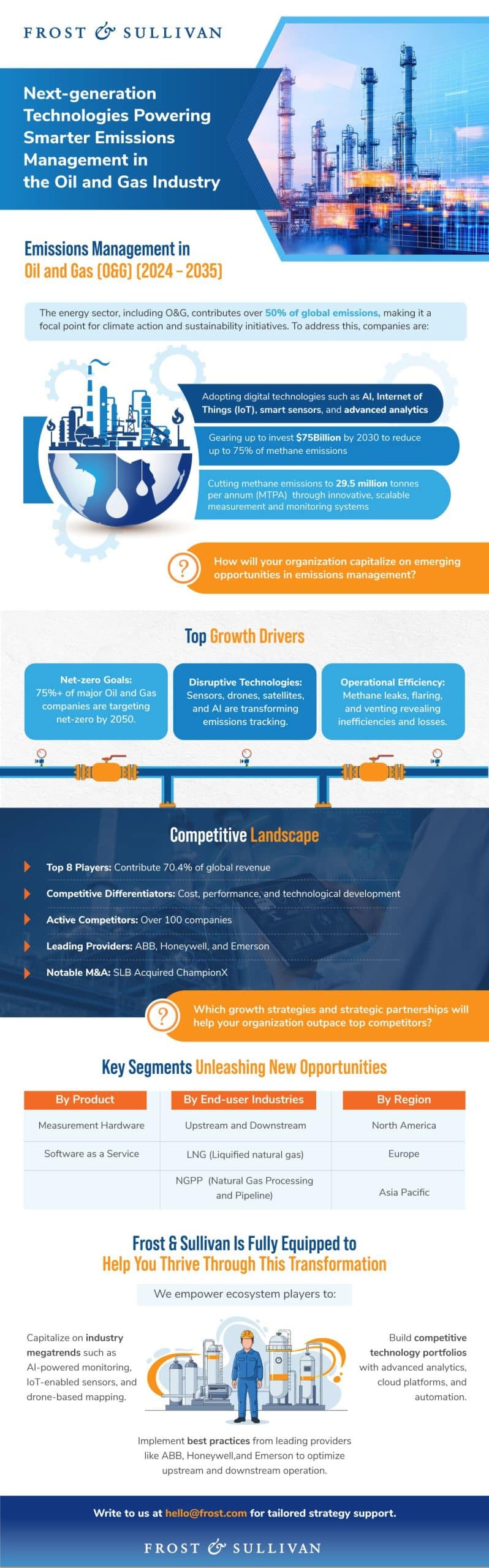
The Emissions Management Landscape at a Glance
What’s Hindering the Adoption of Advanced Emissions Management
Despite accelerating innovation, organizations face several systemic challenges:
- Regulatory Uncertainty and Volatility: Navigating climate policies and emissions regulations that vary across countries and shift with political cycles.
- Data Security and IP Concerns: Protecting sensitive information and intellectual property when sharing data across cloud systems or third-party platforms.
- Legacy Infrastructure and Data Silos: Operating aging upstream and midstream assets on legacy control systems, such as SCADA (Supervisory Control and Data Acquisition) and DCS (Distributed Control System), which limit data interoperability.
- Lack of Standardization: Managing emissions accounting, monitoring, and digital system interoperability without a universal framework across jurisdictions and asset classes.
- High Initial Costs and Uncertain ROI: Justifying upfront investments in sensors, software, and integration when emissions reductions may not produce immediate returns.
- Limited Digital and Emissions Expertise: Building in-house capabilities in carbon monitoring technologies, emissions modeling, data science, and digital integration, especially in field operations.
Is your organization leveraging digital technologies to overcome these growth barriers in the oil and gas ecosystem?
Companies to Action: Driving Innovation in Emissions Management
As emissions management becomes a critical priority, a few global players are leading the way with technology-driven, scalable solutions that help industries achieve sustainability goals.
What Sets Them Apart
- Comprehensive Solutions: Covering a wide spectrum of emissions, from traditional pollutants to greenhouse gases, with end-to-end management systems.
- Cutting-edge Technology: Enhancing sensor sensitivity, measurement precision, and detection accuracy to stay ahead of evolving regulations and industry demands.
- A Customer-focused Approach: Delivering integrated solutions and exceptional service to help clients optimize operations and capture growth opportunities.
The following leaders are revolutionizing the future of emissions oversight:
- ABB: Leading globally with robust R&D, innovative technologies, and end-to-end solutions while expanding influence through thought leadership and educational campaigns.
- Honeywell: Offering complete solutions, including monitoring, reporting, process optimization, and predictive analytics, supported by close collaboration with clients.
- Emerson: Providing a digital automation ecosystem that integrates sensors, gateways, software, and partner technologies for advanced monitoring and Industrial IoT capabilities.
Do you have the right tools to benchmark performance and collaborate with innovators driving emission management?
High-impact Opportunities in Emissions Management
The shift toward data-driven emissions management in oil and gas is creating high-value opportunities powered by AI, ML, and real-time analytics. Key areas gaining momentum include:
- Advanced Methane Leak Detection and Repair (LDAR) Solutions
Methane has 80 times the global warming potential of carbon dioxide (CO₂) over a 20-year horizon, making methane reduction one of the fastest climate-positive actions available. Advanced methane leak detection solutions drastically reduce leak identification time from days to minutes while improving operator safety and regulatory readiness. To take advantage of this opportunity, organizations are:
- Deploying methane-specific sensors (TDLAS, OGI) on drones for precision monitoring across pipelines, tanks, and remote facilities.
- Using satellite-based technologies (GHGSat, MethaneSAT) for large-area coverage and trend mapping across basins and regions.
- Integrating AI/ML to analyze multisource sensor data, identify anomalies, and prioritize repairs based on risk and emissions impact.
- Automated Emissions Reporting and Compliance Software
Global regulatory requirements, including the US EPA Methane Rule, EU Methane Strategy, OGMP 2.0, and carbon border adjustments, are becoming more stringent. Real-time, automated emissions reporting software is essential for compliance, transparency, and participation in carbon markets. As a result, providers are:
- Conducting emissions data audits to identify inconsistencies, manual processes, and high-risk compliance gaps.
- Investing in centralized emissions data platforms aligned with GHG (Greenhouse Gas) Protocol and OGMP (Oil and Gas Methane Partnership) frameworks.
- Using AI/ML to validate data, forecast emissions trends, and model the impact of upcoming regulations.
- Quantum Computing for Emissions Optimization
Quantum computing is emerging as a transformational tool for solving complex emissions optimization challenges beyond computing capabilities. It can evaluate millions of operational permutations simultaneously, enabling real-time, multi-variable optimization across dynamic oil and gas systems. Companies are capitalizing on this opportunity by:
- Building quantum literacy through targeted upskilling and partnerships with IBM Quantum, D-Wave, Google Quantum AI, IonQ, and leading quantum software startups.
- Identifying high-value applications, such as real-time flare minimization or compressor optimization, and collaborating with quantum algorithm developers.
- Launching cross-functional pilot projects with quantum labs and leveraging government grants for climate-tech R&D.
Is your organization prepared to capitalize on these growth opportunities?
Ready to Lead the Next Era of Emission Intelligence?
Emissions management is no longer just a compliance requirement; it has become a strategic lever for cost efficiency, investor confidence, and long-term competitiveness. Operators that act now will gain a measurable advantage as regulations tighten and digital maturity becomes a qualifier for future licensing and investment.
What concrete actions will your organization take today to lead the transformation toward emission management in oil and gas sector?
Frequently Asked Questions (FAQs)
What is emissions management?
Emissions management is the practice of measuring, monitoring, and reducing greenhouse gas and air pollutant emissions from business operations. It helps organizations meet regulations, lower environmental impact, and improve operational efficiency.
What are scope 3 emissions for the oil and gas industry?
Scope 3 emissions in the oil and gas industry are indirect emissions across the value chain, including fuel use by customers, product transport, and supplier activities. These emissions typically make up the largest share of total emissions.
What are scope 1, scope 2, and scope 3 emissions?
Scope 1 emissions come from company-owned sources, scope 2 emissions come from purchased electricity or energy, and scope 3 emissions include all other indirect emissions across the value chain, such as suppliers, transport, and product use.
What are oil emissions?
Oil emissions are pollutants released during oil extraction, refining, transport, and consumption. They include carbon dioxide, methane, and other gases that contribute to climate change and air pollution.
Ready to Lead the Transformation?
- Book a Growth Strategy Session: Align your growth roadmap with Frost & Sullivan’s visionary Growth Pipeline™ Dialog.
- Engage with Growth Experts: Co-design AI-enabled, data-driven operating models that scale industry-specific and commercial impact.
- Share Your Transformation Story: Position your organization as a transformation leader through Frost & Sullivan’s Transformational Growth Leadership platform.
- Join the Growth Council: Collaborate with industry leaders shaping the future of your ecosystem.
- Nominate for the Best Practices Recognition: Be recognized for excellence in growth strategy, execution, and customer impact.
- Demonstrate Industry Positioning on the Frost Radar™: Benchmark your growth performance and innovation strength against industry competitors.
- Activate Brand & Demand Growth: Accelerate awareness, engagement, and revenue growth through integrated brand and demand generation strategies.