This blog is based on the recent Frost & Sullivan analysis, “Global Clinical Diagnostics Industry Growth Opportunities, 2026–2031,” authored by Chandni Hussain, Industry Analyst, Healthcare & Life Sciences Practice.
Clinical diagnostics covers the testing systems and technologies used to detect and monitor diseases across laboratories, referral testing centers, and decentralized care settings. This includes molecular diagnostics, tissue diagnostics, immunodiagnostic testing, clinical chemistry, and point-of-care testing (POCT).
Today healthcare providers and diagnostics companies are looking for faster results, better workflow management, and wider access to testing services. Growing cancer cases, chronic diseases, and infectious disease concerns are increasing demand for decentralized molecular testing, tissue analysis, and combined chemistry-immunoassay testing systems.
Stay Ahead in Clinical Diagnostics
Is your organization equipped to thrive in tomorrow’s connected and decentralized testing environment?
Listen to the Latest Podcast Episode on the Clinical Diagnostics Industry.
Top Clinical Diagnostics Megatrends to Watch 2026
The following five shifts are likely to define clinical diagnostics in 2026 and beyond:
- Agentic AI Starts Taking Over Routine Lab Operations
AI-integrated Laboratory Information Management System (LIMS) platforms are expected to handle QC, sample tracking, and workflow management with far less manual intervention.
- Decentralized Testing Expands Across Emerging Markets
POCT and decentralized molecular testing are becoming critical for chronic disease monitoring and frontline diagnostics where healthcare access remains limited.
- Whole Genome Sequencing Moves Beyond Niche Use Cases
Lower sequencing costs and stronger analytics are making WGS more practical for oncology, hereditary disorders, and rare disease testing.
- Multi-omics Testing Gains Attention in Rare Disease Diagnosis
Combining genomic, proteomic, and metabolomic data is helping laboratories improve diagnostic accuracy in complex cases.
- Clinical Value Becomes Central to Diagnostics Adoption
Payers are placing greater focus on tests that show measurable impact on treatment decisions, outcomes, and healthcare costs.
Which megatrend will have the biggest impact on clinical diagnostics growth in 2026?
What’s Driving Transformation in Clinical Diagnostics?
Transformative Megatrends
- Digital testing platforms, at-home diagnostics, and Diagnostics-as-a-Service (DaaS) models are changing how diagnostic services are delivered and accessed.
- As a result, companies like Labcorp, Quest Diagnostics, and Amazon are expanding online test ordering, home sample collection, and digital result delivery capabilities.
Innovative Business Models
- Multi-omics approaches are helping diagnostics providers combine genomic, proteomic, and molecular data to generate broader clinical insights for complex diseases.
- This shift is encouraging companies to expand integrated testing and interpretation services instead of relying only on standalone products and instruments.
Competitive Intensity
- Growing adoption of next-generation sequencing (NGS), POCT, and at-home diagnostics is increasing competition across the clinical diagnostics industry.
- In response, both emerging players and established vendors are expanding automation, software, and connected testing capabilities to strengthen their position.
So, which growth processes and strategies will help your teams adapt to these industry headwinds?
The Clinical Diagnostics Industry at a Glance
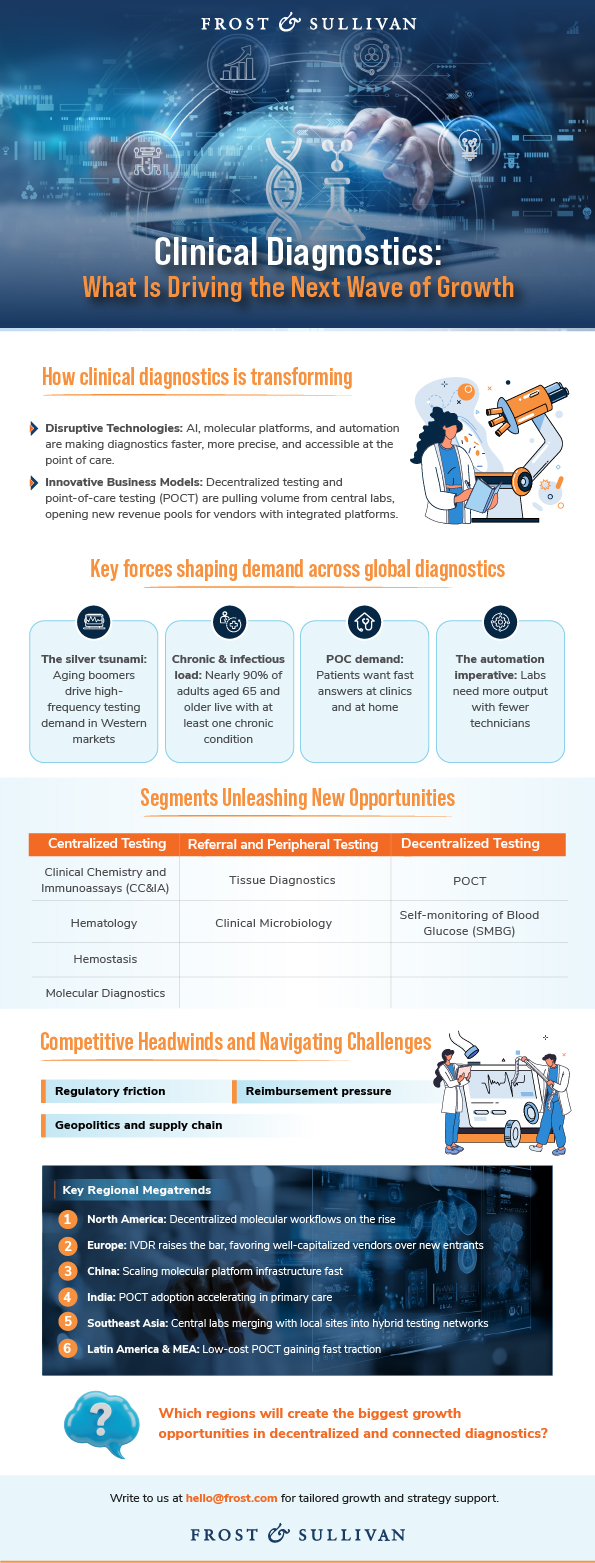
Regional Hotspots Driving Clinical Diagnostics Growth
North America:
US tax reforms and continued investments in AI and advanced infrastructure are expected to support healthcare innovation, business activity, and productivity growth across the region through early 2026.
Latin America:
Easing inflation, fiscal support measures, and manufacturing incentives in countries such as Brazil, Chile, and Mexico are helping sustain domestic demand while creating new nearshoring opportunities.
Europe:
Rising investments in defense, infrastructure, transport, and housing projects across the EU are strengthening manufacturing localization efforts and expanding regional supply-chain activity.
Middle East:
Higher oil prices and increased public spending, particularly in the UAE, are expected to support non-oil diversification initiatives, infrastructure development, and stable domestic demand.
Asia-Pacific:
Infrastructure spending, tax reforms in India, and growing investments in semiconductors, electronics, and AI technologies are continuing to strengthen manufacturing capabilities and industrial growth across the region.
Are you implementing best practices to maximize ROI across high-growth regions?
Companies to Action: Defining the Next Phase of Diagnostics Growth
Roche
- Roche held its leading position in clinical diagnostics through its large installed base and broad diagnostics portfolio.
- The company continued expanding the Cobas® platform across molecular diagnostics, cancer profiling, and companion diagnostics supported by cloud connectivity and analytics.
Abbott
- Abbott continued expanding the Alinity platform across chemistry, immunoassay, and molecular testing.
- Its strong point-of-care testing presence also supported growth across respiratory, cardiometabolic, and chronic care applications.
Danaher/Cepheid
- Danaher and Cepheid continued building their presence in molecular diagnostics, particularly across rapid and decentralized testing.
- Their molecular testing platforms gained traction across hospitals, laboratories, and near-patient care settings.
Emerging Opportunities in the Clinical Diagnostics Industry
- NGS for Rare Disease Diagnosis, Oncology Panels, and Pharmacogenomics
NGS use is increasing across rare disease diagnosis, oncology testing, and pharmacogenomics (PGx) as healthcare providers place greater focus on precision medicine and earlier disease detection. Whole exome sequencing (WES), whole-genome sequencing (WGS), and multi-gene panels are helping improve diagnosis and treatment selection in complex cases.
To benefit from this shift, diagnostics companies and testing providers are:
- Expanding NGS test menus across rare diseases, oncology, and pharmacogenomics applications.
- Developing regional rare disease panels focused on ancestry-specific and founder mutations.
- Connecting PGx testing with clinical decision support tools and EHR systems for routine clinical use.
- Decentralized and Home-based Diagnostics Ecosystem
Healthcare providers are expanding testing beyond centralized laboratories as demand rises for faster, more accessible, and digitally connected diagnostic services. Growing use of telehealth, home sample collection, and POCT is supporting the move toward decentralized and near-patient testing models.
In response, diagnostics companies and healthcare providers are:
- Expanding hybrid testing models that combine decentralized access with centralized laboratory support.
- Developing portable testing devices for chronic disease and infectious disease monitoring.
- Offering direct-to-consumer wellness testing panels through home-based diagnostic services.
Which of these opportunities will have the maximum impact on your organization, and how will you measure it?
What’s Next for Clinical Diagnostics?
Clinical diagnostics continue to shift toward more connected and decentralized testing models. Companies that improve accessibility, workflow efficiency, and clinical value will be better placed for long-term growth.
Frequently Asked Questions (FAQs)
What is clinical diagnostics?
A clinical diagnostic is tests, tools, or procedures used to detect, diagnose, monitor, or assess diseases and medical conditions. This includes laboratory testing, molecular diagnostics, tissue analysis, and point-of-care testing used across hospitals, laboratories, and healthcare settings.
What are the 4 diagnostic methods?
The four commonly used diagnostic methods in healthcare are:
- Laboratory diagnostics – Blood, urine, tissue, and other laboratory-based testing.
- Imaging diagnostics – X-rays, MRI, CT scans, and ultrasound imaging.
- Molecular diagnostics – DNA, RNA, and genetic testing used for disease identification.
- Point-of-care testing (POCT) – Rapid diagnostic tests performed near the patient.
What are the 7 clinical analysis areas of the laboratory?
The seven common clinical laboratory analysis areas are:
- Clinical chemistry
- Hematology
- Microbiology
- Immunology and serology
- Molecular diagnostics
- Histopathology and cytology
- Coagulation and hemostasis
These laboratory disciplines support disease diagnosis, treatment selection, and patient monitoring.
What are four types of diagnostic testing?
Four common types of diagnostic testing are:
- Screening tests – Used to identify diseases before symptoms appear.
- Diagnostic tests – Used to confirm or identify a medical condition.
- Monitoring tests – Used to track disease progression or treatment response.
- Predictive and genetic tests – Used to assess disease risk and inherited conditions.
Ready to Lead the Transformation?
- Book a Growth Strategy Session: Align your growth roadmap with Frost & Sullivan’s visionary Growth Pipeline™ Dialog.
- Engage with Growth Experts: Co-design AI-enabled, data-driven operating models that scale industry-specific and commercial impact.
- Share Your Transformation Story: Position your organization as a transformation leader through Frost & Sullivan’s Transformational Growth Leadership platform.
- Join the Growth Council: Collaborate with industry leaders shaping the future of your ecosystem.
- Nominate for the Best Practices Recognition: Be recognized for excellence in growth strategy, execution, and customer impact.
- Demonstrate Industry Positioning on the Frost Radar™: Benchmark your growth performance and innovation strength against industry competitors.
- Brand & Demand: Accelerate awareness, engagement, and revenue growth through integrated brand and demand generation strategies.