This blog is based on the analysis titled, “Trends in Breakthrough Innovations Unlocking Economic Value in Battery Recycling,” authored by Frost & Sullivan’s growth expert, Panjak Gaur, from the TechVision—Environment & Sustainability team.
The Evolution of Battery Recycling: From Waste Management to Resource Recovery
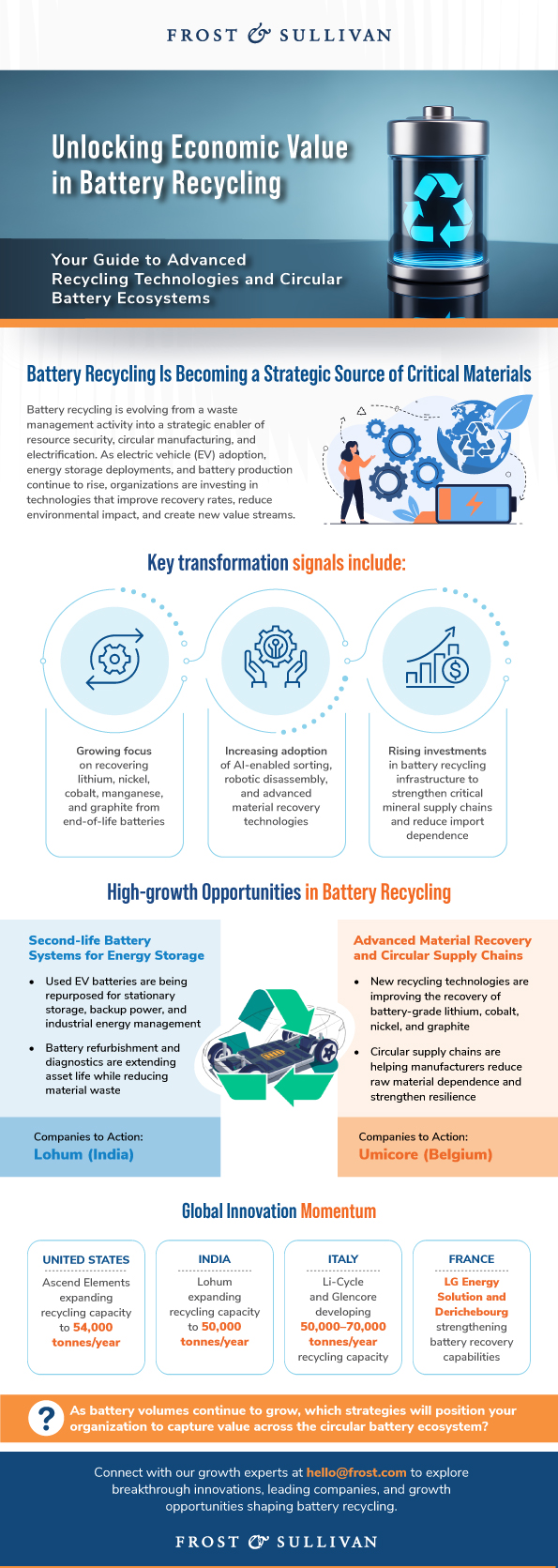
Battery recycling is emerging as a critical component of the energy transition as demand for electric vehicles (EVs), energy storage systems, and critical battery materials continues to accelerate. What was once viewed primarily as a waste management activity is rapidly evolving into a strategic value chain focused on recovering lithium, nickel, cobalt, graphite, and other high-value materials. As supply security, sustainability, and circularity become increasingly important, innovation is reshaping how batteries are collected, processed, and reintegrated into manufacturing ecosystems.
Breakthrough Innovations Unlocking Economic Value in Battery Recycling
Access:
- Advanced recycling technologies improving recovery rates, operational efficiency, and circular value creation across the battery ecosystem
- Key innovation areas shaping the future of battery recycling, from AI-enabled sorting and robotic disassembly to direct recycling and material recovery advancements
- Growth opportunities accelerating adoption through second-life battery systems, circular economy hubs, and closed-loop critical mineral recovery
Advances in recycling technologies, artificial intelligence (AI), automation, and material recovery processes are improving efficiency while reducing environmental impact. Direct recycling, hydrometallurgy, pyrometallurgy, robotic disassembly, and flash joule heating are among the innovations transforming battery recycling economics and enabling higher material recovery rates. At the same time, growing patent activity, technology development, and ecosystem collaboration are accelerating the industry’s evolution and creating new pathways for value creation across the battery supply chain.
Key innovation areas include:
- Advanced battery recycling and material recovery technologies
- AI-enabled process optimization and automation
- Direct recycling and next-generation recovery methods
- Emerging partnerships and innovation ecosystems
[Listen to the Growth Podcast to explore the innovations shaping the future of battery recycling.]
Strategic Imperatives Reshaping Battery Recycling
Battery recycling is becoming increasingly important as governments, manufacturers, and technology developers seek to strengthen resource security, support electrification, and improve circularity across the battery value chain. Three strategic imperatives are accelerating innovation and influencing the future direction of battery recycling technologies.
- Geopolitical Chaos
- Critical mineral supply chains remain concentrated in a small number of countries, creating strategic vulnerabilities for battery manufacturing and energy transition initiatives.
- Nations are pursuing capacity expansion, localization strategies, and supply chain diversification to reduce dependence on imported battery materials.
- Battery recycling is emerging as a strategic pathway to recover critical minerals, strengthen resource security, and improve supply chain resilience.
- Disruptive Technologies
- Solid-state batteries are advancing toward commercialization, offering higher energy density, improved safety, and longer operating life.
- Silicon-anode technologies are enabling faster charging, improved performance, and greater energy storage capacity.
- Sodium-ion batteries are gaining traction as a lower-cost alternative for grid storage and transportation applications.
- Transformative Megatrends
- Electrification across transportation, stationary energy storage, and consumer electronics is accelerating battery demand.
- Global EV adoption continues to expand, increasing future volumes of end-of-life batteries available for recycling.
- Investments in gigafactories, battery manufacturing, and energy storage infrastructure are driving demand for sustainable material recovery solutions.
How is your organization integrating emerging battery technologies into its core growth strategies?
What’s Accelerating and Constraining Battery Recycling Adoption?
Battery recycling is gaining momentum as governments, manufacturers, and technology developers seek to strengthen critical material supply chains and support circular economy goals. Regulatory support, sustainability commitments, and technology innovation are improving the economic viability of recycling while accelerating investment across the ecosystem.
Key factors accelerating adoption include:
- Regulations and Producer Responsibility: Recovery targets, recycling mandates, and extended producer responsibility programs across the EU, United States, China, and India are driving investment and technology development.
- Technology-driven Cost Improvements: Advances in hydrometallurgical processing, direct recycling, AI-enabled sorting, and robotic disassembly are improving recovery rates, reducing costs, and enhancing operational efficiency.
However, several challenges continue to influence adoption:
- Complex Battery Designs and Safety Risks: Variations in battery chemistries, pack designs, and contamination levels complicate recycling processes while increasing handling and compliance requirements.
- Capital Intensity and Technology Evolution: High infrastructure costs, long project timelines, and the rapid pace of battery innovation can create concerns around technology obsolescence.
How is your organization anticipating and responding to emerging uncertainties?
Industry Investments Signal Growing Confidence in Battery Recycling
Organizations across North America, Europe, and Asia are investing in large-scale recycling infrastructure to strengthen material recovery capabilities and reduce supply chain dependence.
Examples include:
- Ascend Elements (United States) targeting 54,000 tonnes/year of recycling capacity by 2025.
- Lohum Cleantech (India) expanding capacity to 50,000 tonnes/year by 2025–2026.
- Li-Cycle and Glencore (Italy) developing a recycling hub with an expected capacity of 50,000–70,000 tonnes/year by 2026–2027.
- Fortum Battery Recycling (Finland) expanding recycling operations to 25,000–40,000 tonnes/year by 2025–2026.
Why it matters: These investments demonstrate how battery recycling is evolving into a strategic industrial capability rather than a niche sustainability initiative.
Download the sample analysis to explore breakthrough innovations shaping the future of battery recycling.
Where Is Innovation Occurring Across the Battery Recycling Value Chain?
Innovation in battery recycling is focused on improving recovery efficiency, lowering environmental impact, and increasing the economic value of recovered materials. Three technology domains are driving industry development:
- Advanced Recycling Process Technologies
- Hydrometallurgy, pyrometallurgy, and direct recycling are improving material recovery and process efficiency.
- New approaches are reducing energy consumption while increasing yield and purity.
- AI and Automation Integration
- AI, computer vision, and robotics are improving battery identification, sorting, and disassembly.
- Automation is helping recyclers increase throughput, accuracy, and operational safety.
- Emerging Material Recovery Innovations
- New technologies are enabling higher-quality recovery of lithium, cobalt, nickel, manganese, and graphite.
- Advanced purification methods are supporting circular battery supply chains and resource security.
Companies to Action: Innovators Advancing Battery Recycling
As battery recycling evolves from a waste management activity into a strategic source of critical materials, leading organizations are investing in advanced recovery technologies, circular business models, and digital traceability capabilities to strengthen resource security and improve material recovery.
Lohum (India)
- Utilizes its proprietary NEETM™ technology to recycle multiple lithium-ion battery chemistries.
- Focuses on recovering critical materials while extending battery life through reuse and repurposing applications.
- Expanding recycling and critical material capabilities to support India’s growing battery ecosystem.
Umicore (Belgium)
- Combines dismantling, pyrometallurgical, and hydrometallurgical processes to recover battery-grade materials.
- Achieves high recovery rates for cobalt, nickel, and copper across multiple battery chemistries.
- Advancing battery passport and digital traceability initiatives to support circular battery value chains.
As battery chemistries continue to evolve, organizations that combine technological innovation with scalable recycling infrastructure will be better positioned to capture long-term value
Growth Opportunities Accelerating Circular Value Creation
Growth Opportunity 1: Second-life Battery System Integration
Many EV batteries retain usable capacity after their automotive lifecycle ends, creating opportunities for deployment in energy storage, backup power, and industrial applications.
Key opportunities include:
- Stationary energy storage systems
- Battery refurbishment and repurposing
- Battery management and diagnostics solutions
Growth Opportunity 2: Integrated Circular Economy Hubs
Organizations are developing integrated ecosystems that combine collection, repair, reuse, remanufacturing, and recycling to maximize material value and reduce waste.
Key opportunities include:
- Digital battery passports and traceability
- Closed-loop material recovery systems
- Cross-industry collaboration and data-sharing models
Ready to Lead the Transformation?
- Book a Growth Strategy Session: Align your growth roadmap with Frost & Sullivan’s visionary Growth Pipeline™ Dialog.
- Engage with Growth Experts: Co-design AI-enabled, data-driven operating models that scale industry-specific and commercial impact.
- Share Your Transformation Story: Position your organization as a transformation leader through Frost & Sullivan’s Transformational Growth Leadership platform.
- Join the Growth Council: Collaborate with industry leaders shaping the future of your ecosystem.
- Nominate for the Best Practices Recognition: Be recognized for excellence in growth strategy, execution, and customer impact.
- Demonstrate Industry Positioning on the Frost Radar™: Benchmark your growth performance and innovation strength against industry competitors.
- Activate Brand & Demand Growth: Accelerate awareness, engagement, and revenue growth through integrated brand and demand generation strategies.
Frequently Asked Questions About Battery Recycling Technologies and Innovation
1. What is battery recycling, and why is it important?
Battery recycling involves recovering valuable materials from end-of-life batteries for reuse in new products and applications. It helps reduce dependence on virgin raw materials, supports supply chain resilience, minimizes environmental impact, and enables circular economy models across the battery value chain.
2. What technologies are transforming battery recycling?
Key technologies include hydrometallurgy, pyrometallurgy, direct recycling, robotic disassembly, artificial intelligence (AI)-enabled sorting, and advanced material recovery processes. These innovations improve recovery efficiency, increase material purity, and reduce the environmental footprint of recycling operations.
3. How does AI improve battery recycling operations?
AI supports battery identification, chemistry classification, automated sorting, and process optimization. Combined with robotics and computer vision systems, AI can improve operational efficiency, increase recovery rates, enhance safety, and reduce processing costs across recycling facilities.
4. What are second-life battery applications?
Second-life battery applications involve repurposing used electric vehicle batteries for less demanding uses after their automotive lifecycle ends. Common applications include stationary energy storage, backup power systems, telecommunications infrastructure, and industrial energy management solutions.
5. What growth opportunities are emerging in battery recycling?
Emerging opportunities include second-life battery integration, integrated circular economy hubs, digital battery passports, advanced material recovery technologies, and closed-loop supply chains. These developments are creating new pathways for value creation while supporting resource security and sustainability objectives.