This blog is based on the analyses titled, 10 Strategic Imperatives in Digital Financial Services, 2026 and 10 Growth Opportunities in Digital Finance, authored by Frost & Sullivan’s growth expert, Dewi Rengganis from the Enterprise Wireless Services team.
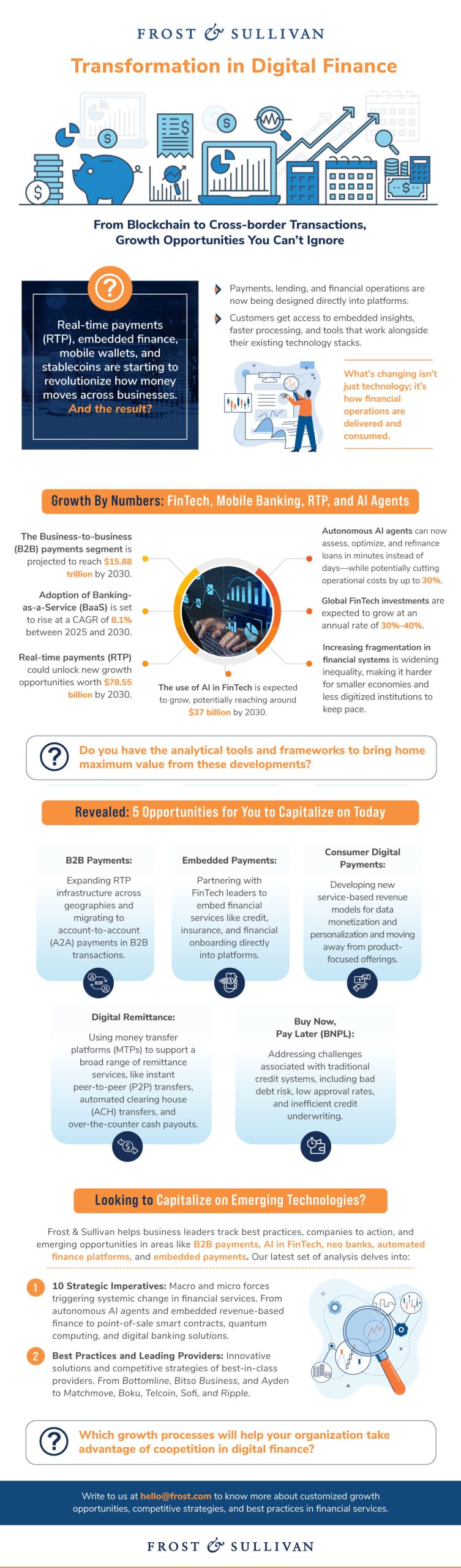
In 2026, digital finance is changing shape in ways that are hard to ignore. A structural reset is underway, driven by autonomous AI agents taking on decision-making and blockchain technologies challenging how future trust and transactions are managed. Parallelly, the push toward real-time payments (RTP), embedded finance rails, and banking-as-a-service (BaaS) has become an operational reality. Customers now expect near real-time settlements, low-cost remittance, AI-based fraud orchestration, identity intelligence, and compliance automation as the baseline in tomorrow’s payment solutions. But fragmentation in legacy systems is curbing the growth that these advances could bring.
What makes this transformation even more critical is its reach beyond financial institutions. It will potentially unlock higher cost efficiencies, optimized customer experiences, and faster decision-making across eCommerce, healthcare, and mobility ecosystems. But it will also raise the competitive bar for everyone—banks, FinTechs, payment networks, and service providers. The real question is: Will your organization lead the digital finance transformation, or struggle to keep up with it?
Optimize Your Digital Finance Strategy
In Frost & Sullivan’s latest growth podcast, we break down ways to capitalize on emerging growth opportunities — from B2B digital payments to buy-now-pay-later offerings.
🎧 Listen to the Podcast Here 🎧
to know more about best-in-class payment platforms, software solutions, and transaction processing services today!
Thriving Through the Financial Services Transformation
Going forward, adapting to these strategic imperatives is crucial for both future growth and innovation:
- Disruptive Technologies — Autonomous AI Agents
Continuous data capture, AI, and machine learning (ML) will optimize credit scoring, lower default rates, and enable better anomaly detection. With this, regulators are under pressure to update security frameworks, while providers will need to address transparency, accountability, and ethical concerns more proactively.
- Rising Competitive Intensity — Embedded Revenue-based Financing
Embedded finance in eCommerce will take up an increasing share of business-to-business (B2B) lending as sellers look for more seamless, built-in financing access. As competition increases and margins tighten, FinTech lenders will feel the pressure to boost productivity and lean more on data-driven pricing models.
- Customer Value Chain Compression — Integrated Financial Services
Subscription models that bring together banking, insurance, eCommerce, and crypto will drive stronger customer engagement and retention. This in-turn will push providers to combine previously separate financial services, service management, and lifestyle features into more holistic offerings.
- Internal Challenges — Internal IT Complexity
Siloed IT environments will give rise to unnecessary work duplication and higher maintenance overhead, pushing operational costs up by 15–25%. This will force providers to move toward more unified, cloud-native setups and modular, API-driven architectures with the help of cloud modernization and strategic partnerships.
- Geopolitical Chaos — Updating Cross-border Frameworks
Global payment networks will break into more localized competing blocs, making cross-border transactions far more complex (and expensive). This will create more urgency for industry incumbents to explore alternatives like blockchain-based payment corridors that can bypass traditional rails and improve speed of services in geopolitically volatile regions
- Transformative Megatrends — Quantum Computing and Cryptography
The speedy rollout of quantum-driven regulations is bound to tighten timelines, and increase spends on audits, certification, and governance. FinTechs will therefore feel the need to move away from legacy encryption toward quantum-resistant algorithms that are lattice-based, hash-based, and enable multivariate cryptography.
Click Here to See the Most Lucrative Growth Opportunities in Digital Finance.
Analyzing the ROI Potential of Growth Avenues
🎧 Listen to Our Growth Podcast on Mobile Backing and ePayments to Know More! 🎧
Thwarting Growth Barriers in Payment Processing
While multiple opportunities come to the surface, execution is far from straightforward. Why? Because organizations often try to scale digital finance while dealing with fragmented systems, evolving regulations, and ever-changing customer expectations. The complexity doesn’t come from one area—it comes from managing multiple moving parts all at once, often across different regions, partners, and technologies that don’t always align.
- Legacy Systems: Outdated IT cores and disparate tools make it difficult to scale real-time, API-driven financial services without adding cost and complexity.
- Regulatory Divide: Differing regional regulations and compliance requirements slow down progress, especially when it comes to cross-border payments and embedded finance platforms.
- Integration and Interoperability: Connecting siloed payment systems, Enterprise Resource Planning (ERP) platforms, networks and rails, fintech services, digital banking tools, and data layers often creates operational bottlenecks and blind spots.
- Margin Pressure: Increasing competition in payments and lending is pushing down fees, forcing providers to rethink pricing and cost structures.
Data and Risk Management: Managing fraud, identity, and compliance in real time requires stronger data capabilities and tighter control frameworks.
How will you identify the right partnership strategies and technologies to overcome these growth barriers?
Growth Strategies For Competitive Differentiation
The biggest gains in the digital finance ecosystem aren’t coming from launching new products or new features, but from reworking how payments, lending, and financial workflows run—it’s coming from fixing what’s slow, fragmented, or expensive in existing payment processing and e-payment systems:
- Attaining Operational Excellence with AI: Banks and FinTechs can plug autonomous AI agents into their existing systems to handle real-time decisions across lending, refinancing, and savings. As this becomes more common, the real work will be around tightening RegTech and making sure these decisions are clear enough to be trusted.
- Scaling Embedded Finance: Financing can be built directly into seller workflows, whether at checkout or inside merchant platforms, using a mix of sales and financial data. To really scale this, providers can forge strategic partnerships across eCommerce, payments, and ERP systems without losing consistency across regions.
- Rewiring Cross-border Payments Infrastructure: Cross-border payments are getting harder to manage, which is why vendors can prioritize blockchain-based corridors to move money outside traditional rails. At the same time, they’ll need to get comfortable working with digital currencies and more complex compliance setups.
- Expanding BaaS: BaaS is steadily taking financial services away from standalone products toward capabilities that sit inside digital platforms, including digital banking solutions and mobile banking experiences. As this picks up, providers will need to work more closely with partners to keep up with demand for flexible, Application Programming Interface (API)-led services.
- Automated Finance Platforms: Many enterprises are still dealing with disconnected finance workflows, and automation platforms can best bring payments, accounting, and treasury into one view. The providers that go deeper on ERP and banking integrations will find it easier to grow, especially in more regulated environments.
- Local Payment Methods (LPMs): Payment aggregators can aim for more localization in digital wallets and account-to-account (A2A) rails to make transactions faster and easier. As models like direct carrier billing gain traction, providers will need to adjust to how businesses pay in different markets, especially in mobile-first regions.
Are your teams equipped to implement the right best practices in embedded B2B payments?
Click Here to Uncover Best Practices in Automated Finance and BaaS.
Ready to Lead the Transformation?
As digital finance matures, differentiation will shift from product innovation to trust architecture—where transparency, explainability, and ethical AI become the core currencies shaping long-term customer relationships and platform strategy. What can you do to thrive through this transformation?
- Book a Growth Dialog:Align your digital finance technology strategy for 2026 and beyond with Frost & Sullivan’s Growth Pipeline™ Dialog.
- Engage with Growth Experts:Co-design AI-enabled, data-driven B2B payment solutions and mobile banking services that scale commercial impact.
- Share Your Transformation Story: Position your organization as a transformation leader in digital finance, payment processing, and BaaS through Frost & Sullivan’s Transformational Growth Leadership program.
- Join the Growth Council:Collaborate with financial services leaders shaping future ICT and backing ecosystems.
- Nominate for Best Practices Recognition:Be recognized for excellence in FinTech, blockchain, automated finance, cross-border payment solutions, and customer impact.
- Demonstrate Industry Positioning on the Frost Radar™:Benchmark your growth performance and innovation strength against your top competitors.
Activate Brand & Demand Growth: Accelerate awareness, engagement, and revenue growth through integrated brand and demand generation strategies.
Digital Financial Services: Frequently Asked Questions (FAQs)
- What is smart payment processing in digital banking?
Smart payment processing uses AI, automation, and data analytics to optimize transactions in real time. It enhances speed, security, and personalization by analyzing transaction patterns, detecting fraud instantly, and enabling seamless payment experiences. This approach goes beyond traditional processing by integrating intelligence into every stage of the payment lifecycle, improving efficiency for both businesses and customers.
- What role does AI play in modern payment systems?
AI enables predictive fraud detection, automated decision-making, and personalized financial services. It analyzes vast datasets to identify anomalies, assess risk, and optimize transaction routing. AI also improves customer experiences through intelligent recommendations and automation, making payment systems faster, safer, and more adaptive to changing user behaviors and market conditions.
- How is blockchain transforming payment processing?
Blockchain enables faster, transparent, and secure transactions by removing intermediaries. It supports cross-border payments with reduced costs and settlement times while enhancing traceability. Smart contracts further automate processes, reducing manual intervention. This technology is particularly valuable in regions with complex financial infrastructure or high remittance volumes.
- What are local payment methods (LPMs) and why do they matter?
Local payment methods are region-specific payment options such as digital wallets, bank transfers, or carrier billing. They improve transaction success rates by aligning with customer preferences and local regulations. Businesses that support LPMs can expand globally more effectively by offering familiar and trusted payment options in different markets.
🎧 Listen to Our Growth Podcast on Financial Services to Know More! 🎧